Import operations software for the manager who runs the desk
You run a desk at about 90% of capacity on grunt work: follow-ups, pack checks, status updates, payment tracking. Docket does the chasing on email, WhatsApp, SMS and voice, checks each pack against the contract, and keeps the status board current, so a container drops from about 2.2 hours of desk work to roughly 20 minutes.
Your desk has two clocks and one inbox. The first clock is the port’s free time, which starts at discharge and ignores your paperwork. The second is the supplier’s, which runs on whenever they feel like replying. The inbox is where the two meet, and it is where your people spend the day.
Where the hours go
Per container, about 2.2 hours of desk work. Supplier follow-ups, 30 to 45 minutes: loading schedules until they are confirmed, then the documents. Export doc-pack preparation and checking, 45 to 90 minutes, the biggest single line. Status tracking and reporting, 20 to 30 minutes, most of it answering the question “where are we on that one”. Payment tracking, 10 to 15. Then a fixed 1 to 2 hours a day collecting prices before the traders can quote.
At 500 containers a month that is about 1,100 hours, on a seven-person desk with about 1,232 to give. Ninety percent of capacity on work that produces nothing a customer pays for. You know this. It is why every peak month ends in overtime and why the best executive on the desk is the one who remembers which supplier needs a phone call.
What Docket does on this desk
It chases. Every open item on every shipment, daily, to the party who owes it. The loading schedule to the supplier until confirmed. The certificate of origin to whoever issues it. The filing status to the customs broker. Email first, and when the email is ignored the escalation ladder climbs: WhatsApp at 24 hours, SMS at 48, an AI voice call at 72. On channels those parties already use, with no portal for anyone to sign up to. About 85% of the chasing is built to run without a person.
It checks. Each document that arrives is read against the contract and against the others in the pack. Consignee spelled the way the buyer is registered. Weights that reconcile across invoice, packing list and bill of lading. The Incoterm and named place. Container and seal numbers. The field that disagrees is named, while the box is on the water. About 65% of the drafting and checking is built to run without a person; the rest is the judgement you would not want a machine to make.
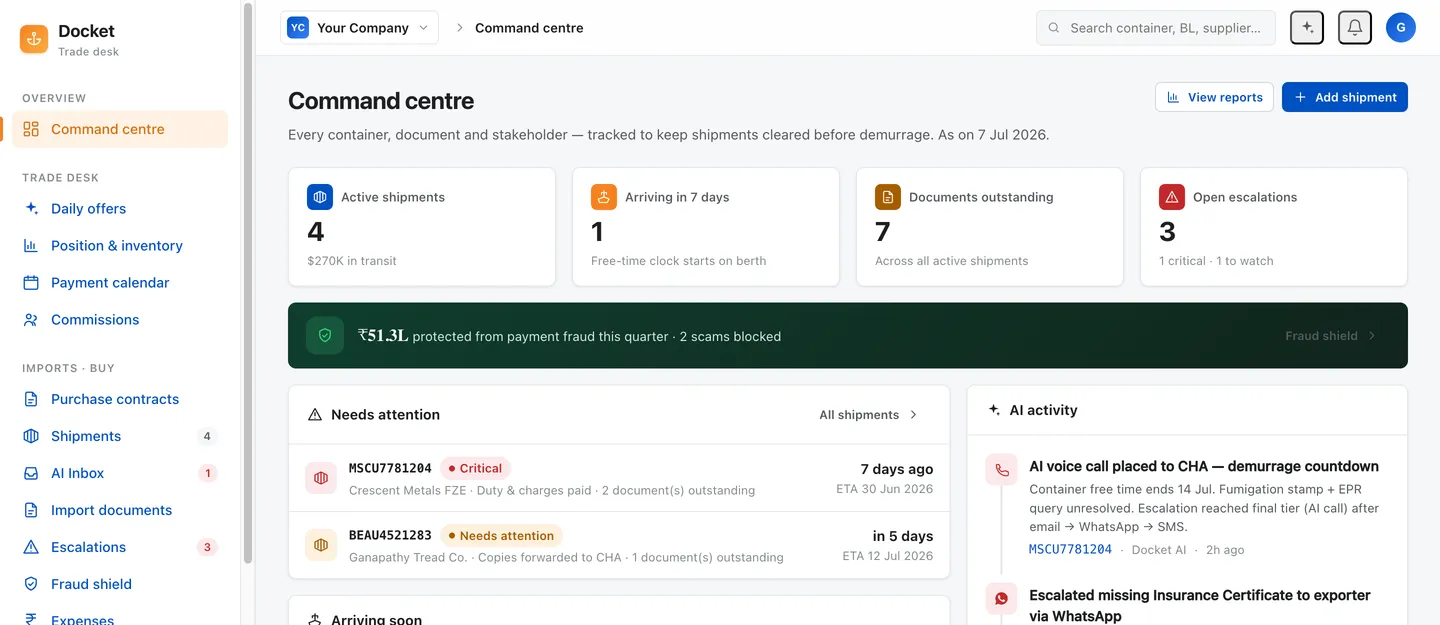
It keeps the board current. The command centre shows which containers need attention today, what is outstanding on each, and which escalation is running. That is the status meeting, without the meeting. Tracking and reporting are built to run at about 85%.
It counts back from the last free day. Free time is whatever your carrier’s tariff or service contract says for that lane, per port, per direction, per equipment type. Docket takes it from your contract, derives the last free day from discharge, and builds the document checklist backwards from that date instead of forwards from the booking. Packs routinely run about eight days late against free time; this is the clock that demurrage prevention is built around.
What the freed time does
Roughly 70% of the desk’s hours, blended. On the 500-container desk that is about 770 hours a month. The container that took 2.2 hours of desk work now takes about 20 minutes of it, the part that needs a person. Your seven people handle 1,000 to 1,200 containers instead of 500, or two or three of them move to buying and selling. Either way, the peak month stops ending in overtime.
What stays with you
Every decision. Docket does not accept a short-shipped lot, does not agree a revised loading date, does not file an entry and does not dispute a carrier invoice. It brings each of those to the right person with the file complete and the history attached, and records what was decided. The audit trail is the by-product: every chase, reply, document and decision on the shipment’s timeline, with the email it came from.
The jobs Docket takes off this desk
- Chases suppliers daily — schedules, prices, docs — Loading schedules until confirmed, prices every morning, and whoever owes the missing document.
- Escalates on WhatsApp / call when it's urgent — Email first. Then WhatsApp, SMS and an AI voice call — automatically.
- Checks every document is present & correct — BL, invoice, COO, packing list, insurance — verified against your checklist, per container.
- Tracks every expense — traced to its email — Duty, port charges, CHA fees, detention — pulled from invoice emails, so each container's landed cost is live. Every line links to the email it came from.
- Logs everything in a full audit trail — Every check, reminder, commitment and dollar on record — with the raw email behind it, one click away.
Questions this role asks
What happens when a supplier ignores the email?
The ladder climbs. Email first; if there is no reply, WhatsApp at 24 hours, SMS at 48, and an AI voice call at 72. Each step goes to the person who owes the item, on a channel they already use, with the shipment and the missing document named. Your team sees every step and steps in when a human is needed.
Do I lose visibility if the machine is doing the chasing?
You gain it. Every chase, every reply and every document received is on the shipment's timeline with the source email attached. The command centre shows which containers need attention today and why, which is the status meeting you currently run by asking each person in turn.
Where does Docket start on a new shipment?
With the purchase contract. It reads the contract, derives the document list for that lane, names who owes each item, sets the payment dates from the terms, and counts back from the last free day. The chase begins from there, not from the booking.
What stays with my team?
Judgement. Accepting a short-shipped lot, agreeing a revised loading date, the call to the bank when a release is stuck, the decision to file on a provisional value. Docket brings each of those to the right person with the file complete; it does not make the call.
How is this different from the tracking portal we already use?
A portal tells you where the box is. Demurrage is almost never caused by not knowing where the box is; it is caused by a document that arrived after free time ran out. Docket works the document deadline and the people who owe each item. The portal keeps doing what it does.
Sources
- Docket operational baseline, import–export desk
- Docket engineering model — projected automation rate by task
- US Federal Maritime Commission, Interpretive Rule on Demurrage and Detention (46 CFR § 545.5) · checked 2026-09-04