Import document checking software that reads the whole pack
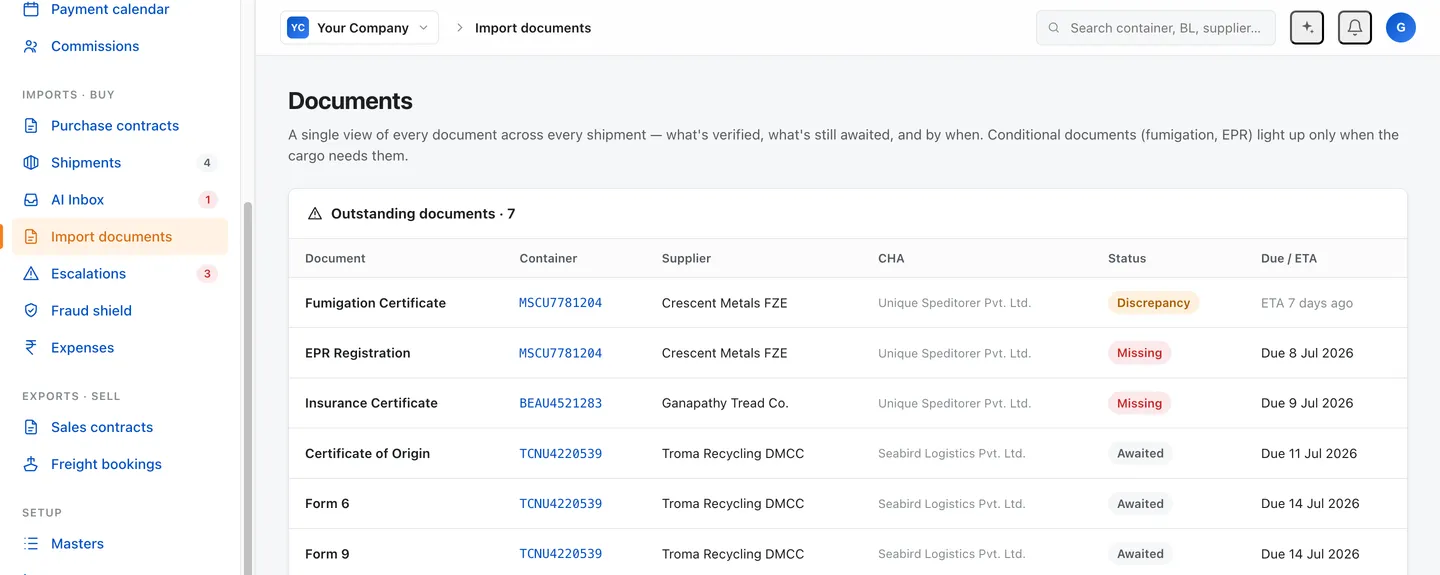
Import document checking software should do one job: open every document in the pack, compare it against the purchase contract and the party masters, and tell you which field is wrong while there is still time to fix it. Checking a pack by hand takes 45 to 90 minutes a container. Docket drafts and checks about 65% of that work and hands you the exceptions.
Replaces: A junior executive reading PDFs against a printed checklist · Export documentation software that only generates documents and never checks them · A shared drive of folders named after container numbers · The WhatsApp group where someone asks whether the COO has arrived · The trade ERP field that records a document was received but never reads it
Import document checking software has one job, and it is not generating a template. The job is to open the invoice, the packing list, the certificate of origin and the bill of lading, read what is actually written in them, compare every field against the purchase contract, and name the one that is wrong. While the box is still on the water. Not on the day your customs broker calls.
Checking a pack by hand runs 45 to 90 minutes a container. That is the single largest line in the 2.2 hours of desk work each container consumes. It is also the line that costs the most when it slips, because a document nobody read is a document nobody can fix.
What does a document check actually involve?
Two separate questions, and most desks only ask the first.
Completeness. Is every document the lane needs sitting in the folder? Commercial invoice, packing list, bill of lading, certificate of origin, insurance certificate, pre-shipment inspection certificate where the destination demands one, fumigation or phytosanitary certificate where the cargo demands one, plus whatever the letter of credit lists. A checklist answers this. A junior executive with a printout answers this.
Where the shipment is under a letter of credit, the credit is the checklist and the check runs field by field against it: goods description against the invoice wording, latest shipment date against the bill of lading, consignee and notify party, insured value, the presentation period. Each field passes, warns or fails, with the credit clause it was checked against, so a discrepancy is caught on your desk and not in the bank’s refusal notice.
Correctness. Do the values inside those documents agree with each other, and with the contract you signed? This is the harder question and it is where the money is.
The fields that break a pack:
- Consignee and notify party, spelled the way the buyer is registered, not the way the exporter’s clerk remembers it
- Description of goods, matched to the contract line and to the HS code declared
- Quantity, gross weight, net weight, and whether the three reconcile across invoice, packing list and bill of lading
- Incoterm and named place, because CIF and CFR are one letter apart and a different insurance obligation
- Port of loading and port of discharge
- Container and seal numbers, matched across the BL and the packing list
- Invoice value, currency, and whether the total is the sum of the lines
- Dates, in the order the credit requires them
Banks are unforgiving about this. Under the ICC’s UCP 600, Article 14, a bank examines documents on their face to decide whether they constitute a complying presentation, and a discrepancy is refusal. A trading desk finds this out on the day the bank refuses, which is a week after the exporter could have reissued the invoice for free.
Why does checking eat 45 to 90 minutes a container?
Because nothing arrives in one place, in one format, at one time.
The invoice comes as a PDF from the supplier. The packing list is a photograph of a printed page, taken at an angle, forwarded through two inboxes. The bill of lading arrives as a draft for approval, then again as a final, and the second one is not always the one that got filed. The COO comes from a chamber of commerce with its own numbering. The insurance certificate comes from a broker who copies four people, one of whom has left the company.
Somebody on your desk opens all of it, retypes the important values into a spreadsheet, and compares. Then a correction comes in and they do it again.
A 500-container month at 2.2 hours a container is 1,100 hours. A seven-person desk has about 1,232 hours available at 176 hours a person. That desk is running at roughly 90% capacity on grunt work before anyone buys or sells a single tonne. The checking line is the biggest single piece of it.
What a trade ERP does, and what Docket does
Every system on this market records the trade. That is a real category and those products are good at it. None of them read the documents and none of them chase the people who owe you documents.
| Trade ERP / documentation software | Docket | |
|---|---|---|
| Stores the contract | Yes | Yes |
| Generates export documents from your masters | Yes | Yes |
| Records that a document was received | Yes | Yes |
| Opens the document and reads the fields | No | Yes |
| Compares every field to the purchase contract | No | Yes |
| Names the discrepancy and who has to fix it | Notifies you | Names the field, both values, and the party |
| Emails the exporter until it is fixed | No | Yes, daily |
| Escalates when nobody replies | No | WhatsApp at 24h, SMS at 48h, AI voice call at 72h |
| Files the customs declaration | No | No. Your broker files it |
| Moves the container | No | No |
VISCO, Shipzy and IncoDocs all sit in the left column and they are honest about it. IncoDocs generates export documents for around $13 a month and does that job well. It has no view on a certificate of origin that somebody else issued and emailed you. Gen10 and IGNITE answer questions from your own book. e2open reaches counterparties, once every counterparty has onboarded to the network.
The empty quadrant is the system that reads the document and goes after the person who has to correct it. That is where Docket sits.
What does Docket automate, and what does it leave you?
Doc-pack drafting and checking measures at about 65% automated. We publish that number rather than a rounder one because it is what the live demo does against a real import SOP. Nobody should claim 100% on documents. Somebody still has to look at the exception, and some exceptions need a phone call to a person, not a machine.
Across all desk work the blended automation rate is 70%. On the 500-container reference desk that frees about 770 hours a month, which is 4.25 FTE of capacity.
Read that as capacity, because that is what it is. Your same seven people now handle 1,000 to 1,200 containers instead of 500. Or two of them stop retyping weights off a packing list and move to buying and selling, which is the work that actually earns the margin. Nobody on a growing desk has ever complained about having more hours.
At a loaded US$25 an hour, those 770 hours are US$19,250 a month of desk time removed. Docket at that volume is 350 shipments at $6, so US$2,100. Net, that is US$17,150 a month and US$205,800 a year. Demurrage and fraud savings are left out of that base case on purpose.
What happens when a wrong document goes unread?
The pack goes late, and the port does not wait.
Free time starts at discharge. It does not start when your paperwork is ready and it does not care why the COO had the wrong consignee. Document packs routinely run about eight days late against free time. A week of demurrage on one container has cost US$12,000. One missed doc-pack a month annualises to US$12,000 to US$24,000.
There is a second failure that costs more and is quieter. The fraud one.
Every inbound email on a live shipment is a chance for somebody to send a revised invoice from a look-alike domain with new bank details. Docket screens every inbound email for four signals: look-alike sender domain, bank details changed mid-deal, beneficiary name that does not match the contract party, and urgency or secrecy language. One catch on the single shipment was US$62,500.
That screen only works because the system already read the original invoice. Checking and fraud detection are the same capability pointed at two problems.
Be clear about what Docket does not do
Credibility on a trade desk is worth more than a feature list, so here is the boundary.
Docket does not move containers. It has no equipment, no slots and no trucks.
Docket does not replace your customs broker and does not file the customs declaration. The filing is your broker’s licence and their liability, and it stays there. What changes is that your broker receives a clean, complete, checked pack days earlier, instead of a folder at 6pm with two documents missing.
Docket does not sign for you. It does not approve a draft BL and it does not accept a discrepancy on your behalf. It surfaces the exception and waits for a human.
Docket does not claim 100% on anything. Doc-pack drafting and checking is 65%. Supplier chasing is 85%. Tracking and reporting is 85%. Those are measurements, not targets.
How does checking connect to the chase?
A check that produces a list is a to-do list, and to-do lists are what your desk already has too many of.
Docket takes the discrepancy and works it. The exporter gets an email naming the field, showing the contract value and the document value, and asking for a corrected copy. If nothing arrives, the ladder runs: WhatsApp after 24 hours, SMS after 48, an AI voice call after 72. On channels the counterparty already uses. No portal, no login, nothing for the supplier’s clerk in a different country to sign up for.
Your team sees four flags instead of forty documents. Everything that happened is in the audit trail, with the email it came from, so when someone asks in March why the March shipment cleared late, the answer takes thirty seconds.
Where to start
Start with the contract. The purchase contract is the first thing a trader records and it is the thing every check, every chase and every payment date derives from. Load the contract, connect the mailbox, map the SOP. Setup starts at $1,500 and covers all three.
Then pick one lane and one supplier and run it for a month. Count how many discrepancies surface before the vessel sails instead of after. That is the number that decides this, and it is a number your own desk produces.
And honest about the numbers: every figure on this page is either an operational baseline or comes off a published rate table, and neither is a substitute for your own desk. If you have paid demurrage because a document was late, come argue with the numbers using yours.
Book a walkthrough with your own contract and your last three packs. Bring the worst one. If the person who checks those packs is not you, the documentation executive’s page is written from their seat.
Questions traders ask
What does import document checking software actually check?
Two things. Completeness, meaning every document the lane and the letter of credit require is present. Correctness, meaning the values inside them agree with each other and with the purchase contract. Consignee, notify party, description of goods, HS code, quantity, gross and net weight, incoterm, port pair, container and seal numbers, invoice value and currency. A pack can be complete and still be wrong.
Does it replace my customs broker?
No. Docket does not replace your customs broker and does not file the customs declaration. Your broker files, and the filing is their licence and their liability. Docket makes sure the CHA has a clean, complete pack in hand early enough to file without a rush, and chases the exporter and the bank until that is true.
Can it read a scanned bill of lading?
Yes. Most of what arrives on a trade desk is a photograph of a printed page forwarded through three inboxes. Docket reads scans and photographs, pulls the fields, and compares them to the contract. Where a field is unreadable it says so and asks, instead of guessing. A wrong value stated with confidence is worse than a blank.
Does it check documents against a letter of credit?
Yes, field by field. Docket reads the credit, builds the document list from it, and checks each document as it arrives against the credit's terms and against the other documents: goods description, latest shipment date, consignee and notify party, insured value, presentation period. Each field passes, warns or fails with the clause it was tested against. It cannot make the bank waive a discrepancy or fix a credit drafted wrong; it can put the discrepancy in front of you while the document can still be reissued.
Is this trade documentation software, or only a checker?
Both words fit, and the checking is the part that matters. Trade documentation software usually means a tool that generates the invoice, packing list and certificate of origin from a template. Docket reads the documents that come back from the exporter, the bank, the insurer and the chamber, checks each field against the purchase contract and the party masters, and chases whoever owes a correction. Generating a clean document is easy. Catching the wrong one before the last free day is the job.
How is this different from export documentation software?
IncoDocs and similar tools generate documents. That is a real job and they do it. Checking is the opposite direction: documents arrive from your supplier, your forwarder and your bank in whatever shape they chose, and someone has to read them against the contract. Generation software has no opinion on a COO that came from somebody else.
What happens when it finds a discrepancy?
It names the field, shows both values, and starts the chase. The exporter gets an email the same day. If nobody replies, it moves to WhatsApp after 24 hours, SMS after 48, and an AI voice call after 72. Your team sees the exception, not the whole pack. That is the difference between reading 40 documents and reading four flags.
What does it cost?
Checking is not a separate module. It is included in every plan, priced per shipment: $10 up to 50 shipments a month, $8 from 51 to 300, $6 above 300. A shipment bills at most two containers, so a big consignment does not cost extra. Setup starts at $1,500 and covers masters, mailbox connection and SOP mapping.
Sources
- Docket operational baseline, import–export desk
- Docket engineering model — projected automation rate by task
- ICC Uniform Customs and Practice for Documentary Credits (UCP 600), Article 14 on the standard for examination of documents
- US Federal Maritime Commission, Interpretive Rule on Demurrage and Detention (46 CFR § 545.5)
- CPF Board employer contribution rate and Ordinary Wage ceiling schedule