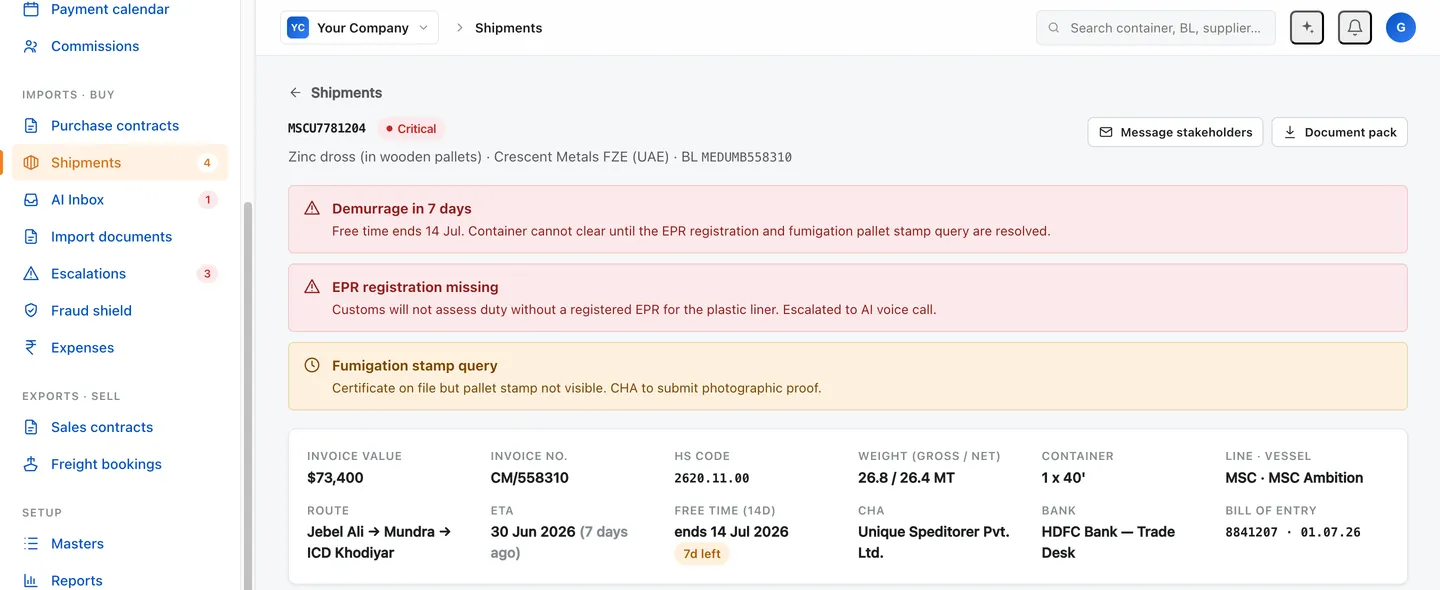
Demurrage and detention software: finish the pack in time
Demurrage and detention software has one measurable goal: have the document pack complete before free time runs out. Free time starts at discharge, not when your paperwork is ready. Packs routinely run about eight days late against it, and a week of demurrage on one container has cost US$12,000. Docket works the checklist backwards from the last free day and chases daily.
Replaces: A whiteboard with vessel ETAs and a mental note of which ones are tight · Carrier tracking portals checked one lane at a time · The demurrage dispute process, which starts after you have already paid · An assistant phoning the customs broker every afternoon for a filing status · Freight audit software that finds the charge after the invoice arrives
Demurrage and detention software is worth buying for one outcome and one only: the document pack is complete before the last free day, so there is nothing to pay. Everything else in the category, the dashboards, the dispute workflows, the freight audit that catches the charge after the invoice lands, arrives too late to change the number.
Free time starts at discharge. It does not start when your exporter couriers the originals, or when the bank releases documents against payment, or when the fumigation stamp finally arrives. It counts calendar days and it does not ask.
Document packs routinely run about eight days late against free time. A week of demurrage on one container has cost US$12,000. One missed pack a month annualises to US$12,000 to US$24,000.
None of those eight days were a shipping problem.
Why do two clocks decide whether you pay?
Every shipment runs two clocks at the same time.
The port clock starts on discharge and counts down your free days. It is set by the carrier’s tariff or, if you negotiated one, by your service contract.
The paperwork clock starts whenever the last party in the chain decides to act. The exporter, the bank, the insurer, the chamber of commerce, the forwarder, your customs broker.
When the second clock loses, you pay storage on a container that was never physically delayed. The box was there. The paper was not.
The US Federal Maritime Commission’s interpretive rule on demurrage and detention is useful here because it says out loud what the charge is for. The rule tests these charges against what it calls the “incentive principle”: whether the charge actually serves to move cargo. Read that from the importer’s side and the conclusion is blunt. The charge exists to make you finish your paperwork. Finish it and there is nothing to argue about.
What does prevention mean in practice?
It means running the clock backwards.
Most systems work forwards from booking. Booking, then sailing, then ETA, then arrival, then a scramble. Prevention starts from the other end.
- Derive the last free day from discharge, using the free time on your contract for that carrier and that lane.
- Take the full document checklist for the lane, the destination and the letter of credit.
- Assign each item to the party who owes it, with a deadline set backwards from the last free day, not forwards from booking.
- Chase every one of those parties, daily, until the item arrives.
- Check each document as it lands, against the purchase contract, so a wrong one is caught while there is still time to reissue it.
- Escalate the moment someone goes quiet.
Step four is where every other product stops.
Which kind of demurrage and detention software is this?
The category sells three different things under one name, and it pays to know which one you are looking at.
Visibility and alerts. The container’s milestones from the carrier, a free-time countdown, an alert when the last free day is near. Useful. It tells a person to act.
Audit and dispute. The carrier’s invoice checked against your contract rates, the gate and pick-up messages kept as evidence, a workflow for contesting the charge. Useful after you have already been billed.
Laytime claims. Charter-party demurrage on a bulk or tanker voyage, calculated from the statement of facts. A different trade and a different clock.
The noun changes, the kinds do not. The same three products come back as a demurrage management system, as demurrage planning software, or as detention billing automation, and nothing inside them changes with the name. Work out which of the kinds above you are being shown before you compare two of them on price.
Docket is a fourth kind. It works the cause, which is the document pack, and it does the acting: the chase, the check, the escalation. The others show you the clock. This one finishes the paperwork before it runs out.
What demurrage software means on a container import
The shortest name for the category is the most ambiguous one. Searched on its own, demurrage software returns two trades that share a word and nothing else: container demurrage, which is a carrier’s charge on a box that sat at the terminal past its free days, and charter-party laytime demurrage, which is settled between owner and charterer from a statement of facts on a bulk or tanker voyage.
This page is the first one. If your demurrage arrives as a line on a carrier invoice against a container number, you are in the right place. If it arrives as a claim under a charter party, the calculation is different and so is the software for it.
What demurrage and detention alert software does, and what Docket does
| Alert / tracking software | Trade ERP | Docket | |
|---|---|---|---|
| Shows the container’s milestones | Yes | Sometimes | Yes |
| Shows a free-time countdown | Sometimes | No | Yes |
| Holds the document checklist for the lane | No | Yes | Yes |
| Sets each document deadline from the last free day | No | No | Yes |
| Reads each document and checks it against the contract | No | No | Yes |
| Chases the exporter, bank, insurer and customs broker daily | No | No | Yes |
| Escalates when nobody replies | No | No | WhatsApp at 24h, SMS at 48h, AI voice call at 72h |
| Files the customs declaration | No | No | No. Your broker files it |
| Moves the container | No | No | No |
| Disputes the charge after you paid | Some do | No | Not the point |
VISCO, Shipzy, Gen10 and IGNITE all record the trade and record it well. Nobody in that list sends the email at 9am, notices no reply by Wednesday, and rings the supplier’s office on Thursday. That is the empty quadrant, and it is the only quadrant that changes the demurrage number.
How does the chase actually reach someone?
Four steps, on channels the counterparty already uses.
Email goes first. Twenty-four hours of silence moves the same ask to WhatsApp. Forty-eight hours moves it to SMS. Seventy-two hours triggers an AI voice call. Each step carries the shipment reference and one specific ask.
There is no portal and no login. Your supplier’s documentation clerk does not create an account, does not get invited, and does not need to know Docket exists. Products built as networks need every party onboarded before they help you, which is why enterprise implementations run into six and seven figures and take quarters. The ladder works on day one against a counterparty who has never heard of us.
Supplier chasing measures at about 85% automated on a live demo running a real import SOP end to end. Doc-pack drafting and checking measures at about 65%. We publish both rather than a single flattering figure, because the checking half genuinely needs a human on the exceptions and nobody should pretend otherwise.
What does the freed time do to the desk?
A 500-container month costs 1,100 hours of desk work at 2.2 hours a container. Seven people at 176 hours each is 1,232 hours. That desk runs at about 90% capacity on grunt work before it buys or sells anything.
Blended across all desk work, the automation rate is 70%. On that desk it returns 770 hours a month, which is 4.25 FTE of capacity.
Capacity, not headcount. The same seven people handle 1,000 to 1,200 containers instead of 500. Or two or three of them move to buying and selling, the work that produces the margin, while the machine runs the checklist. Nobody who ever grew a trading desk did it by having fewer hands.
At a loaded US$25 an hour, 770 hours is US$19,250 a month removed. Docket at 350 shipments on the Trade Desk rate is US$2,100. Net: US$17,150 a month, US$205,800 a year. Money freed minus what we cost.
Demurrage savings are deliberately left out of that base case. They sit on top, and they are the reason this page exists, but the ops number stands without them.
Free time is not a standard number, so do not treat it as one
This is the most common and most expensive assumption on an import desk.
Free time varies by carrier, and two lines calling the same port allow different periods. It varies by port and terminal, and again by whether the box moves to an inland container depot. It varies by direction and by equipment, so dry, reefer and special are not the same. And it varies by what you negotiated.
That last one is a real lever and it costs nothing to ask for. On a lane where the carrier wants your volume, extra free days are cheaper for them to give than a rate reduction, and worth more to you if your pack is habitually late.
Docket holds your carrier’s free-time terms per lane, next to the purchase contract: the free days, the demurrage and detention rates and the point they step up, per carrier, port pair and equipment. The last free day on every shipment is derived from that record, not from a default, and the carrier’s invoice can be read against the same terms when it arrives. We publish port free-time tables only where we hold a sourced row for a named carrier, and where we do not have it the page says so instead of showing a number that would be wrong for your lane. A confident wrong free-time figure is worse than a blank one, because you will plan against it.
A worked example, on the only numbers we publish
No tariff table, because we do not hold a sourced free-time row for your lane. What we can work through is the shape of the loss, using the figures published on this site and nothing else.
Take one container on a lane where the pack runs late by the usual margin.
| Step | What happens | The number |
|---|---|---|
| Day 0 | The box is discharged. Free time starts here, not when your paperwork is ready | — |
| Day 0 onward | The desk works the shipment: supplier follow-ups, doc-pack prep and checking, status tracking, payment tracking | about 2.2 hours per container |
| The gap | The document pack lands behind free time by the usual margin | about 8 days late |
| The bill | A week of demurrage on one container | US$12,000 on a reported incident |
Now the quieter version, which is the one that actually shows up in a year of accounts. One missed document pack a month, not a disaster, just the ordinary one that nobody escalates: US$12,000 to US$24,000 a year. No single event is large enough to trigger a meeting. The annual total is a salary.
Against that, the chase itself. Of the 2.2 hours a container takes, Docket is built to automate about 85% of the follow-up work, leaving roughly 20 minutes of judgement per container. The eight days are not a discipline problem. They are what a desk at about 90% capacity on grunt work produces, and the fix is to take the grunt work away rather than to ask the desk to try harder.
Two honest caveats. The US$12,000 is one reported incident, not an average, and it is not annualised anywhere on this site. And demurrage is deliberately left out of the return case we publish — the ops-cost saving is the number a trader can check against their own payroll this afternoon, and it stands on its own.
What Docket does not do
Docket does not move containers. It has no slots, no trucks and no equipment, and it cannot make a terminal release a box faster.
Docket does not replace your customs broker and does not file the customs declaration. Your broker files. What changes is that the pack reaches them complete and checked, days earlier, so the filing is routine instead of a rescue.
Docket does not remove congestion, customs holds, inspection queues or equipment shortages. Those cause demurrage too and no software touches them.
Docket does not dispute charges for you after the fact. Prevention and dispute are different products, and dispute is the one you buy when prevention already failed. If a bill has already landed, the separate walkthrough on disputing a demurrage invoice sets out which rules apply in which trade and what evidence each argument needs.
Docket does not claim to eliminate demurrage. It addresses the eight days that came from paperwork, which is most of the gap.
The second thing that happens on a tight shipment
Urgency is the fraudster’s favourite condition. A shipment inside free time with a chase running is exactly when a revised invoice arrives from a domain one character off the real one, with changed bank details and a note asking you to keep it quiet.
Docket screens every inbound email on a live shipment for four signals: look-alike sender domain, bank details changed mid-deal, beneficiary name that does not match the contract party, and urgency or secrecy language. One such attempt, on a single shipment, was US$62,500.
That works because the system already read the original contract and the original invoice. The check that prevents demurrage and the check that prevents payment diversion are the same capability aimed at two different losses.
Where to start
Pick your worst lane. The one where the pack is always late and everybody already knows which supplier it is.
Load the purchase contract, connect the mailbox, map the SOP. Setup starts at $1,500. Run that lane for a month and count one number: how many packs were complete before the last free day. That number is either better than last month or it is not, and it belongs to you, not to us.
Every figure on this page is either an operational baseline or comes off a published rule. Neither one knows your lane, your carrier or your customs broker.
If you have paid demurrage because a document was late, bring the invoice and the timeline. We will show you which day the chase would have started.
Questions traders ask
How does demurrage and detention software differ from a tracking portal?
A tracking portal tells you where the box is. That is useful and it is not the problem. Demurrage is almost never caused by not knowing where the container is. It is caused by a document that arrived after the free days ran out. Prevention means working the document checklist backwards from the last free day and chasing the people who owe you each item.
Can it guarantee I never pay demurrage?
No, and any tool that says so is selling. Congestion, customs holds, inspections and equipment shortages cause delays no software touches. What Docket addresses is the paperwork clock, routinely runs about eight days late against free time. That is the part caused by a PDF and a person who did not reply, and that part is fixable.
Does Docket file my customs declaration?
No. Docket does not file the declaration and does not replace your customs broker, whatever it is called where you clear: the Bill of Entry in India, the permit declaration on TradeNet in Singapore, the Mirsal 2 declaration in Dubai, the entry summary in the US. The filing is your broker's licence and their liability. What Docket does is make sure they have a complete, checked pack in hand days before the last free day, and chases them daily if the filing status has not come back.
Where do the free time numbers come from?
From your carrier tariff or your service contract, not from us. Free time varies by carrier, port, terminal, direction and equipment, and two lines calling the same port allow different periods. Docket holds those terms per lane, per carrier and per equipment type, next to the trade contract, and derives every last free day from them. We publish port free-time data only where we hold a sourced row for a named carrier, and say so where we do not.
Does it cover detention as well as demurrage?
Both clocks, one cause. Demurrage runs on a container sitting inside the terminal past its free days; detention runs on the carrier's equipment outside the terminal before it is returned empty. Both are set by the carrier and both start without asking you, and the same late document pack triggers either one. Docket manages the pack deadline that drives both. It does not track empty returns to the depot; your transporter does that.
What does demurrage software do?
It depends which of four products is being sold to you under that name: container visibility that counts free time down and alerts a person, invoice audit and dispute tooling that checks the carrier's bill after it lands, laytime claims software for charter-party demurrage on bulk and tanker voyages, or document chasing that works to get the pack complete before free time ends. Docket is the fourth. The shortest phrasing hides the widest range, so ask which one before you compare prices.
Is this demurrage management software, or prevention?
Prevention. Most products sold as demurrage management software show you the container, count down the free days and alert a person when the last free day is close. The alert is not the fix. Docket starts earlier, on the document pack that decides whether the box clears inside free time, and it does the chasing itself rather than telling you to. If you want a dashboard of charges already incurred, that is a different category and we are not in it.
Is this demurrage and detention alert software?
No, and the distinction is the whole product. Demurrage and detention alert software watches the free time and tells a person when the last free day is close. That is worth having and it is not sufficient: the alert lands on a desk that already knew, and the reason the pack is not ready is a supplier who has not replied, a bank that has not released documents and a delivery order nobody has settled. Docket sends the chase instead of the alert — email, then WhatsApp, then SMS, then an AI voice call — to the party who owes the document. If you want the alert as well, you get it; it is the by-product, not the product.
Does Docket track the container?
Docket tracks the paperwork, not the box. It takes the vessel's arrival and discharge from the shipment record and your forwarder's updates, derives the last free day from that and your carrier's free time, and works the document deadlines backwards from it. If you already run a container visibility tool, keep it. Docket is the part that acts on the date it shows you.
Can I use the record to dispute a demurrage or detention invoice?
The record is yours and it is complete: every chase, every reply, every document with the date it arrived and who sent it. When a carrier's invoice lands, you can see which day the pack was complete and which party sat on which paper. Docket does not file the dispute or negotiate the waiver for you. It gives you the timeline the argument turns on.
Is this for container demurrage or charter-party laytime?
Container demurrage, at the port, on an import. Laytime and demurrage on a chartered bulk or tanker vessel is a different calculation, settled under the charter party from the statement of facts, and there is specialist software for it. If your demurrage is a carrier line item on a container that sat at the terminal past its free days, this page is about you.
What does this cost against what demurrage costs?
Docket is priced per shipment: $10 up to 50 a month, $8 from 51 to 300, $6 above 300, with a shipment billing at most two containers. One missed doc pack a month annualises to US$12,000 to US$24,000. A single week of demurrage on one container has cost US$12,000. The comparison is not close.
Sources
- US Federal Maritime Commission, Interpretive Rule on Demurrage and Detention (46 CFR § 545.5)
- Docket operational baseline, import–export desk
- Docket engineering model — projected automation rate by task
- Docket product specification, escalation ladder