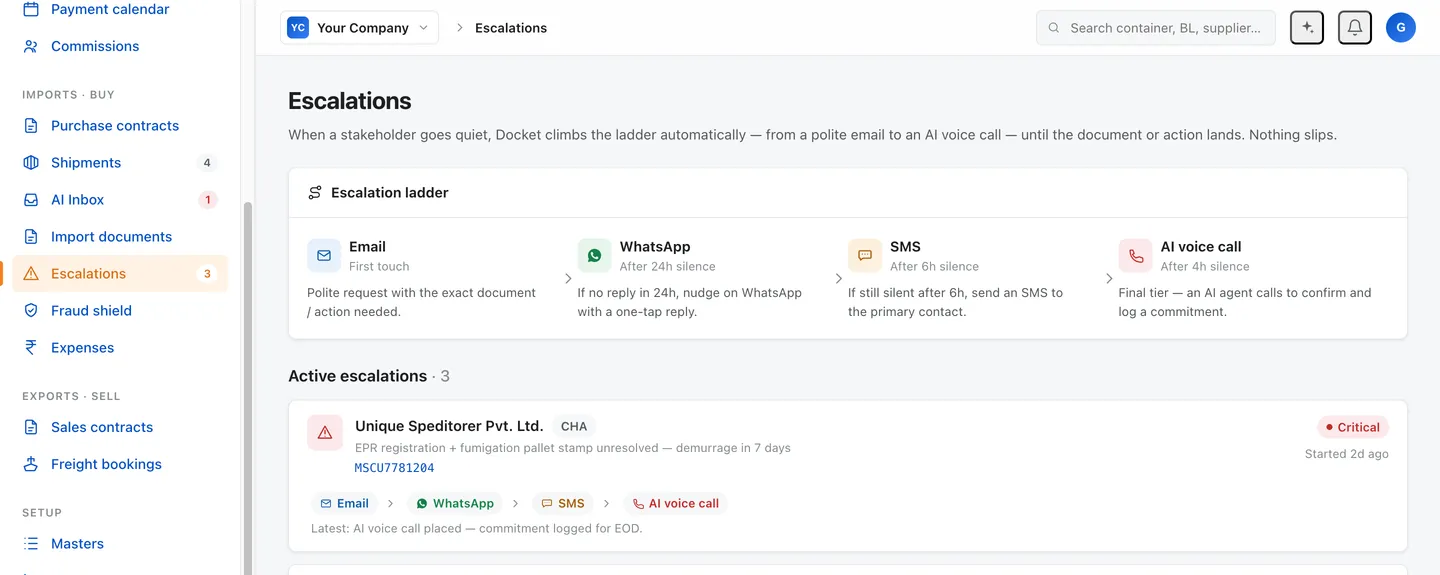
Supplier follow-up automation with an escalation ladder
Supplier follow-up automation only works if it reaches a person who is ignoring you. Docket sends the daily chase by email, moves to WhatsApp after 24 hours, SMS after 48 and an AI voice call after 72. Chasing measures at about 85% automated, which takes the follow-up work on a container from 30 to 45 minutes down to a review. Your team reads exceptions.
Replaces: A daily reminder list in a spreadsheet, worked by one executive every morning · The WhatsApp group where three people ask the same supplier the same question · Outlook follow-up flags that nobody clears · A CRM sequence built for sales prospects, pointed at suppliers · The 1 to 2 hours a day somebody spends collecting prices supplier by supplier
Supplier follow-up automation fails for one reason. It sends the email and then stops. The supplier who was going to reply to an email was never the problem. The problem is the mill in another timezone that has read nothing for four days, and the forwarder who answers WhatsApp but not Outlook, and the bank officer who needs a phone call.
So the useful measure of any chasing tool is simple. What does it do on day three?
Supplier follow-ups run 30 to 45 minutes per container, every container, forever. On top of that sits a fixed 1 to 2 hours a day of price collection, asking supplier after supplier what they are quoting this morning. That second one is not per container. It is a tax on the day itself.
What does the escalation ladder actually do?
Four steps, on channels the counterparty already uses.
| Step | Channel | Fires after |
|---|---|---|
| 1 | Immediately | |
| 2 | 24 hours of silence | |
| 3 | SMS | 48 hours of silence |
| 4 | AI voice call | 72 hours of silence |
Every step carries the same ask, with the shipment reference, the contract line and the one thing you need. Not a reminder that a reminder was sent.
The ladder is the defensible part of Docket and it is the part competitors cannot copy by adding a feature. It works because there is nothing for the supplier to join. No portal. No invitation. No account for a clerk in Jebel Ali to create before your chase reaches them. e2open reaches counterparties too, after 400,000 partners onboarded and after an implementation that runs from $200,000 to over a million. Docket reaches a supplier who has never heard of Docket, this afternoon.
Why is chasing the biggest job on a trade desk?
Because six parties touch one shipment and none of them owns the coordination.
The supplier owes you a loading schedule, then a shipping advice, then documents. The forwarder owes you a booking, a container number, a sailing date. The customs broker owes you a filing confirmation. The bank owes you a document release. The insurer owes you a certificate. You owe your customer a delivery date built out of all of it.
Nobody in that chain reports to you. Every one of them has fifty other shipments. So the work of a trade desk is not recording the shipment. It is asking, and asking again, and knowing who has not answered.
Add it up. A 500-container month at 2.2 hours a container is 1,100 hours. Seven people at 176 hours each is 1,232 hours of capacity. That desk spends about 90% of everything it has on grunt work before a single tonne is bought or sold. Chasing is the largest recurring slice of it, and it is the slice with the least judgement in it.
What changes when the chase runs itself?
Supplier chasing measures at about 85% automated in the live demo running a real import SOP end to end. Applied to the chase, that takes a container from 2.2 hours down to about 20 minutes of human attention.
One honest note on that number, because a trader will do the arithmetic and should land where we do. The 20-minute figure is the 85% follow-up cut applied to the chase. It is not the rate for the whole desk. Across all desk work, blended, the rate is 70%, and 70% is what the money below is built on. Computing freed hours from 20 minutes would overstate the return by roughly a fifth. We would rather publish the smaller number and have it hold.
At 70% blended on the 500-container desk, 770 hours a month come back. That is 4.25 FTE of capacity.
Say what that means, plainly. It is not a headcount cut and it is not sold as one. Your same seven people now handle 1,000 to 1,200 containers instead of 500. Or two or three of them move off the follow-up list and onto buying and selling, which is where the margin actually comes from. Trading desks grow into freed capacity. That is what they are for.
At a loaded US$25 an hour, 770 hours is US$19,250 a month of desk time removed. Docket at 350 shipments on the Trade Desk rate is US$2,100. Net, US$17,150 a month, US$205,800 a year. Money freed minus what we cost, with nothing hidden and no demurrage or fraud savings folded in.
Your desk is leaving about US$200k a year on the table to manually type what Docket learns in a month.
What a CRM sequence gets wrong about suppliers
Plenty of desks have tried to point a sales tool at this. It does not fit, for three reasons.
A sequence is time-based. A chase is state-based. A sales cadence sends email two on day three whatever happened. A supplier chase has to know that the loading schedule arrived on Tuesday, so the Wednesday ask is now about the shipping advice, not the schedule. Docket derives the ask from where the shipment actually is.
A sequence stops at email. The whole value is in step four.
A sequence does not read the reply. When the supplier answers with a photograph of a handwritten weight slip, somebody has to open it, read it, and update the shipment. Docket reads the inbound, extracts what it needs, updates the record, and closes the chase item. If it cannot read something, it says so and asks rather than guessing.
There is a fourth thing a CRM will never do. It will not notice that the revised invoice came from a domain one character off the real one, with new bank details, marked urgent and confidential. Docket screens every inbound email on a live shipment for exactly that. One such attempt, on a single shipment, was US$62,500.
Does the chase have anything to do with demurrage?
Directly. Free time starts at discharge, not when your documents are ready. Packs routinely run about eight days late against free time. A week of demurrage on one container has cost US$12,000.
Nothing about those eight days was a shipping problem. It was somebody not replying, and nobody noticing for three days that they had not replied. A chase that escalates on day one closes most of that gap before it becomes a charge.
Daily offers, the job nobody counts
The 1 to 2 hours a day of price collection deserves its own paragraph because it never shows up in a container cost.
Every morning, someone messages every supplier and asks what they are quoting. Then they put the answers somewhere. Then somebody senior reads them and forms a view. By the time the view is formed, half the morning is gone and the prices have moved.
The daily offers track does the asking. Every supplier, every morning, on their channel, and the answers arrive laid out with movement against yesterday. It runs standalone at $15 per supplier per month, with or without the rest of Docket. The purchase-contract chase track, daily loading-schedule follow-ups followed by shipment verification and the payment calendar, is $2 per contract.
What Docket will not do
Docket does not move containers. No slots, no trucks, no equipment.
Docket does not replace your customs broker and does not file the customs declaration. That filing is your agent’s licence and their liability. Docket makes sure they have what they need, early, and chases them on the same ladder as everyone else.
Docket does not negotiate. When a supplier comes back on price, on quality, or with a reason the mill is down, that goes to a human on your desk. Nothing about the ladder is designed to keep you away from your supplier. It is designed to keep you away from the part of the conversation that was never a conversation.
Docket does not sell unlimited voice calls, at any price, in any plan. Voice is the sharpest tool in the ladder and it is metered on purpose.
Docket does not claim 100% on anything. Chasing is 85%. Tracking and reporting is 85%. Doc-pack drafting is 65%. Those are projected rates from Docket’s own engineering model, published weakest line included, so there is a number to hold us to.
Where to start
Load the purchase contract. Every chase, every check and every payment date derives from it, so it is the first thing in and the reason onboarding is days rather than quarters. Connect the mailbox. Map the SOP. Setup starts at $1,500 and covers all three, and the per-shipment rate runs $10, $8 or $6 depending on volume, with a shipment billing at most two containers.
Then take one supplier who is habitually late and put them on the ladder for a month. Count the replies and count how many came in before day three. That single number tells you more than this page does.
The figures here are an operational baseline, not an industry survey, and your desk will sit somewhere either side of them. Bring us your slowest supplier and let us both watch what happens on day three. For the whole desk rather than one supplier, start from the operations manager’s page.
Questions traders ask
Does my supplier have to log in to anything?
No. That is the whole design. The chase runs on email, WhatsApp, SMS and voice, which are the channels your counterparty already uses every day. There is no portal, no invitation and no onboarding for the supplier's clerk in another country. Network products need every party to join before they work. Docket works on day one with a supplier who has never heard of us.
What exactly does the escalation ladder do?
It climbs. Email goes out first. If there is no reply after 24 hours, the same ask goes to WhatsApp. After 48 hours, SMS. After 72 hours, an AI voice call. Each step carries the same specific ask, not a nag. The point is that a silent supplier stops being silent, and that nobody on your desk has to remember which of 40 suppliers went quiet on Tuesday.
Will it annoy suppliers I have worked with for ten years?
It sends what your executive would have sent, on the day they would have sent it, with the shipment reference and one specific ask. Most desks find suppliers reply faster because the ask is precise and arrives at the same time daily. You set which suppliers escalate to voice and which stop at WhatsApp. Nothing is unlimited and nothing is automatic without your SOP saying so.
What does 85% automated actually mean?
It means about 85% of the follow-up work on a shipment runs without a person: composing the ask, sending it, timing it, escalating, reading the reply, updating the shipment. The remaining share is what needs judgement. A price negotiation, a relationship call, a supplier saying the mill is down. Docket routes those to you rather than answering them.
Can I use only the chasing, without the rest of Docket?
Yes. Two tracks run standalone. Daily offers, where the AI asks every supplier for prices each morning and lays them out with movement against yesterday, is $15 per supplier per month. Purchase-contract chase, which runs daily loading-schedule follow-ups then shipment verification and the payment calendar, is $2 per contract. Both work alongside a full plan or on their own.
Does it replace my forwarder or my customs broker?
No. Docket does not move containers, does not replace your customs broker and does not file the customs declaration. It chases the parties who owe you something and records what they said. Your forwarder still books, your CHA still files. They get chased too, on the same ladder, which is usually the part that surprises people.
Sources
- Docket operational baseline, import–export desk
- Docket engineering model — projected automation rate by task
- Docket product specification, escalation ladder
- US Federal Maritime Commission, Interpretive Rule on Demurrage and Detention (46 CFR § 545.5)