Import payment tracking software for finance and accounts
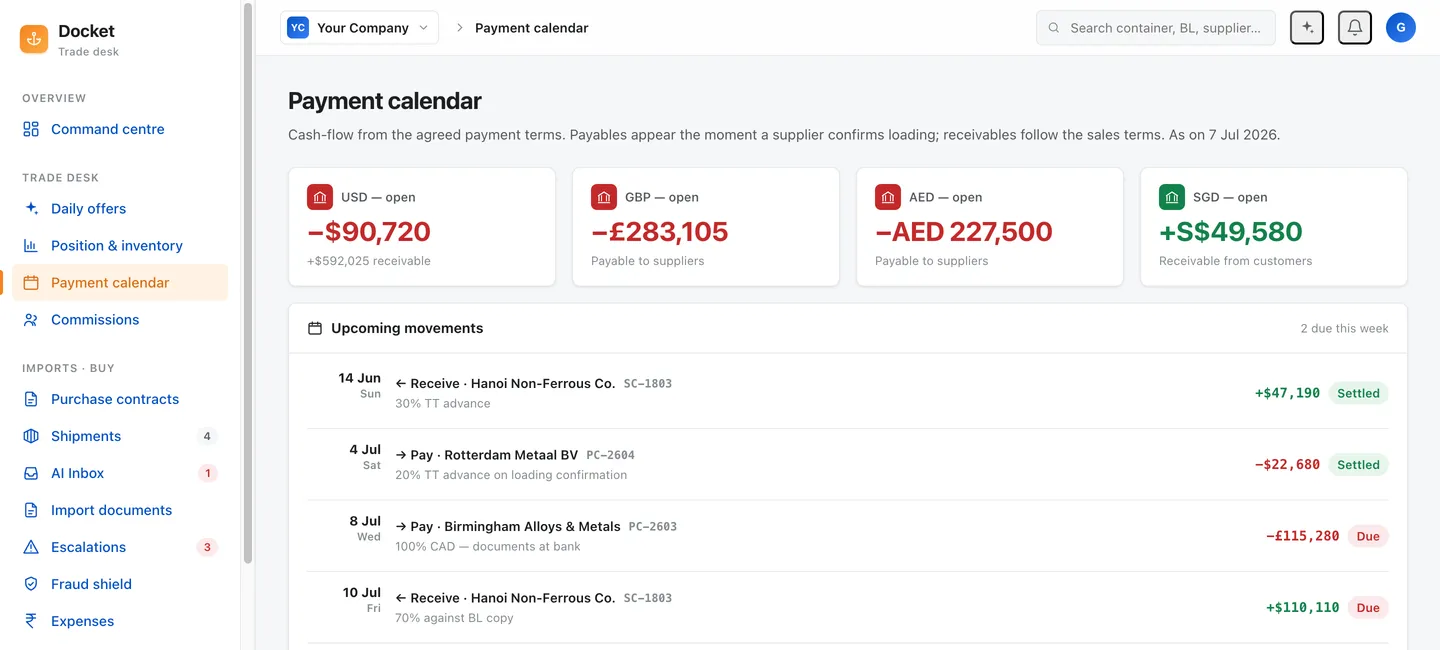
Finance on an import desk pays from three things it did not write: the contract's terms, the invoices that arrive by email, and the bank details in the supplier's last message. Docket builds the payment calendar from the contract, matches each invoice to a consignment with its source email kept, and screens every inbound message for the signals of a payment-diversion attempt.
Finance on an import desk works from three documents it did not write. The purchase contract, which says when money is due. The invoices, which arrive by email from a dozen parties in a dozen formats and say how much. And the last message from the supplier, which says where to send it. Two of those are typed into a spreadsheet by hand, and the third is trusted.
The calendar you build by hand
Every contract carries terms, and every term is a date: a percentage against shipping documents, thirty days from bill of lading date, the balance at sight under the credit. Somebody reads the contract, works out the dates, and puts them somewhere. Then the bill of lading date moves, and the dates move with it, and the somewhere is a spreadsheet that was right last Tuesday.
Docket reads the contract when it is recorded and derives the payment calendar from the terms. When the bill of lading date is confirmed, the dates that depend on it update. What you see is what is due, on which shipment, against which document, before the bank’s reminder. Payment tracking is 10 to 15 minutes of the 2.2 hours a container consumes; small per container, and the piece most likely to be wrong when volume rises.
The landed cost that is always a month behind
Duty, port charges, broker fees, detention, demurrage, freight, insurance, inland haulage. Each arrives as an invoice, by email, from a different party, and each has to be matched to a container before the landed cost on that container means anything. Most desks do this at month end, from memory, and the number is a reconstruction.
Docket matches each invoice email to a consignment and a cost line as it arrives, and keeps the email attached to the line. The landed cost on a container is live, and every figure on it traces to a document rather than to somebody’s recollection. The demurrage line is attacked at the cause, the document deadline, which is the operations desk’s job and the reason the demurrage entry exists.
The email that changes the bank account
Trade runs on email, and the email that costs the most is the one that says the supplier’s bank details have changed. It arrives mid-deal, from an address one character off the real one, with a reason that is plausible and a tone that is urgent. A single payment-diversion attempt on one shipment has been reported at US$62,500. That is one event and the site treats it as one event; it is not a rate.
Docket screens every inbound message for four signals: a look-alike domain, bank details changed part-way through a deal, a beneficiary name that does not match the contract, and urgency or secrecy language. A hit holds the payment and names the reason, so the call to the supplier’s known number happens before the transfer, not after. The trade fraud screening page covers what it checks and what it cannot.
What stays with you
The payment itself, always. Docket does not release funds, does not compute duty, does not classify goods, and does not reconcile the bank. It puts the date, the amount, the document and the source email on one line, and holds the line when something on it does not match. The audit trail that produces is the one the auditor asks for: every invoice to its email, every payment to its term, every hold to its reason.
The jobs Docket takes off this desk
- Builds your payment calendar itself — Loading confirmed → payables scheduled from your terms; receivables follow the sales contract. Currencies kept separate.
- Tracks every expense — traced to its email — Duty, port charges, CHA fees, detention — pulled from invoice emails, so each container's landed cost is live. Every line links to the email it came from.
- Logs everything in a full audit trail — Every check, reminder, commitment and dollar on record — with the raw email behind it, one click away.
Questions this role asks
Where does the payment calendar come from?
From the contract terms, at the moment the contract is recorded. Thirty days from bill of lading date, a percentage against shipping documents, the balance at sight of the credit: each becomes a dated entry on the shipment before the first invoice arrives, so you know what is due before the bank does.
How does an expense get traced to an email?
Each invoice that arrives by email is matched to a consignment and a cost line: duty, port charges, broker fees, detention, demurrage, freight. The source email stays attached to the line. When someone asks why the landed cost on a container moved, the answer is the email, not a memory.
What does the fraud screen look for?
Four signals, on every inbound message: a sender domain that looks like the supplier's but is not, bank details that changed part-way through a deal, a beneficiary name that does not match the contract, and the language of urgency and secrecy that these emails always carry. A hit holds the payment and names the reason.
Has it caught one?
The product was not running when the attempt it is modelled on happened. A single payment-diversion attempt on one shipment has been reported at US$62,500. That is one event, not a rate, and the site does not annualise it.
Does Docket compute my duty?
No. Tariff rates change on notification and are jurisdiction-specific, and a number a machine generated is a number a customs officer will disagree with. Docket holds the classification you and your broker agreed, flags a consignment that departs from it, and records the duty that was billed.
Sources
- Docket operational baseline, import–export desk
- Reported incident, import–export desk
- Docket engineering model — projected automation rate by task