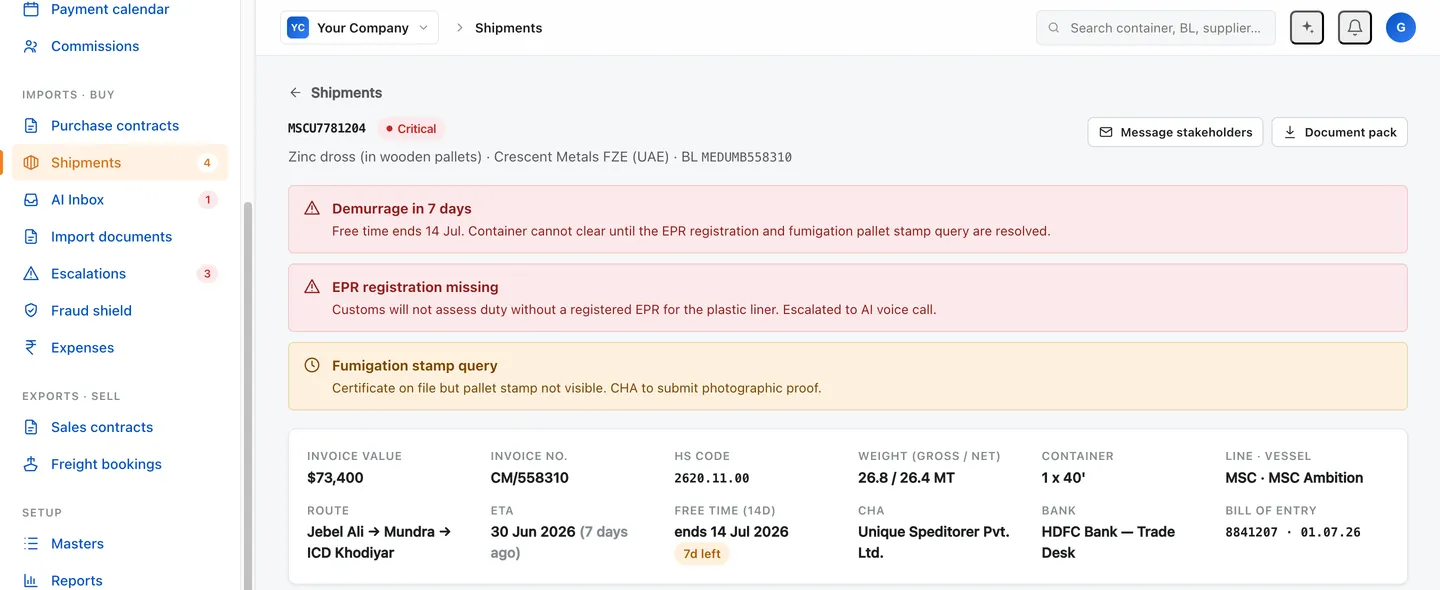
Demurrage meaning: what it costs, who owns the clock
Demurrage is what the carrier or terminal charges when your container sits inside the port past its free time. It is distinct from detention, which applies once the box leaves the gate. The clock starts at discharge and ignores your paperwork. Document packs routinely run about 8 days late against free time, and a week of demurrage costs about US$12,000 on one container.
- Demurrage
- The charge a carrier or terminal levies when a container remains inside the port past its allotted free time, accruing daily per container until the box is collected.
Demurrage is the charge that accrues when a container stays inside the terminal beyond its free time. It is rent on terminal space. It runs per container per day, it starts at discharge, and it does not pause because your bank has not released the originals yet. Almost every demurrage bill an importer pays is a document bill wearing a logistics costume.
Demurrage is not detention
The two are routinely conflated, including by people who pay both on the same box in the same month.
- Demurrage. The box is still inside the port, past free time.
- Detention. The box has left the port, and you are holding the carrier’s equipment past the free period.
The US Federal Maritime Commission draws exactly this line in its interpretive rule, and most carrier tariffs follow it. The line is the terminal gate. Everything before the gate is space. Everything after it is equipment.
| Demurrage | Detention | |
|---|---|---|
| What is being charged | Terminal space | The carrier’s container |
| Clock starts | Discharge from the vessel | Gate-out from the terminal |
| Clock stops | Gate-out | Empty returned to the nominated depot |
| Billed by | Carrier, or the terminal, or both | Carrier |
| Usual cause | Documents, customs, finance | Transport, yard space, plant shutdown |
| Who fixes it | The importer’s documentation desk | The importer’s logistics desk |
| Where the fix sits | Before the vessel arrives | After the box is released |
Outside the United States there is often a third line on the same container: the terminal’s own terminal storage charge, billed by the port under a published tariff with its own free days, beside the carrier’s demurrage under your contract.
Read the last two rows again. The reason the distinction matters is not vocabulary. It is that the two charges are produced by two different teams, and calling both of them “demurrage” sends the post-mortem to the wrong desk. Every month.
How does the demurrage clock actually start?
At discharge. Not at your convenience, and not on notification.
The sequence on a normal import runs like this:
1/ The vessel berths and the box is discharged onto the terminal stack. The free time clock starts here, in calendar days, weekends and public holidays included unless your tariff says otherwise.
2/ The carrier’s arrival notice reaches you, or does not, or reaches the wrong mailbox. The clock does not care.
3/ Customs needs a filed and assessed declaration. In India that is the Bill of Entry, due by the end of the day before the vessel arrives, which means the pack has to be finished while the ship is still at sea.
4/ The carrier releases cargo against surrendered originals or a telex release, and against payment of freight and local charges. A delivery order is issued.
5/ Your CHA books transport and the box gates out. Demurrage stops. Detention starts.
Between step 1 and step 5 sit six parties who have never met: exporter, bank, carrier, terminal, CHA, transporter. Free time is measured in a handful of days. That is the whole design flaw.
Why is demurrage a paperwork problem?
Because two clocks race on every shipment and only one of them is visible.
The first clock is the port’s free time, which starts on discharge and does not know your circumstances. The second is your document pack: bill of lading, commercial invoice, packing list, certificate of origin, and whatever inspection or analysis certificates the commodity needs.
When the second clock loses, you pay demurrage on a container that was never physically delayed. Paperwork routinely runs about eight days late against free time, and a week of demurrage on one container comes to roughly US$12,000.
That is the failure mode in one line. Nobody was late with the ship. Somebody was late with a PDF.
What does a week of demurrage actually cost?
Two numbers, and they measure different things.
The catastrophic version is the one above: about US$12,000 for a week on a single container. That is the incident everybody remembers, tells the board about, and then never sees again for a year.
The routine version is the one that quietly matters more. One missed document pack a month, costing between US$1,000 and US$2,000 each time, annualises to US$12,000 to US$24,000. Nobody escalates any single instance of it. It never appears as a line item called demurrage in the annual review, because it is spread across twelve shipments and buried in clearing-agent reimbursements.
Set that against what the desk costs to run. Docket’s operational baseline is about 2.2 hours of desk work per container, split as 30 to 45 minutes of supplier follow-ups, 45 to 90 minutes of export document-pack preparation and checking, 20 to 30 minutes of status tracking and reporting, and 10 to 15 minutes of payment tracking. A 500-container desk burns about 1,100 hours a month on that work. Seven people at about 176 hours each give you 1,232 hours. The desk is at roughly 90% capacity on grunt work before anyone buys or sells anything.
So the demurrage bill and the ops-cost bill have the same parent. There is no spare hour in the month to chase the certificate of origin, so the certificate of origin arrives late, so the box sits.
Who owns demurrage inside an importer’s business?
Nobody, which is why it recurs.
The clearing agent knows the box is sitting but does not hold the missing document. The buyer holds the supplier relationship but has moved on to the next cargo. Finance sees the charge four weeks later, on a consolidated CHA reimbursement, with no trace back to which shipment or which missing paper caused it. The trader who signed the contract never sees the number at all.
Three questions worth asking on your own desk this week:
- Can you name, per shipment, the last free day? If the answer is on a whiteboard or in one person’s head, the answer is no.
- Can you name which single party owed the item that made the pack late? Not “the supplier”. The person, the document, the date it was first requested.
- Does your demurrage cost sit in one account code, per shipment, or is it inside a clearing-agent reimbursement nobody itemises?
A charge with no owner and no line item is a charge that will be paid again next month.
What can you actually dispute?
More than most importers try, and the ground has moved since 2022. Before any of it, read the bill: what each field on a demurrage invoice means, and which one is wrong most often.
The Ocean Shipping Reform Act of 2022 amended the Shipping Act of 1984 and pushed the Federal Maritime Commission to write billing rules. The resulting Demurrage and Detention Billing Requirements rule sets out what a charge must contain to be billed at all: who may be billed, what information the invoice must carry, the window in which the invoice has to be issued, and the window in which the party billed may dispute it. A charge that does not meet those requirements is challengeable on its face, before anyone argues about the merits.
The older interpretive rule at 46 CFR § 545.5 carries the principle underneath all of it. Demurrage exists as an incentive to move cargo. Where the cargo could not have been moved, the charge does not serve the purpose it was created for, and the Commission weighs that in deciding whether a practice is unreasonable.
Three fact patterns are worth documenting every time, because they are the ones that win:
The terminal was shut or unworkable. Gate closures, strikes, systems outages, weather. Keep the terminal’s own notice. It is the strongest evidence there is, because the carrier cannot dispute its own operator.
The carrier could not deliver. No appointment slots released, equipment misplaced in the stack, the box not available for pickup on the days you were charged for.
Customs held the goods. In India the Handling of Cargo in Customs Areas Regulations 2009 place obligations on the custodian, including a bar on charging rent or demurrage on goods that customs itself has seized or detained. The evidence for the period is a detention certificate from the formation that held the consignment, and the Supreme Court applied the regulation against a port trust on exactly that footing in 2017. If your box was held for examination and you paid demurrage for the holding period, that is worth a letter.
What loses, every time: “our supplier was slow with the certificate of origin.” That is your contract, your counterparty and your problem, and no regulator will move it.
The order to work these in, the evidence each row needs and the windows that apply in which trade are set out in the walkthrough on how to dispute a demurrage invoice.
What can an importer negotiate before the box ships?
Four levers, in the order they pay back.
1/ Free time, in the service contract. Extra free days cost a carrier little on a lane where they want your volume, and they are worth more than a small freight-rate reduction if your document pack is habitually late. Ask for the days. Get them in writing.
2/ The Incoterm. Under the C rules the seller pays freight to destination while risk passed at origin, and destination charges land on you in a shape you did not choose. Buying on FCA or FOB and controlling the carriage yourself means you choose the line, and you negotiate the free time directly instead of inheriting whatever your supplier’s forwarder agreed.
3/ Document deadlines written into the purchase contract. Not “documents to be sent promptly.” A named document, a named party, a number of days after the bill of lading date, and a stated consequence. Most purchase contracts on a trading desk have a detailed quality clause and nothing at all on documents, which is backwards given where the money leaks.
4/ Delivery to an inland container depot. Moving the box off the gateway terminal can restart or extend the clock, depending on the lane and the tariff. Check the tariff, not the folklore.
Common misconceptions
“Demurrage and detention are the same charge.” They are two charges, on two sides of one gate, with two different causes. See the table above.
“Demurrage is what the ship charges when it waits.” That is the charter-party sense of the word, and it is a different charge with different parties: a charterer pays a shipowner for exceeding the agreed laytime. If a shipbroker and a container importer both say “demurrage” in the same meeting they are discussing two things. The charterer’s charge has its own entry.
“Free time is five days.” Free time is whatever your carrier’s tariff or your service contract says, per port, per direction, per equipment type. Two lines calling the same berth allow different periods.
“The charge starts when I am notified.” It starts at discharge. Arrival notices are a courtesy, not the trigger. This is why importers end up paying demurrage when the ship arrived on time.
“The clearing agent handles it.” The clearing agent files and collects. The clearing agent does not own your supplier relationship, your bank release, or your contract terms, and those are what make packs late.
“It is the cost of doing business.” One missed pack a month runs US$12,000 to US$24,000 a year on the baseline desk, and a single bad week on one container has cost US$12,000 on its own. That money comes out of trading margin, which is thin. The charge is not small. It is invisible, which is different.
Where Docket sits
Docket does not move containers, does not negotiate with the terminal, and will not dispute a carrier invoice for you. Demurrage that has already accrued is somebody’s argument to have, and it is not ours.
What Docket does is work the clock that produces it. It reads the purchase contract, takes the vessel’s arrival and discharge from the shipment, derives the last free day, and builds the document checklist backwards from that date rather than forwards from the booking. Then it chases the party who owes each item, daily, on the channels that party already uses: email first, WhatsApp at 24 hours, SMS at 48, an AI voice call at 72. Nobody signs up for a portal. That is the whole of what demurrage prevention software means here: the pack, finished inside free time. The other three things sold under that name, and the day each one shows up, are set out in which kind of demurrage and detention software an import desk needs first.
On the baseline desk, that takes about 2.2 hours of work per container down to roughly 20 minutes, an 85% cut in the cost of the chase. Document-pack drafting automates at about 65%, because the judgement calls stay with your team.
The goal is narrow enough to check: have the pack complete and internally consistent before the vessel discharges. Do that and there is no demurrage to argue about.
Questions traders ask
What does demurrage mean?
Demurrage is the charge a carrier or terminal levies when a container remains inside the port past its allotted free time. It accrues per container per day from discharge, and it runs whether or not your paperwork is ready.
Is demurrage the same as detention?
No. Demurrage is charged while the box sits inside the terminal past free time. Detention is charged once the box has left the port and the carrier's equipment has not come back empty. The line is the terminal gate: before it is space, after it is equipment.
When does the demurrage clock start?
At discharge from the vessel, in calendar days, weekends and public holidays included unless your tariff says otherwise. It does not start when you are notified, and it does not pause because documents or bank releases are pending.
How much does demurrage cost per container?
It moves with port, carrier, contract and equipment type. A week on one container has cost about US$12,000, and the quieter pattern of one missed document pack a month at US$1,000–2,000 an event adds up to US$12,000–24,000 a year.
Who is responsible for demurrage charges?
The carrier or terminal bills the party on the contract of carriage, which on an import is normally the consignee named on the bill of lading: you, the importer. Whether you can recover it from someone else depends on your sales contract. If the pack was late because the supplier sat on a certificate, a well-drafted contract lets you claim it back; without that clause the charge stays with you. The US billing rule used to restrict who could be invoiced, but that section (46 CFR 541.4) was set aside by the D.C. Circuit in September 2025 and removed from the regulation in January 2026, so the restriction is gone. Its invoice-content, 30-day issuance and dispute-window requirements all still stand.
What is a demurrage invoice?
The carrier's or terminal's bill for the days a container sat inside the port past free time. A proper invoice states the container and bill of lading numbers, the day free time started and the day it ended, the daily rate for each tier, the number of days billed, and where to dispute it. In the US the Federal Maritime Commission's billing rule requires all of that, requires the invoice to be issued within 30 days of the charges stopping, and gives the billed party at least 30 days to dispute. Check the start date against the discharge date first; it is the field most often wrong.
What is vessel demurrage?
A different charge with the same name. Vessel demurrage is what a charterer pays the shipowner under a charter party when loading or discharging takes longer than the agreed laytime, at a daily rate written into the charter. It is a bulk and tanker term. Container demurrage, the subject of this page, is what a terminal or carrier charges an importer for a box left inside the port past its free time. If you ship in containers, the second one is yours.
Sources
- US Federal Maritime Commission, Interpretive Rule on Demurrage and Detention (46 CFR § 545.5) · checked 2026-08-08
- US Federal Maritime Commission, Demurrage and Detention Billing Requirements final rule (46 CFR part 541)
- Ocean Shipping Reform Act of 2022, amending the Shipping Act of 1984
- Laytime Definitions for Charter Parties 2013 (BIMCO, CMI, FONASBA, Baltic Exchange), definition of demurrage
- Handling of Cargo in Customs Areas Regulations 2009 (HCCAR), India, on custodian obligations
- Docket operational baseline, import–export desk · checked 2026-08-08