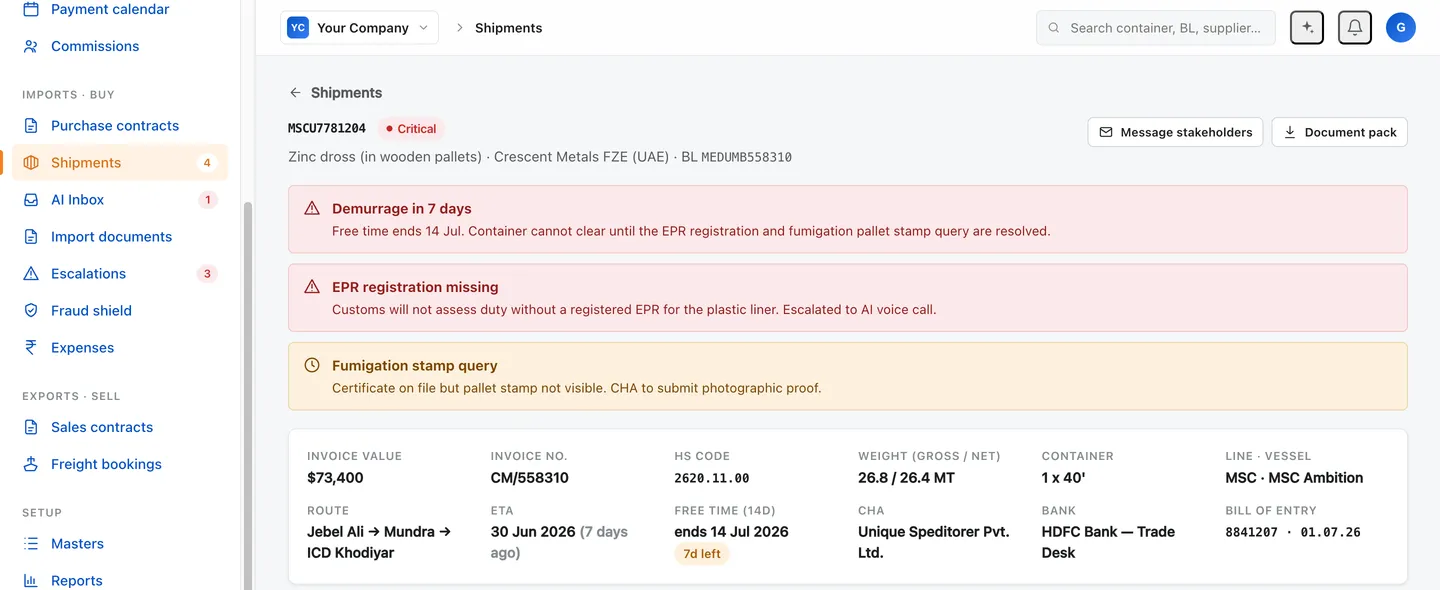
General order: who gets told, and who gets billed
General order is the customs custody an import container moves into when it has not been entered: deposited in a bonded warehouse at the risk and expense of the consignee. Unentered cargo may stay at the place of unlading to the fifteenth calendar day after landing; the carrier then has twenty days to notify CBP and a warehouse. Five things put a box there and only one is filing nothing.
- General order
- The customs custody status of imported merchandise that has not been entered or released: taken into the port director's custody and deposited in a general order warehouse at the risk and expense of the consignee, where storage runs on top of whatever the terminal has already billed.
General order is the answer to a question importers rarely ask in advance: if nobody files the entry, where does the container go? It does not stay in the terminal’s stack indefinitely and it is not seized. It is moved, by somebody else, to a bonded warehouse you did not choose, and billed to you.
The regulation’s own words are the ones to hold on to:
Merchandise shall be considered general order merchandise when it is taken into the custody of the port director and deposited in the public stores or a general order warehouse at the risk and expense of the consignee.
Six words in that sentence decide who pays for everything that follows.
Five ways in, and only one is a missed deadline
The common belief is that general order is what happens when you forget to file. That is one of five triggers, and the other four are closer to an ordinary bad week on a document pack.
Entry not made within the time the law allows is § 127.1(a). But entry “incomplete because of failure to pay estimated duties” is (b). Entry that, “in the opinion of the port director,” cannot be made “for want of proper documents or other causes” is (c). A belief by the port director that merchandise “is not correctly or legally invoiced” is (d).
So a missing certificate, a commercial invoice the officer reads as wrong, and a funding delay on the duty all land the container in the same custody as filing nothing at all. Three of the five are the document pack. That is the part worth knowing before a vessel rather than after one.
The clocks, and whose they are
Unentered cargo may remain at the place of unlading until the fifteenth calendar day after landing. That is the only number most desks have heard, and it is the beginning of the sequence rather than the end.
What follows is a chain of duties that the importer is not part of. No later than twenty calendar days after landing, the master, owner or agent of the vessel must notify CBP of merchandise for which entry has not been made, on pain of a penalty of up to $1,000 per bill of lading, or, where the merchandise on the bill is worth less than that, a penalty equal to its value. Within the same twenty days the carrier must also notify a bonded warehouse certified to receive general order merchandise. A carrier that fails to relinquish custody in time “may be liable for liquidated damages equal to the value of that merchandise.”
The warehouse proprietor then has five calendar days from that notice to take possession, and once notified it is the proprietor’s responsibility “to arrange for the transportation and storage of the merchandise or baggage at the risk and expense of the consignee.”
Two shorter clocks sit beside these. Cargo still on board more than twenty-five days after the report of arrival may be unladen by the port director “at the expense and risk of the owners.” And merchandise taken into custody under 19 U.S.C. 1490(b) goes to a general order warehouse after one day after the day the vessel was entered.
Read the list again and notice what is missing. Every notification duty runs between the carrier, CBP and the warehouse. Not one of them runs to the consignee, who is the party the whole arrangement bills. The notice addressed to the importer comes later and from a different part of the regulation: a notice of sale, or a forfeiture notice, thirty days before the event.
Getting the cargo back, and the six-month mark
The general order period “expires 6 months from the date of importation,” and within it there are real exits.
Within six months of importation, goods in general order may be exported without examination or appraisement if delivered to the exporting carrier, or entered for immediate transportation to any port of entry the consignee designates. After six months, immediate transportation is permitted “only for the purpose of filing an entry for consumption at the port of destination”. The destination choice goes, and so does the export route.
Two conditions apply throughout. Storage “at the ordinary rates and all other expenses shall be paid by the owner or consignee of the merchandise upon entry thereof,” so the bill is settled at the exit rather than billed along the way. And withdrawal “of less than a single general order lot shall not be permitted” except in the narrow case § 141.52 allows: a consignment with one problem line generally cannot be split so that the clean cargo moves.
At the six-month mark, merchandise that has stayed in customs custody “without all estimated duties and storage or other charges having been paid” is considered unclaimed and abandoned. Some cargo never gets the six months: unclaimed explosives, dangerous articles, fruit and other perishables are sold after three days’ public notice, and goods liable to depreciation on six to ten days’.
Why this belongs on a demurrage page
Because general order looks like the end of the storage problem and is not.
When the box physically leaves the terminal, the terminal storage charge stops accruing. What replaces it is warehouse storage at the ordinary rates, the cost of the move itself, and the carrier’s detention on its own container, which runs until the equipment is returned regardless of who is holding it. Three meters, two custodians, one bill presented at entry.
And the trigger for all of it is upstream of the vessel. Document packs routinely run about eight days late against free time; a week of demurrage on one container has cost about US$12,000; and three of the five routes into general order are a document that was not there or not right. The dates that decide whether a box reaches day fifteen are the dates on the purchase contract, the invoice and the certificate, which is why this clock belongs to demurrage and detention software that counts from the document pack, not to the warehouse that eventually sends the bill.
Questions traders ask
What does general order mean in shipping?
It is a customs custody status, not a carrier status. Merchandise becomes general order merchandise when it is taken into the port director's custody and deposited in the public stores or a general order warehouse "at the risk and expense of the consignee". In practice it means your container has left the terminal's stack without being released to you, and a bonded warehouse is now storing it and billing the charges to you.
How long before a container goes to general order?
Fifteen calendar days from landing in the US. The regulation allows merchandise "regularly landed but not covered by a permit for its release" to remain at the place of unlading until the fifteenth calendar day after landing. After that the carrier has until the twentieth calendar day to notify CBP and a bonded warehouse certified to receive general order merchandise, and the warehouse operator has five calendar days from that notice to take possession. Cargo left on board is on a different clock again: after twenty-five days from the report of arrival the port director may unlade it at the owner's expense.
Why did my container go to general order?
Five things do it and only the first is filing nothing. Entry not made within the time the law allows; entry incomplete because estimated duties were not paid; entry that in the port director's opinion cannot be made "for want of proper documents or other causes"; a belief by the port director that the merchandise is "not correctly or legally invoiced"; and your own request. So an incomplete document pack and an invoice the officer reads as wrong put a container in the same place as no filing at all.
Does anyone tell the importer the cargo went to general order?
No notification duty in the chain runs to the importer. The carrier notifies CBP, the carrier notifies the bonded warehouse, the warehouse notifies CBP if it cannot collect — and the importer, who pays for all of it, has no statutory right to notice at this stage. The notice that does come addressed to you arrives much later, as a notice of sale or a title-vesting notice, thirty days before the event. That gap is the whole operational point: the party being billed finds out by asking.
Can I get cargo out of general order?
Yes, for six months, and the routes narrow at that mark. Within six months of importation, goods in general order may be exported without examination or appraisement if delivered to the exporting carrier, or entered for immediate transportation to any port of entry the consignee designates. After six months, entry for immediate transportation is permitted "only for the purpose of filing an entry for consumption at the port of destination". Either way, storage at the ordinary rates and all other expenses are paid by the owner or consignee on entry.
Can I take part of the shipment out?
Generally not. The regulation states that withdrawal from general order of less than a single general order lot is not permitted except as provided in § 141.52. So a consignment with one problem line cannot usually be split so the clean cargo moves — which is why a document check that catches the problem line before the vessel is worth more than any argument afterwards.
What happens at the end of the general order period?
It expires six months from the date of importation. Merchandise that has remained in customs custody for six months from importation "without all estimated duties and storage or other charges having been paid" is considered unclaimed and abandoned, and goes to sale or to title vesting. Some cargo moves far faster: unclaimed explosives, dangerous articles, fruit and other perishables are sold after three days' public notice, and goods liable to depreciation on six to ten days'.
Does general order stop the demurrage clock?
It stops one meter by starting another, and the second one is harder to see. Once the box physically leaves the terminal the terminal's storage stops accruing, but the general order warehouse's storage and the move itself are expressly at the consignee's risk and expense, and the carrier's detention on its own container keeps running until the equipment comes back. A desk that treats the general order move as the end of the exposure finds out at entry, when the ordinary-rate storage and all other expenses fall due in one bill.
Sources
- 19 CFR § 127.1, Merchandise considered general order merchandise — merchandise is general order merchandise when taken into the custody of the port director and deposited in the public stores or a general order warehouse "at the risk and expense of the consignee" for any of five reasons: "(a) Whenever entry of any imported merchandise is not made within the time provided by law or regulations prescribed by the Secretary of the Treasury. (b) Whenever entry is incomplete because of failure to pay estimated duties. (c) Whenever, in the opinion of the port director, entry cannot be made for want of proper documents or other causes. (d) Whenever the port director believes that any merchandise is not correctly or legally invoiced. (e) Whenever, at the request of the consignee or the owner or master of the vessel or person in charge of the vehicle in which merchandise is imported, any merchandise is taken possession of by the port director after the expiration of 1 day after entry of the vessel or report of the vehicle." · checked 2026-10-06
- 19 CFR § 127.2, Withdrawal from general order for entry or exportation — "(a) Exportation within 6 months from date of importation. Merchandise in general order may be exported without examination or appraisement if the merchandise is delivered to the exporting carrier within 6 months from the date of importation. This merchandise may be entered within 6 months from date of importation for immediate transportation to any port of entry designated by the consignee. (b) After expiration of 6 months from date of importation. Entry for immediate transportation shall be permitted after the expiration of the 6-month period only for the purpose of filing an entry for consumption at the port of destination. (c) Withdrawal of less than single general order lot. The withdrawal from general order of less than a single general order lot shall not be permitted except as provided for in § 141.52 of this chapter." · checked 2026-10-06
- 19 CFR § 127.4, General order period defined — "The general order period is that period of time during which general order merchandise, as defined in § 127.1, is not subject to sale. The general order period expires 6 months from the date of importation." · checked 2026-10-06
- 19 CFR § 4.37, General order — "(a) Any merchandise or baggage regularly landed but not covered by a permit for its release shall be allowed to remain at the place of unlading until the fifteenth calendar day after landing. No later than 20 calendar days after landing, the master or owner of the vessel or the agent thereof shall notify Customs of any such merchandise or baggage for which entry has not been made"; failure "may result in assessment of a monetary penalty of up to $1,000 per bill of lading", and "If the value of the merchandise on the bill is less than $1,000, the penalty shall be equal to the value of such merchandise." § 4.37(c): the carrier must also notify a bonded warehouse certified as qualified to receive general order merchandise within the same 20-day period, and "It shall then be the responsibility of the bonded warehouse proprietor to arrange for the transportation and storage of the merchandise or baggage at the risk and expense of the consignee"; failure to notify a warehouse may make the party "liable for the payment of liquidated damages of $1,000 per bill of lading". § 4.37(d): a party that fails to timely relinquish custody to a bonded General Order warehouse "may be liable for liquidated damages equal to the value of that merchandise". § 4.37(e): the warehouse operator has "five calendar days after receipt of notification" to take possession. § 4.37(g): where merchandise remains on board more than 25 days after the report of arrival, the port director may under 19 U.S.C. 1457 "take possession of such merchandise and cause it to be unladen at the expense and risk of the owners". § 4.37(h): merchandise taken into custody under 19 U.S.C. 1490(b) is sent to a general order warehouse "after 1 day after the day the vessel was entered" · checked 2026-10-06
- 19 CFR § 127.11, Unclaimed merchandise — any entered or unentered merchandise "which remains in Customs custody for 6 months from the date of importation or a lesser period for special merchandise as provided by § 127.28 (c), (d), and (h), and without all estimated duties and storage or other charges having been paid, shall be considered unclaimed and abandoned" · checked 2026-10-06
- 19 CFR § 127.13, Storage of unclaimed and abandoned merchandise — "A class 11 bonded warehouse or warehouse of class 3, 4, or 5, certified by the port director as qualified to receive general order merchandise, will be responsible for the transportation and storage"; § 127.13(b): "Storage at the ordinary rates and all other expenses shall be paid by the owner or consignee of the merchandise upon entry thereof. If the goods are sold, such charges shall be paid from the proceeds of the sale to the extent that proceeds are available." · checked 2026-10-06
- 19 CFR § 127.28(c) and (d), Special merchandise — unclaimed explosives and other dangerous articles, and fruit and other perishable articles, "shall be sold after 3-days' public notice"; other unclaimed merchandise liable to depreciation is sold at public auction "upon public notice of not less than 6 or more than 10 days, as the port director may determine" · checked 2026-10-06
- Docket operational baseline, import–export desk — desk time per container and the document-pack lateness against free time · checked 2026-10-06