Mundra port storage charges: 2 free days, or 10
Mundra (INMUN) has three container terminals and, unlike Nhava Sheva, all three publish an identical storage tariff. An import laden container gets 2 free days out by road and 10 by rail, counted from the day of landing and including Sundays and holidays. Export by road gets 7. Here the free period is set by how the box leaves, not by which terminal worked the vessel.
Terminal storage: 2 free days, then these rates
Import laden (FCL) containers evacuated by road, the ordinary case for a direct-delivery import. Rail-evacuated laden containers get 10 free days under the same tariff and export by road gets 7; both are in the exceptions below. Rates shown are the up-to-20ft and 40ft columns; each booklet carries a third, higher column for containers above 40ft. at CT2 (AMCT), CT3 (AICTPL) and CT4 (ACMTPL) — the three container terminals publish the same storage tariff. Free time counted from the day of landing, up to the day of loading, delivery or removal of the container, and including Sundays and holidays. 'Per day' means per calendar day or part thereof..
| Period | Up to 20ft | Over 20ft |
|---|---|---|
| First 2 days | Free | Free |
| Days 3–5 | USD 8 | USD 16 |
| Days 6–15 | USD 15 | USD 30 |
| Days 16–30 | USD 21 | USD 42 |
| Beyond 30 days | USD 30 | USD 60 |
Per container per day.
- Above 40ft: US$24 a day in days 3–5, US$45 in days 6–15, US$63 in days 16–30 and US$90 beyond 30.
- Rail-evacuated laden containers, import or export: first 10 days free, then US$6 up to 20ft and US$12 at 40ft in days 11–15, US$20 and US$40 in days 16–30, US$30 and US$60 beyond 30.
- Export laden by road: first 7 days free, then US$9 up to 20ft and US$18 at 40ft in days 8–10, and the import bands from day 11.
- Hazardous containers: storage charged at twice the normal rate.
- Over-dimensional containers: storage charged at four times the normal rate.
Source: Adani International Container Terminal Pvt Ltd, Tariff Booklet effective 16 June 2026 — § 3.11 Charges for container storage in container terminal, and notes (a) to (d) · checked 2026-09-19
This page is about one Indian port: Mundra, UN/LOCODE INMUN, on the Gulf of Kutch in Gujarat. It exists for the same reason the Nhava Sheva page does: the terminals publish their storage tariffs, so the exposure can be known before the vessel sails rather than discovered on an invoice. What the published set says here is close to the opposite of what it says at Nhava Sheva, and the difference is worth an hour of anyone’s planning.
At Mundra the terminal does not matter
Mundra has three container terminals. CT2 is Adani Mundra Container Terminal, run by Adani Ports itself. CT3 is Adani International Container Terminal. CT4 is Adani CMA Mundra Terminal, the joint venture with CMA CGM. Three operators, three separately published tariff booklets, all of them effective 16 June 2026.
Read the three side by side and § 3.11 is the same clause three times. Same free periods, same bands, same dollar rates, same notes. Whichever terminal works your vessel, the storage bill is computed identically.
That is not how the other big Indian gateway works. At Nhava Sheva the five container terminals publish five different tariffs: three free days at two of them, two at the other three, dollars at three and rupees at two, with the widest gap belonging to a single operator. There, which terminal berthed the vessel changes the number. Here it does not.
So an importer who learned the rule at one gateway has learned nothing usable about the other. The variable moved.
What it moved to: how the box leaves
At Mundra the free period is decided by the evacuation mode.
| Movement | Free period | First charged band, 20ft / 40ft |
|---|---|---|
| Import laden, out by road | 2 days | Days 3–5: US$8 / US$16 |
| Import laden, out by rail | 10 days | Days 11–15: US$6 / US$12 |
| Export laden, in by road | 7 days | Days 8–10: US$9 / US$18 |
| Transhipment laden | 10 days | Days 11–15: US$12 / US$24 |
Five times the free time on the same import container at the same terminal, decided by whether it leaves on a trailer or on a train. Nothing about the cargo changes. Nothing about the importer changes.
The direction matters nearly as much. An export box sitting in the yard waiting for its vessel gets seven free days. The identical box arriving as an import gets two.
After the free period the road bands run US$8 up to 20ft and US$16 at 40ft for days 3 to 5, US$15 and US$30 for days 6 to 15, US$21 and US$42 for days 16 to 30, then US$30 and US$60. Hazardous cargo is charged at twice those rates and over-dimensional cargo at four times.
The clock runs on Sundays
The counting rule is in note (b), and it is stricter than the one at Nhava Sheva in two separate ways.
The Mundra note reads that the storage period “shall be reckoned from the day of landing up to the day of loading / delivery / removal of container and will include Sundays and holidays”. NSICT at Nhava Sheva counts from the day following the day of landing, and its free dwell is exclusive of customs notified holidays and port non-working days.
So two containers landing on the same Friday, one at each port, are on different clocks before anyone has done anything wrong. The Mundra box has started counting and will keep counting through Saturday and Sunday. The Nhava Sheva box has not started, and its weekend may not count at all.
With two free days and no weekend relief, a Friday landing at Mundra that is not collected by Sunday is already into charged time on Monday morning, before a single working hour has passed since arrival.
This is the terminal’s bill, not the carrier’s
Everything above is a terminal storage charge: rent for the ground the box occupies, billed by the terminal operator, published and identical for every user of that terminal. It is not demurrage in the carrier’s sense, and paying one does not settle the other.
The carrier’s free time at Mundra is a term of your service contract. Two importers moving
identical boxes off the same vessel routinely hold different allowances, which is why the
freeTime table on this page is empty rather than filled with a plausible number. When a
sourced row for a named carrier on a real lane arrives, it goes here and not before.
An importer who clears late pays both meters. The one on this page you can look up today.
What to do with it
Find out, before the vessel sails, whether the box is leaving by road or by rail, because that single fact is worth eight days of free storage. If it is going out by road, the document pack has to be complete and the delivery order in hand inside two calendar days of landing, weekend or not.
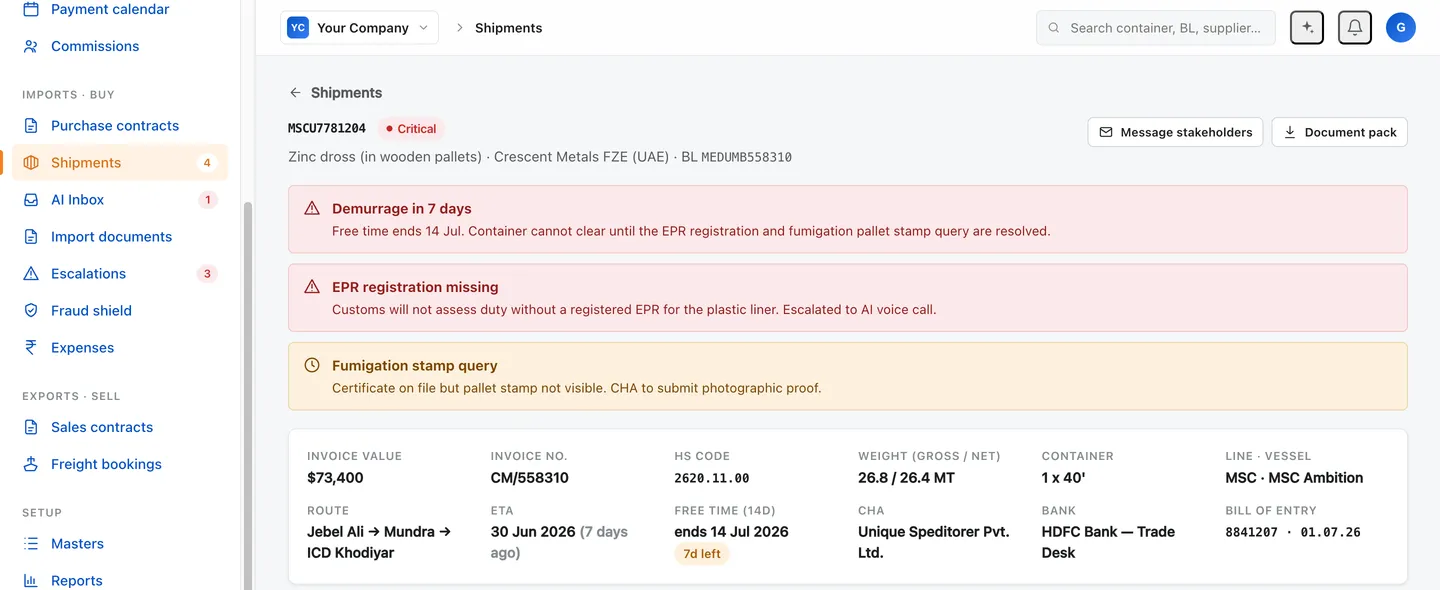
That is a deadline you can compute the day the contract is signed, and it is the deadline most desks compute on the Tuesday after the box landed. Docket works the checklist backwards from it and chases the parties who owe you each item. That is what software that tracks free time per terminal and per contract has to do to be worth anything: act before the charge exists, rather than report it after.
Sources
- Adani Ports, Mundra Port downloads — the page through which each container terminal's current tariff booklet is published · checked 2026-09-19
- Adani International Container Terminal Pvt Ltd (CT3), Tariff Booklet effective 16 June 2026 — § 3.11 container storage, notes (a) to (g), and the definition of 'Per day' · checked 2026-09-19
- Adani CMA Mundra Terminal Pvt Ltd (CT4), Tariff Booklet effective 16 June 2026 — § 3.11 container storage and notes (a) to (g) · checked 2026-09-19
- Adani Ports & Special Economic Zone Ltd (CT2, AMCT), Tariff Booklet effective 16 June 2026 — § 3.11 container storage · checked 2026-09-19
- Docket operational baseline, import–export desk · checked 2026-08-08