How to dispute a demurrage invoice, and why most disputes fail
Disputing a demurrage invoice turns on who is billing you, whether the bill is valid where you trade, and whose days it covers. In US trades the FMC's billing rule sets 30 days to invoice and 30 to contest. In India a detention certificate covers days Customs held the goods. Elsewhere it is contract. Everywhere, days lost to a late document pack are yours, which is why most disputes fail.
The invoice arrives about three weeks after the container finally moved, and it is for more than the freight was. The instinct is to write back and argue. The disputes that work do not argue. They list dates, and they attach the paper that proves each one.
Which is why the answer to “how do I dispute this” mostly gets decided weeks before the invoice exists.
First, work out who is billing you
There are two bills and they are not the same charge.
Demurrage is the custodian’s charge for the box sitting inside the terminal past its free days. The counterparty is the port, the container freight station or the inland depot. Detention is the carrier’s charge for its own equipment being out of the system, and the counterparty is the shipping line. One late document pack can trigger both, from two parties, on two clocks, under two contracts.
Disputing the wrong one at the wrong party is the most common wasted week on an import desk. Read the header of the invoice before you read the figure.
Second, work out whether the bill is even valid
This depends entirely on where the shipment moved, and importers routinely apply the rules of a trade they are not in.
US trades. The Federal Maritime Commission’s billing rule, 46 CFR part 541, took effect on 28 May 2024 and put real limits on the invoice itself. A demurrage or detention invoice has to be issued within 30 calendar days of the date the charge was last incurred, and where it is not, the billed party is not required to pay it. The invoice has to carry the information the rule requires. And it sets minimum dispute windows: at least 30 days for the billed party to request mitigation, refund or waiver, and at least 30 days for the billing party to resolve it, with longer periods allowed by agreement.
One part of that rule is gone, and pages written in 2024 still tell you it is there. Section 541.4 limited who could be invoiced to a party in contractual privity or the consignee. In World Shipping Council v. FMC, decided on 23 September 2025, the D.C. Circuit set that section aside, and the Commission removed it from the regulation by a final rule in January 2026. So “you cannot bill me, I am not the contracting party” is no longer an argument on the face of the rule. Everything else in part 541 is unaffected and still applies: the issuance deadline, the content requirements, the dispute windows.
Behind all of it sits the older interpretive rule, 46 CFR § 545.5, which asks whether a charge served its purpose of getting cargo moving. That is the argument to make when the charge accrued during a period when nothing you did could have moved the box.
India. The route is different and narrower. Regulation 6(1)(l) of the Handling of Cargo in Customs Areas Regulations, 2009 bars a customs cargo service provider from charging rent or demurrage on goods seized, detained or confiscated by Customs. The evidence for that period is a detention certificate from the officer or formation that held the consignment. In Mumbai Port Trust v. M/s Shri Lakshmi Steels, decided on 27 July 2017, the Supreme Court held the port trust was not entitled to demurrage in view of that regulation, where Customs had issued such a certificate. Note the scope: the custodian’s charge, for the certified days. The line’s container detention is a separate contract and a separate conversation.
Singapore, the UAE and most other trades. No statutory equivalent. What you have is the carrier’s tariff, the bill of lading, and whatever free time and waiver language you negotiated into the service contract. Which means the pressure you have is commercial: your volume on that lane, next year’s rate discussion, and the fact that the line would rather keep the account than win US$3,000.
Third, work out whose days they actually were
Here is the table to build before you write anything. One row per day, or per block of days, with a party against each.
| Period | Whose delay | Recoverable? |
|---|---|---|
| Goods held by Customs for examination, testing or a licence question | The department | In India, via a detention certificate against the custodian’s charge |
| Terminal congestion, a strike, equipment shortage, a port closure | The terminal or the carrier | Sometimes, on the interpretive-rule argument in US trades; commercially elsewhere |
| Invoice issued outside the regulatory window, or missing required content | The billing party | In US trades, on the face of the rule |
| Document pack incomplete, supplier unresponsive, invoice disagrees with the packing list | You | No |
Most demurrage invoices are mostly the last row. That is the finding that matters more than any of the legal footing above, and it is why this post is not a template letter.
Why most disputes fail
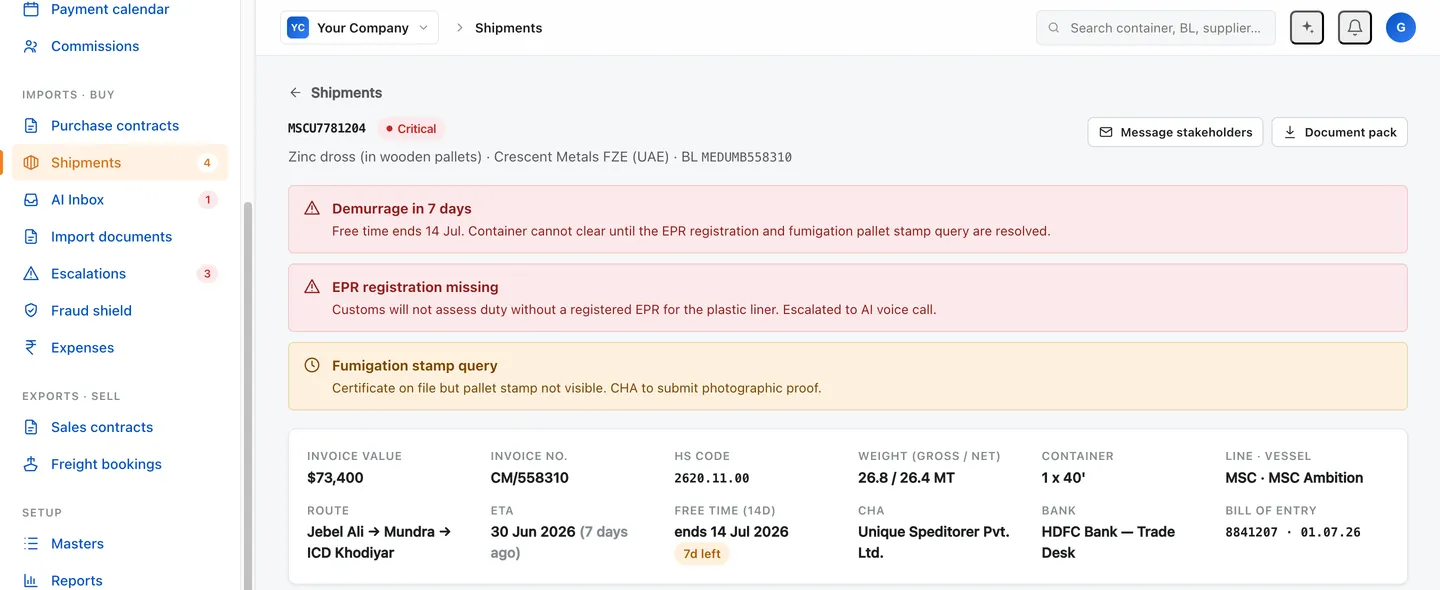
Free time starts at discharge. It does not start when your paperwork is ready, it does not pause at the weekend, and it does not care that the supplier’s office was shut. On the desks this site is written from, the document pack routinely lands about eight days behind free time. Not through negligence: one container takes about 2.2 hours of desk work, and a seven-person desk running 500 containers a month is at roughly 90% capacity on that work alone before anyone buys or sells anything.
Eight ordinary days, produced by an ordinary desk under ordinary load. And not one of them is certifiable, waivable or arguable, because nobody else caused them.
So the dispute you can win is the narrow one: the days a third party took, named, dated and evidenced. Ask for those. Do not bundle them with the other eight and hope the whole thing gets waived, because bundling is how a request that had a good half in it gets refused whole.
What to send, and in what order
- Read the invoice against your own contract. The free days you negotiated, not the tariff default. Two lines calling the same port allow different periods.
- Check the invoice’s own validity against the rules of the trade it moved in: the issuing date, the party billed, and whether the same charge went to someone else too.
- Separate the periods into the table above, with a date range and a party per row.
- Attach the paper per row. The detention certificate, the terminal’s own gate and availability timestamps, the carrier’s notice of arrival, the email in which the party who held things up said so.
- Ask for the specific days, in writing, with a number. Not a waiver of the invoice.
- Send it to both counterparties separately where both are billing you, and expect two independent answers.
Do this before the invoice exists
The uncomfortable arithmetic of the section above is that the recoverable half is small and the preventable half is large. A week of demurrage on one container has cost US$12,000 on a reported incident, and the quieter version — one missed document pack a month — runs US$12,000 to US$24,000 a year without ever being big enough to trigger a meeting.
Nothing in a dispute process touches either number reliably. Working the document pack backwards from the last free day does, because it addresses the eight days rather than litigating them afterwards. That is what demurrage and detention software that works the document pack is for: the checklist derived from the purchase contract, the chase running daily on email, WhatsApp, SMS and then a voice call, and the pack checked before it goes anywhere near a bank.
The by-product is the dispute file. Every document with the date it arrived and who sent it, every chase and every reply, in one place. When a bill does land, you are not reconstructing six weeks of a mailbox to work out which day the pack was complete. You already know, and so does the person you are writing to.
The gap in this post
I am not a lawyer and this is not advice on your invoice. The 30-day windows apply to US trades and nowhere else; the Indian route runs through a certificate you have to apply for and a regulation addressed to the custodian, not the line; and outside those two, the footing is contractual and the outcome commercial.
The 2.2 hours, the eight days and the US$12,000 are an operational baseline from an import–export desk, not an industry survey. A desk buying DDP with a forwarder absorbing the coordination will see smaller numbers, because it has a smaller problem.
What holds everywhere is the shape of it. Disputes are won on dates. The dates are made, or lost, in the six weeks before the invoice.
Questions this raises
How long do I have to dispute a demurrage invoice?
It depends where the shipment moved. For US trades the FMC's billing rule gives a billed party at least 30 days to request fee mitigation, refund or waiver, and the billing party at least 30 days to resolve it, with longer periods allowed by agreement. Outside that jurisdiction there is no statutory clock and the answer is whatever your contract and the line's tariff say, which is usually short. Read the invoice the day it arrives.
What makes a demurrage invoice invalid?
In US trades, timing and content. The FMC rule requires a demurrage or detention invoice to be issued within 30 calendar days of the date the charge last accrued, and where it is not, the billed party is not required to pay. The invoice must also carry the information the rule specifies. The section that limited who could be billed, 46 CFR 541.4, was set aside by the D.C. Circuit in September 2025 and removed from the regulation in January 2026, so that argument is gone. Elsewhere validity is a contract question, not a regulatory one.
Can I refuse to pay demurrage caused by a customs hold?
In India there is a specific route. Regulation 6(1)(l) of the Handling of Cargo in Customs Areas Regulations 2009 bars the custodian of the customs area from charging rent or demurrage on goods seized or detained by Customs, and the Supreme Court applied it against a port trust in 2017 where a detention certificate had been issued. It covers the custodian's charge for the certified period. The shipping line's container detention is a separate contract.
Why do most demurrage disputes fail?
Because the days being charged are usually the importer's own. Free time starts at discharge, and on an ordinary import desk the document pack runs about eight days behind it. Those days were not caused by Customs, the terminal or the carrier, so no rule and no certificate covers them. A dispute succeeds when someone else took the time and you can prove which days.
What evidence does a demurrage waiver request need?
Dates, attributable to a party. The discharge date, the free days under your contract with the carrier, the day each document in the pack arrived and from whom, the day the entry was filed, the day the goods were released, and the certificate or correspondence covering any period a third party held them. A request that names dates gets read differently from one that asks for consideration.
Sources
- US Federal Maritime Commission, Demurrage and Detention Billing Requirements final rule, 46 CFR part 541 (published 26 February 2024, effective 28 May 2024) · checked 2026-09-07
- World Shipping Council v. Federal Maritime Commission, US Court of Appeals for the D.C. Circuit, 23 September 2025: 46 CFR 541.4 set aside; the Commission removed the section by final rule in January 2026 · checked 2026-09-07
- US Federal Maritime Commission, Interpretive Rule on Demurrage and Detention (46 CFR § 545.5) · checked 2026-09-07
- Handling of Cargo in Customs Areas Regulations, 2009, regulation 6(1)(l) · checked 2026-09-07
- Mumbai Port Trust v. M/s Shri Lakshmi Steels and Ors., Supreme Court of India, 27 July 2017 · checked 2026-09-07
- Docket operational baseline, import–export desk · checked 2026-09-07