Letter of credit: what it pays against, and what it does not
A letter of credit is an undertaking by a bank to pay the seller once documents matching the credit are presented. Banks check paper, not cargo. Under UCP 600 the bank has a maximum of five banking days to examine a presentation and must state every discrepancy in a single notice. An LC protects the seller's cash and the buyer's documents. It protects neither party's goods.
- Letter of Credit
- A bank's written undertaking to pay a seller a stated amount against a presentation of documents that complies with the terms of the credit, governed in most trade by ICC UCP 600.
A letter of credit is a bank’s promise to pay against documents. Not against goods, not against quality, not against the ship arriving. If the paper matches the credit, the bank pays. If the paper does not match, the bank can refuse, and the cargo sitting at the port has no bearing on that decision. UCP 600 Article 5 states it in one line: banks deal with documents and not with goods, services or performance.
That sentence is the whole instrument. Read it twice.
Does an LC guarantee I get the goods?
No. It guarantees the seller gets paid when the seller produces the right paper.
An importer who opens an LC has bought a document-conditioned payment. The bill of lading, the invoice, the packing list, the certificate of origin and the inspection certificate become the object of the deal. A seller who ships rusted scrap and presents a clean set of documents gets paid. A seller who ships perfect cargo and presents a bill of lading dated one day after the latest shipment date does not, until the buyer waives.
The one lever an importer has is the document list. Every check you want performed on the cargo has to exist as a piece of paper named in the credit, issued by a party you trust, with wording you have specified. A pre-shipment inspection certificate from a named agency is a real control. “Goods to be of merchantable quality” in the credit narrative is not, because no bank will test it.
Who are the parties, and what does each one owe?
Five roles, and the words matter because UCP 600 uses them precisely.
- Applicant. The importer. You instruct your bank to issue the credit, you post the margin or the limit, and you carry the amendment fees.
- Issuing bank. Your bank. Its undertaking to pay is independent of your sale contract (Article 4) and independent of your view on whether the goods are acceptable.
- Beneficiary. The seller. Gets paid on a complying presentation.
- Advising bank. The bank in the seller’s country that authenticates the credit and passes it on. It takes no payment risk.
- Confirming bank. An advising bank that adds its own undertaking (Article 8). Now the seller has two banks on the hook, which matters when the issuing bank sits in a country the seller’s bank does not like.
The independence principle in Article 4 cuts both ways for an importer. Your bank will not withhold payment because your supplier let you down commercially. Your dispute with the supplier is a separate matter, argued under the sale contract, after the money has gone.
What does the bank actually check?
Documents against the credit, documents against each other, and documents against UCP 600 and ISBP 745. Article 14(d) sets the standard: data in a document does not have to be identical to data in the credit or in another document, but it must not conflict with it.
The provisions that catch importers most often:
- Article 14(b). The issuing bank, the confirming bank and any nominated bank each get a maximum of five banking days following the day of presentation to decide whether a presentation complies. That is the outer limit, not a service commitment.
- Article 14(c). A presentation including an original transport document must be made no later than 21 calendar days after the date of shipment, and never after the expiry date of the credit.
- Article 16(c) and 16(d). If the bank refuses, it must give a single notice stating each discrepancy it is refusing for, by the close of the fifth banking day. It cannot refuse for one discrepancy today and a fresh one next week.
- Article 18. The description of the goods in the commercial invoice must correspond with the description in the credit. Every other document may describe the goods in general terms. This is why a sloppy goods description in the LC application creates an invoice discrepancy months later.
- Article 28(f)(ii). Where the credit is silent, the insurance cover must be at least 110% of the CIF or CIP value of the goods.
- Article 30. A tolerance of 5% more or less in quantity is allowed where the credit does not state the quantity in packing units or individual items and the drawing does not exceed the credit amount. “About” or “approximately” against the amount, quantity or unit price permits 10% either way, under Article 3.
None of that is negotiable at presentation. It is decided when the credit is drafted, by the person filling in the LC application form at your desk.
What is a discrepancy, and what does it cost?
A discrepancy is any point where the presentation does not comply. Late shipment. Expired credit. Invoice value above the credit amount. A bill of lading that says “shipper’s load and count” where the credit called for a clean on board notation. A certificate of origin naming a consignee spelled differently from the invoice. A missing signature.
The cost lands in four places, and only the first one is visible on a bank statement.
- The discrepancy fee, charged by the issuing bank per presentation.
- The amendment fee, if the fix requires amending the credit rather than waiving.
- The delay. The documents sit while the seller re-presents or you waive. Meanwhile the container has been discharged, and free time is running.
- The demurrage. This is the expensive one and it is never itemised as an LC cost.
Document packs routinely run about eight days late against free time, and a week of demurrage on a single container runs about US$12,000. The LC did its job perfectly. The importer still paid.
We do not publish a discrepancy rate here. The commonly quoted figures for first presentations refused are widely repeated and thinly sourced, and this site does not print a number it cannot stand behind.
LC versus the alternatives
Four ways to settle an import, ranked by who carries the risk.
| Method | Who carries the risk | Bank’s role | Cost to the importer | When it fits |
|---|---|---|---|---|
| Advance payment | Importer, fully | None. A wire | Bank charges only | New supplier who will not ship otherwise, small value |
| Letter of credit | Shared, shifted onto documents | Undertakes to pay on a complying presentation | Issuance, amendment, discrepancy fees, margin or limit blocked | New counterparty, large value, country risk on either side |
| Documentary collection, D/P | Exporter carries it | Handles documents, gives no undertaking | Modest collection charges | Established relationship, exporter wants control of the originals |
| Documentary collection, D/A | Exporter carries it, plus credit risk | Handles documents against acceptance | Modest collection charges | Established relationship, importer needs credit |
| Open account | Exporter, fully | None | Bank charges only | Long relationship, or the importer has the upper hand |
The trade is straightforward. An LC costs the most and blocks working capital, and it is the only one of the five that puts a bank’s balance sheet between two strangers. As a relationship matures, desks move down the table toward open account, and the paperwork burden falls with it.
Sight, usance, confirmed, transferable
Four words that change the economics of the same instrument.
Sight. Payment on a complying presentation. Simplest, and hardest on the importer’s cash, because the money leaves before the goods clear.
Usance, also called deferred payment or acceptance. Payment falls due a stated number of days after sight, after the bill of lading date, or after another defined event. The importer gets the documents, clears the cargo, sells it, and pays later. The seller can discount the accepted draft. This is the version that funds a trading desk.
Confirmed. A second bank adds its undertaking. The seller stops caring about your bank’s country. You pay the confirmation charge, directly or in the price.
Transferable. Under Article 38, a credit expressly marked transferable can be transferred to a second beneficiary. Traders buying and selling the same cargo use this to pay their supplier out of their customer’s credit. It is precise, it is fiddly, and the substitution of invoices under Article 38(h) is where it goes wrong.
The document pack an LC usually calls for
The standard import pack, roughly in the order the bank reads it:
- Commercial invoice
- Packing list
- Full set of original bills of lading, marked as the credit requires
- Certificate of origin
- Insurance policy or certificate, where the Incoterm puts insurance on the seller
- Pre-shipment inspection certificate
- Certificate of analysis or weight, on commodity cargo
- Beneficiary’s certificate confirming courier of documents, where the credit calls for it
Each line is a separate party, a separate deadline and a separate chase. The bank checks the pack in five banking days. Assembling it takes weeks, and nobody owns that part.
Where importers actually lose money on an LC
Three places, in order of size.
The credit was drafted badly. Latest shipment date too tight against the supplier’s loading schedule. Goods description copied from a quotation that no longer matches the invoice. A document required from a party who has no practice of issuing it. Every one of these becomes a discrepancy that was written into the credit at the application stage.
Nobody chased the pack. Documents are late because six parties each assume another one is moving. The exporter waits on the surveyor. The surveyor waits on the loading date. The CHA waits on the certificate of origin. No system has all six in one place, so the desk finds out on the day the ship arrives.
The amendment cycle. One amendment starts a fresh round of seller consent, bank fees and courier time. Two amendments on a shipment mean the shipment is now late.
The Docket baseline puts about 2.2 hours of desk work on a single container, of which 45 to 90 minutes is document-pack preparation and checking, and 30 to 45 minutes is supplier follow-ups. On a 500-container desk that is roughly 1,100 hours a month, and the seven-person team is at about 90% capacity before anyone buys or sells anything.
Where Docket sits
Docket does not issue letters of credit and does not replace your bank. It works on the part that is failing, which is the pack.
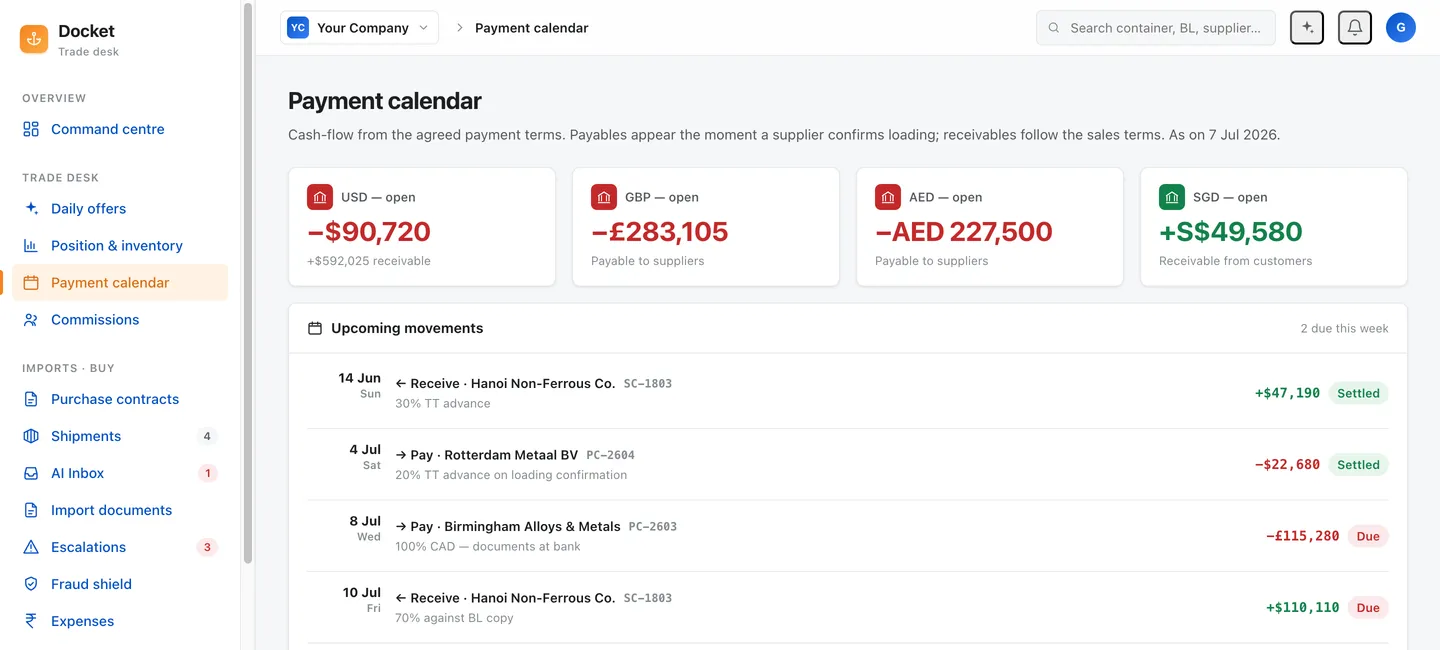
It reads the credit and the purchase contract, builds the document checklist from them, sets the payment calendar from the contract terms, and checks each document as it arrives against the credit terms and against the other documents, field by field, each one passing, warning or failing against the clause it was tested on. Goods description against the invoice. Shipment date against the latest shipment date. Consignee and notify party against the bill of lading. Insured value against the 110% rule where the credit is silent. That check is part of its import document checking software.
Then it chases. Email first, WhatsApp at 24 hours, SMS at 48, an AI voice call at 72, on the channels the exporter and the CHA already use. Nobody signs up for a portal.
The honest limit: Docket cannot make a bank waive a discrepancy, cannot shorten the five banking days, and cannot fix a credit that was drafted wrong before it read it. What it can do is have the pack complete and internally consistent before the vessel discharges, which is the difference between a fee and a demurrage bill.
Every inbound email in that chain also passes the fraud shield, because an LC amendment request is exactly the shape a payment-diversion attempt takes.
Questions traders ask
What is ICC UCP 600 and how does it apply to a letter of credit?
UCP 600 is the International Chamber of Commerce's Uniform Customs and Practice for Documentary Credits, the 2007 revision, which most letters of credit incorporate by reference. It sets the rules the banks apply: documents are examined on their face, the issuing bank has a maximum of five banking days to decide, and every discrepancy must be stated in a single refusal notice. If your credit says it is subject to UCP 600, those articles decide whether you are paid.
Does a letter of credit guarantee I get the goods?
No. It guarantees the seller payment against documents that comply with the credit, and it guarantees the buyer that the bank will pay only against those documents. Neither bank inspects the cargo. A compliant presentation for a container of the wrong goods is still paid; the remedy is in the sales contract and the inspection certificate, not the credit.
How many days does the bank have to check the documents?
A maximum of five banking days following the day of presentation, under UCP 600 Article 14(b), to determine whether the presentation complies. A refusal must be given in a single notice listing every discrepancy. Documents that arrive late against the credit's expiry or latest shipment date are discrepant before anyone reads them.
Sources
- ICC Uniform Customs and Practice for Documentary Credits, UCP 600 (ICC Publication 600, 2007 revision)
- ICC International Standard Banking Practice for the Examination of Documents under UCP 600, ISBP 745 (ICC Publication 745, 2013)
- Docket operational baseline, import–export desk