Bill of Entry: the filing that starts customs clearance
A Bill of Entry is the customs declaration an importer files to clear imported goods in India, normally through the CHA on ICEGATE. Section 46 of the Customs Act 1962 requires it by the end of the day before the carrying vessel arrives, and it may be filed up to thirty days ahead. Late filing attracts a charge that escalates, and it stacks on top of demurrage and detention.
- Bill of Entry
- The customs declaration an importer files to clear imported goods in India, filed electronically on ICEGATE, normally by the CHA, and required before the goods can be assessed, duty paid and the cargo released.
The Bill of Entry is where an import stops being a logistics problem and becomes a customs one. Until it is filed and assessed, the goods cannot be cleared, and the free time clock keeps running regardless. It is due by the end of the day before the vessel arrives, which means it has to be ready while the ship is still at sea.
What is a Bill of Entry?
A Bill of Entry is the formal declaration to Indian customs that goods have arrived and what they are. It carries the importer and IEC, the supplier, the invoice reference, the description, the HS classification, quantity, unit and total value, country of origin, freight and insurance, the Incoterm, and the duty payable line by line: basic customs duty, social welfare surcharge, IGST, compensation cess where it applies, and any anti-dumping or safeguard duty on the classification.
It is filed electronically on ICEGATE, the customs EDI gateway, in practice by the CHA rather than by the importer directly. Section 46 of the Customs Act 1962 is the provision that requires it, and the Bill of Entry (Electronic Integrated Declaration and Paperless Processing) Regulations govern how it is filed.
Under section 46(4) the importer subscribes to a declaration as to the truth of the contents and produces the supporting documents: the invoice, the contract, the packing list, the certificate of origin, and any licence or registration the goods need. The declaration is the importer’s, not the agent’s. That distinction becomes real the day something on it is wrong.
The three types of Bill of Entry
Which one you file decides when duty is paid and where the goods sit.
| Type | Form | Filed for | Duty payable | Typical user |
|---|---|---|---|---|
| Home consumption | Form I, historically white | Goods cleared straight into the domestic market | Now, before release | Most importers, most shipments |
| Warehousing, into-bond | Form II, historically yellow | Goods moved into a bonded warehouse | Deferred until the goods leave the bond | Traders holding stock, duty-heavy cargo |
| Ex-bond | Form III, historically green | Goods being taken out of a bonded warehouse | On the quantity released, at the rate in force then | The same trader, later, in part lots |
The colours are pre-electronic history and the forms are now data sets on ICEGATE, but the three-way split still decides the cash. A trading desk with slow onward sales and heavy duty should be asking whether into-bond and ex-bond is the cheaper structure. Most never model it, because nobody on the desk owns landed cost as a number.
When is a Bill of Entry due?
Section 46(3) sets the deadline: the entry must be presented before the end of the day, including holidays, preceding the day on which the carrying vessel or aircraft arrives. Not on arrival. Not within a few days of arrival.
The same section allows early filing. An advance Bill of Entry may be presented ahead of arrival, within the window the section permits, once the carrier’s arrival manifest is lodged. That is the lever almost nobody pulls, and it is the cheapest one available: file early, get the query early, fix it while the ship is still at sea instead of while the box is accruing demurrage.
The timing is the whole problem. The pack has to be complete before the ship berths, while the exporter may still be couriering originals and the bank may not have released documents against payment. An importer who starts assembling paperwork when the arrival notice lands has already missed the window.
How does clearance actually run, step by step?
Eight steps, and the importer touches only three of them.
1/ The carrier files the arrival manifest. Under the Sea Cargo Manifest and Transhipment Regulations the shipping line lodges the manifest ahead of arrival. Nothing you file can be matched until this exists.
2/ The CHA files the Bill of Entry on ICEGATE, against the manifest line, using the invoice, packing list, bill of lading and origin certificate you supplied.
3/ Self-assessment. Section 17 puts the classification and valuation on the importer. You declare the HS code and the value. Customs verifies rather than calculates. What a single heading carries in duty and paperwork is easiest to see on a worked example: HS 7204.49, ferrous waste and scrap.
4/ The Risk Management System routes it. Some entries are facilitated straight through. Others go for assessment, for examination, or for both.
5/ Faceless assessment. Under the Turant Customs programme an entry raised at one port may be assessed by a National Assessment Centre officer sitting somewhere else entirely. The practical effect on your desk is that queries arrive by system message, not by walking up to a counter, and answering them fast is a documents job.
6/ Duty payment. Assessed duty is paid electronically. Section 47(2) charges interest where duty is not paid within the period allowed, which is a separate meter from demurrage and runs at the same time.
7/ Examination, where the entry is marked for it. Goods are physically checked against the declaration. A packing list that does not match what is in the box turns a routine examination into a query, and a query into days.
8/ Out of charge. The proper officer makes the order permitting clearance for home consumption under section 47. Only now can the delivery order be used and the box gated out. Demurrage stops. Detention starts.
Where a value or classification cannot be settled immediately, section 18 allows provisional assessment against a bond and security, and the entry is finalised later. It gets the cargo out. It also leaves an open liability on your books that somebody has to track until it closes — and until it does, the duty line in your import landed cost calculation is an estimate, not a number you can bill against.
What do late-filing charges cost?
Late filing attracts a charge that accrues per day and steps up the longer it runs. The rates are set by regulation and are revised from time to time.
We are deliberately not quoting a rupee or dollar figure on this page. The current per-diem is the sort of number that changes by notification, and a stale figure here would be worse than none. Check the current CBIC notification, or ask your CHA what they are actually being charged this month.
What is worth internalising is the shape of it. The charge escalates, and it runs alongside the other meters rather than instead of them. A container stuck for a week on a missing certificate of origin can be accruing terminal demurrage, carrier detention, a late-filing charge and section 47(2) interest at the same time, billed by four different parties, arriving on your desk in four different months.
That is why the post-mortem never finds the cause. The charges are separated from the event by weeks, and from each other by the account codes they land in.
Bill of Entry, Shipping Bill, Bill of Lading: what is the difference?
Three documents that sound alike and do unrelated jobs.
| Bill of Entry | Shipping Bill | Bill of Lading | |
|---|---|---|---|
| Direction | Import | Export | Either |
| Who files or issues it | Importer, through the CHA | Exporter, through the CHA | The carrier |
| Filed with | Indian customs, on ICEGATE | Indian customs, on ICEGATE | Nobody. It is a commercial document |
| Legal effect | Declaration of imported goods for assessment | Declaration of goods for export and drawback | Receipt, contract of carriage, document of title |
| Governing provision | Customs Act 1962, section 46 | Customs Act 1962, section 50 | Contract and carriage law, not customs |
| Deadline | End of the day before arrival | Before the goods are loaded | Issued after loading |
The one that trips importers is the third column. A bill of lading is not a customs document and filing it with anybody clears nothing. It is the thing your bank holds and your carrier releases against, which is a different chain of custody with a different set of delays.
Where it goes wrong
Almost always the same way. The Bill of Entry cannot be filed because one input is missing.
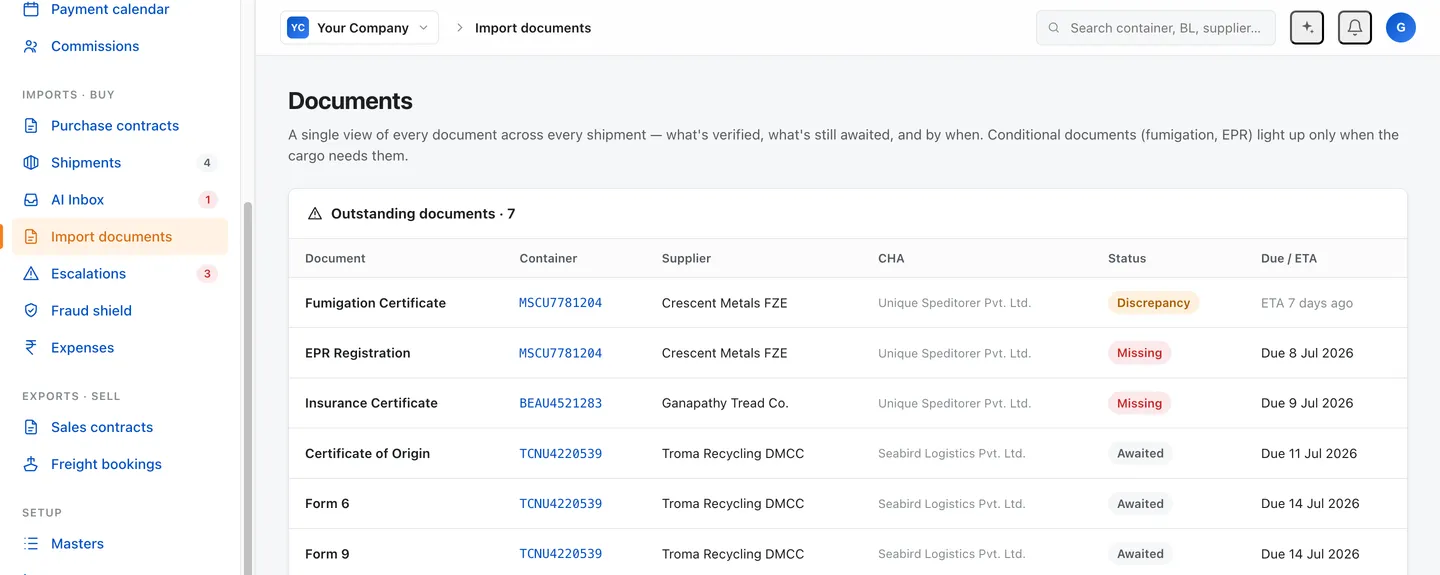
A certificate of origin that never arrived, because the chamber of commerce in the exporter’s country works to its own calendar. An invoice that does not match the packing list on quantity or on description. A fumigation certificate for a wooden-pallet consignment. An EPR registration for plastics. A test report for a commodity under quality control orders. A classification the CHA is unwilling to file without written confirmation from the importer, which is sitting unread in a trader’s inbox.
The pattern underneath is the same every time: the CHA is waiting on the importer, the importer is waiting on the exporter, and nobody owns the follow-up. Six parties, no coordinator, and a deadline set by a vessel that does not slow down.
The arithmetic on the desk explains why. Docket’s operational baseline puts about 2.2 hours of work on a single container, of which 30 to 45 minutes is supplier follow-ups and 45 to 90 minutes is document-pack preparation and checking. A 500-container desk consumes about 1,100 hours a month. Seven people at roughly 176 hours each provide 1,232 hours. The desk is at about 90% capacity on grunt work before anyone buys or sells anything. Packs routinely run about eight days late against free time.
What can an importer actually control?
Five things, none of which require a regulator’s permission.
File in advance. The section allows it. Use it, and turn a query on the day of arrival into a query a week earlier.
Fix the masters once. Most classification and description queries come from a supplier description that was never reconciled to your HS code. Settle it once per product, store it, and stop re-litigating it per shipment.
Write document deadlines into the purchase contract. Not “documents to be sent promptly.” A named document, a named party, a number of days after the bill of lading date, and a consequence. Most purchase contracts on a trading desk run to pages on quality and one line on documents.
Get the AEO status if your volume justifies it. The Authorised Economic Operator programme carries facilitation benefits, including deferred duty payment and faster handling, for importers with a clean compliance record.
Know who your CHA is waiting on, today. Not at the weekly review. Today, per shipment, by name.
Common misconceptions
“The CHA handles it.” The CHA files. The declaration under section 46(4) is the importer’s, the classification under section 17 is the importer’s, and the penalty for a wrong one lands on the importer.
“We can file after the ship arrives.” You can, and you pay for it, daily, escalating.
“Late filing is the same as demurrage.” Four separate meters can run at once: terminal demurrage, carrier detention, the late-filing charge, and interest under section 47(2).
“Provisional assessment closes the matter.” Section 18 gets the cargo out against a bond. The file stays open, and somebody on your side has to close it.
“Faceless assessment slowed everything down.” It changed where the officer sits. What decides your clearance time is still whether the answer to the query is in your files or in your supplier’s inbox.
Where Docket sits
Docket does not file Bills of Entry, is not a customs broker, and does not replace your CHA. Classification, valuation and the filing itself stay where they are.
What Docket does is make sure the CHA has a complete, internally consistent pack before the deadline rather than the morning after it; that is the job its document checking software for imports does. It works the checklist backwards from the vessel’s arrival instead of forwards from the booking. It reads the purchase contract, derives what the shipment owes, checks each document as it lands against the contract and against the other documents, identifies which single party owes the missing item, and chases that party daily: email first, WhatsApp at 24 hours, SMS at 48, an AI voice call at 72. On channels the exporter and the CHA already use. Nobody signs up for a portal.
On the baseline desk, that takes a container from about 2.2 hours of desk work to roughly 20 minutes, an 85% cut in the cost of the chase, with document-pack drafting automated at about 65%.
The honest limit: Docket cannot make a chamber of commerce issue a certificate faster, and it will not tell you your HS code is wrong. It makes sure that on the day before the vessel arrives, nobody is still looking for the file.
Sources
- Customs Act 1962, section 46 (entry of goods on importation), India
- Customs Act 1962, sections 17, 18 and 47 (self-assessment, provisional assessment, clearance for home consumption)
- Bill of Entry (Electronic Integrated Declaration and Paperless Processing) Regulations, CBIC
- Sea Cargo Manifest and Transhipment Regulations 2018 (SCMTR), CBIC
- CBIC Turant Customs programme, faceless assessment through National Assessment Centres
- Docket operational baseline, import–export desk