Landed cost: every line between the invoice and your yard
Landed cost is the total cost of a consignment delivered into your warehouse: goods value plus customs duty, shipping-line charges, port handling, CHA fees, inland transport, insurance, bank charges, inspection, and any demurrage and detention. Most desks calculate it at month end, after the cargo has been sold. Getting it late is the same as not having it.
- Landed cost
- The total cost of a consignment delivered into the buyer's warehouse, combining the goods value with duty, freight, port and terminal charges, agent fees, inland transport, insurance, bank charges, inspection and any demurrage or detention.
Landed cost is what one consignment costs you by the time it is standing in your yard, cleared, unloaded and available to sell. Goods value is the smallest problem in that sentence. The rest arrives as nine separate categories of charge, from six different parties, over roughly six weeks, and about a third of it lands after you have already quoted your customer.
A trader who sells on a 5% margin and misses US$600 of charges on a container has to write US$12,000 of fresh business to get back to where they thought they were.
What goes into landed cost?
Nine categories. Each one has a different party issuing it, a different point in the shipment when it becomes known, and a different treatment for customs and for accounts.
| Cost category | Who charges it | When you know it | Typical timing |
|---|---|---|---|
| Customs duty and import taxes | The customs authority | At assessment, on the declared value | Clearance |
| Shipping-line charges | Carrier or NVOCC | Booking, plus surcharges that move | Booking to delivery order |
| Port and terminal handling | Terminal operator | Tariff is published, quantity is not | Discharge to gate-out |
| CHA and clearing agent fees | Your customs broker | Agreed schedule, plus reimbursements | After clearance |
| Inland transport | Transporter | Rate known, waiting charges are not | Gate-out to delivery |
| Marine insurance | Insurer or the seller under CIF and CIP | Premium known at booking | Booking |
| Bank charges | Your bank | Schedule known, count is not | LC issuance to settlement |
| Inspection and survey | Inspection agency | Quoted per consignment | Pre-shipment and on discharge |
| Demurrage and detention | Carrier and terminal | Only when it has already happened | After the fact |
The last row is the one that ruins the number. Every other line can be estimated at booking with reasonable accuracy. Demurrage and detention are unknowable at booking, arrive weeks later, and are large. A week of demurrage on one container runs about US$12,000, and a single missed document pack a month runs US$12,000 to US$24,000 a year.
How is the customs value calculated?
Under the WTO Customs Valuation Agreement, the primary method is transaction value: the price actually paid or payable for the goods when sold for export to the country of importation, adjusted by the additions listed in Article 8. Those additions include commissions and brokerage other than buying commissions, packing, assists, royalties, and, where the importing member has so elected, the cost of transport, loading and handling to the place of importation and the cost of insurance.
Two consequences a trading desk feels directly.
Your Incoterm changes what customs sees. Buy CIF and the freight and insurance are already inside the invoice value. Buy FOB or FCA and they are separate invoices that many jurisdictions add back to reach the assessable value. Same cargo, same total cost, different paperwork, and a different set of documents your broker needs from you.
Your HS classification sets the rate. The WCO Harmonized System governs the six-digit code; national tariffs extend it to eight or ten digits and attach the duty rate, preferential rates under trade agreements, and any anti-dumping or safeguard measures. A classification argument with customs is a landed-cost problem wearing a technical costume. Get the code right at contract stage, from the product specification, not at the port from the packing list.
We do not publish duty rates on this site. They are jurisdiction-specific, they change on notification, and the only correct source is the tariff schedule of the customs authority you are importing into. Singapore Customs, India’s Central Board of Indirect Taxes and Customs, Dubai Customs and the UAE Federal Customs Authority each publish their own.
Which is also why the landed cost calculator on this site takes the duty rate as an input rather than looking one up. Bring your own rate and your own charges and it will work the consignment through — including the two steps a spreadsheet usually gets wrong: whether the duty is assessed on the CIF value or the goods value alone, and whether the import tax is recoverable.
Why is landed cost always late?
Because nobody owns it. The information exists, in nine mailboxes, and no single party is accountable for pulling it into one number.
Here is the actual sequence on a normal import. The supplier invoice arrives at contract stage. The freight invoice arrives at booking, then a fuel or congestion surcharge amends it. The terminal handling charge appears on the delivery order. The broker’s bill comes after clearance, mixing their fee with reimbursements they paid on your behalf. The transporter bills at month end, with detention on a separate line. The bank debits charges across four dates. The demurrage invoice, if there is one, shows up last.
By the time all nine have landed, the cargo has been sold, the customer has been invoiced and the margin was decided on an estimate.
The desk work behind this is not small. Our baseline puts about 2.2 hours of desk work on a single container, and payment tracking alone accounts for 10 to 15 minutes of it, with status tracking and reporting another 20 to 30. On a 500-container desk that is about 1,100 hours a month against a seven-person capacity of about 1,232 hours. The team is at roughly 90% capacity on grunt work before anyone negotiates a purchase.
What a landed-cost number is actually for
Four uses, and they need different levels of precision.
Pricing the next sale. You need the cost per unit, per grade, on the lane you are about to quote. An estimate built from the last three consignments beats a perfect number that arrives in six weeks.
Checking the margin you thought you made. This one needs to be exact, traced to documents, and reconciled against what was actually paid.
Arguing with a counterparty. A detention claim you cannot substantiate line by line against the tariff and the gate-out timestamp is a claim you will lose.
Filing accounts. Duty and freight capitalise into inventory value in most accounting regimes. Getting the split wrong between what capitalises and what expenses moves your reported margin.
A single landed-cost figure that tries to serve all four ends up serving none. What works is one traced record per consignment, updated as each invoice arrives, with an estimate flag on the lines that are still open.
How to build a landed cost that holds up
Five steps, in the order they pay back.
1/ Fix the cost categories once and never change them. Nine buckets, the same nine on every consignment, across every lane. Comparability is worth more than precision.
2/ Estimate at booking. Populate every bucket with a number the day the contract is signed, using your own history. Mark them as estimates. An estimated landed cost on day one is a decision tool. An exact one on day forty is a history lesson.
3/ Trace every actual back to a document. Invoice number, date, party, the email it arrived in. When a line cannot be traced, it cannot be defended in a dispute and it cannot be audited.
4/ Allocate on a rule you wrote down. Ocean freight per container, duty per assessable value, inspection per consignment, bank charges per settlement. Write the rule once so two people do not allocate the same charge two ways.
5/ Close the gap between estimate and actual, per line. The variance report is where the learning is. A freight estimate that is consistently 8% light is a fixable input. A demurrage line that appears on one consignment in three is a process failure upstream, in the document pack.
Where Docket sits
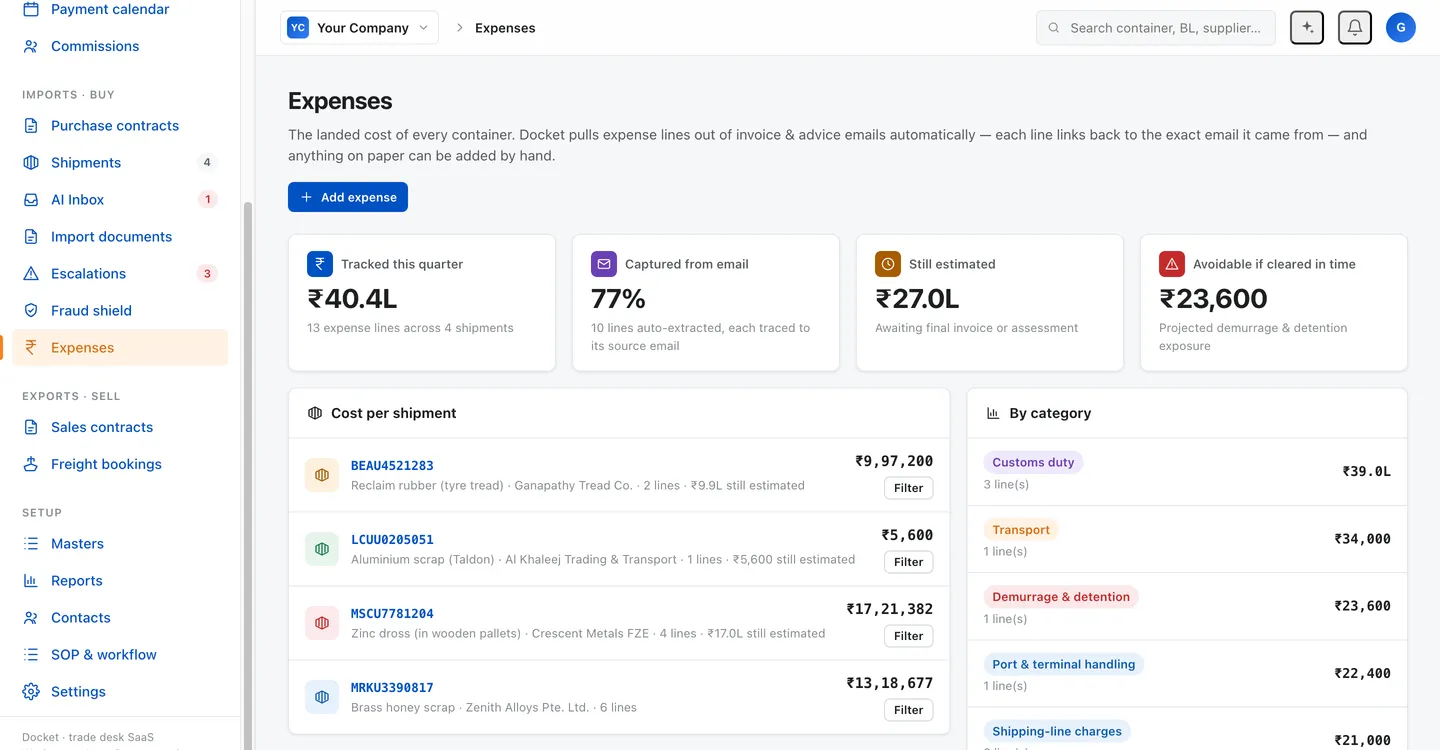
Docket builds the landed cost from the contract forward instead of from the invoices backward. That is what its landed cost tracking software is for. The allocation across SKUs stays in your ERP; why the two have to run in that order is the subject of landed cost software, per container first. If you are shortlisting products, the three kinds of landed cost tools for an import desk are set out side by side there, with the column most comparisons leave out: which of them actually collects the charge.
It reads the purchase contract, sets the expected cost lines from the Incoterm, and then watches the mailbox. Each invoice that arrives is matched to a consignment and a cost bucket, with the source email retained, so every line traces to a document rather than to somebody’s memory. The payment calendar comes off the contract terms, so you know what is due before the bank does.
The demurrage line gets attacked at the cause. Docket derives the last free day from discharge, works the document checklist backwards from it, and chases whoever owes the missing paper. Email first, WhatsApp at 24 hours, SMS at 48, an AI voice call at 72, on channels the exporter and the CHA already use.
The honest limits, stated plainly. Docket does not classify your goods for you and does not compute your duty. Tariff rates are jurisdiction-specific and change on notification, and a number a machine generated is a number a customs officer will disagree with. Docket holds the classification you and your broker agreed and flags when a consignment departs from it. It also cannot invoice a charge that no party has issued. What it removes is the chasing and the retyping.
On the reference desk we model, that is about 770 hours a month freed at the blended 70% automation rate, worth roughly US$19,250 of desk time at a loaded US$25 an hour. Against Docket at 350 shipments on the Trade Desk rate, US$2,100 a month, the net is about US$17,150 a month, near US$205,800 a year. Demurrage and fraud savings are deliberately left out of that arithmetic. They are proof, not the base case.
The four people that frees do not leave. They move to buying and selling, which is the work that makes the margin the landed cost is measuring.
Sources
- WTO Agreement on Implementation of Article VII of GATT 1994 (Customs Valuation Agreement)
- WCO Harmonized Commodity Description and Coding System (Harmonized System)
- ICC Incoterms 2020 rules (ICC Publication 723E)
- Docket operational baseline, import–export desk