Liquidated damages: the claim against your customs bond
Liquidated damages is the sum CBP demands under a customs bond when the importer breaches one of its conditions: a document not produced, goods not redelivered, an entry not completed. It is contractual rather than penal, and the amount is a formula in the bond itself at 19 CFR 113.62(n). A petition for relief is due within 60 days of the notice.
- Liquidated damages
- The amount CBP demands from the principal and surety under a customs bond when a bond condition is breached. The sum is fixed by the bond conditions rather than assessed as a penalty, and the principal may petition for cancellation within 60 days of the notice.
A customs bond is a contract, and liquidated damages is what the contract says a breach costs. That is the whole idea behind the name: the sum is liquidated, fixed in advance, so when a condition is broken nobody has to argue about the size of the loss. CBP sends a notice of claim and demands payment.
It is worth separating from the word it is usually confused with. A penalty is assessed for breaking a law. Liquidated damages are claimed for breaking a bond. 19 CFR part 172 covers petitions for relief from both liquidated damages and penalties that a bond secures, and it says plainly that it “does not relate to petitions on unsecured fines or penalties or seizures and forfeitures”.
The amount is a formula, and the formula is in the bond
The basic importation and entry bond is the one every formal entry stands on, and the one a rule proposed on 8 October 2026 would require on every informal entry type too. It sets out its own consequence of default at 19 CFR 113.62(n):
If the principal defaults on agreements in this condition … the obligors agree to pay liquidated damages equal to the value of the merchandise involved in the default, or three times the value of the merchandise involved in the default if the merchandise is restricted or prohibited merchandise or alcoholic beverages.
Two more rates sit beside it. A default that does not involve merchandise is $1,000 for each default. A failure to deposit estimated duties is twice the unpaid duties, taxes and charges, or $1,000, whichever is greater. An Importer Security Filing violation carries its own $5,000 per violation under paragraph (j). Value for these purposes is the value CBP determines under 19 U.S.C. 1401a: the customs value, not the figure on the purchase order.
So the size of the claim is decided by which condition was breached, and the conditions are documents: produce the evidence, complete the entry, redeliver the goods, mark them. The marking case is the clearest, because 19 CFR 134.54(a) names its own measure, an amount equal to the entered value of the articles not properly marked or redelivered, and the J-List is the list most likely to put an importer there.
The clock, and why it is two clocks
Under 19 CFR 172.1(a) the notice goes to the principal and the surety, in writing, at the same time. The principal then has 60 days from the date the notice was mailed to petition the Fines, Penalties and Forfeitures Officer (19 CFR 172.3(b)). Miss it, and CBP demands payment from the surety, which gets 60 days of its own.
There is one short fuse worth knowing about. Where fewer than 180 days remain before the statute of limitations could be raised as a defence, the notice may specify a shorter period for the petition, “not less than 7 working days”, and if nothing is filed the matter goes to the Chief Counsel for referral to the Department of Justice.
What gets a claim cancelled
Facts, filed in time. The officer’s cancellation power under 19 CFR 172.11 is wide, and the petition under 172.2(c) has to set out the date and place of the violation and the facts relied on. The marking rules show what those facts look like when the regulation bothers to specify: relief under 134.54(c) turns on the importer not being in bad faith, having “been diligent in attempting to secure compliance”, and having attempted redelivery “by all reasonable means”.
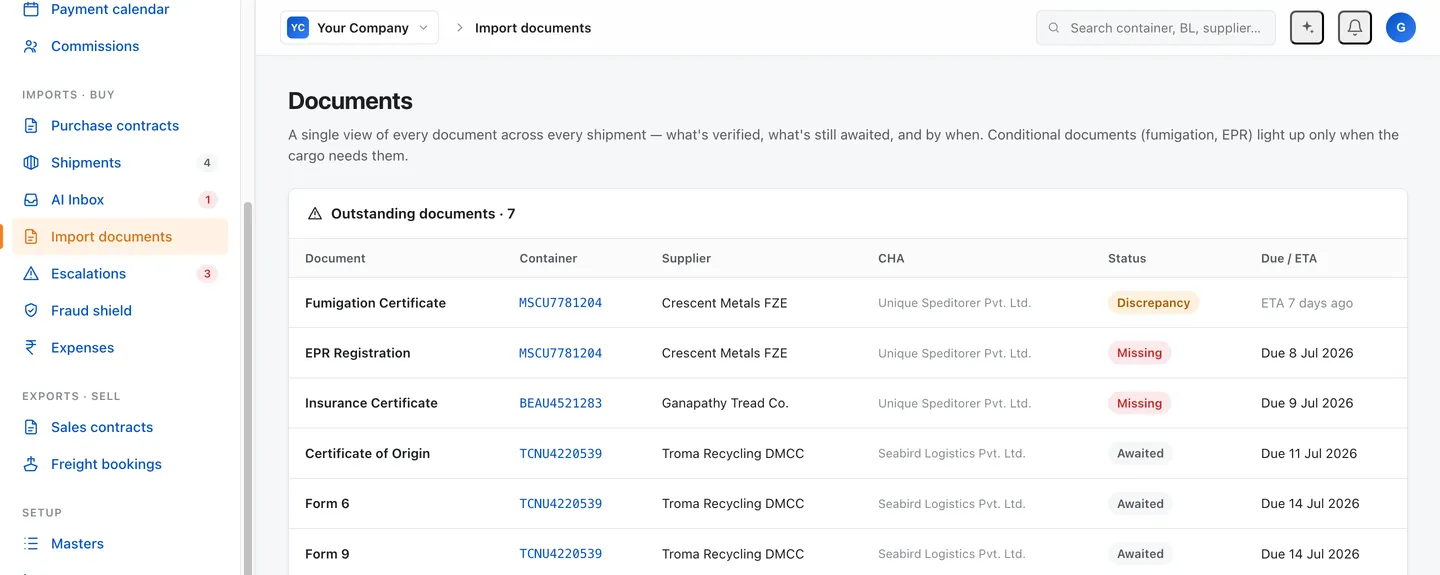
Diligence is a record or it is nothing. Which document was missing, who was asked for it, on what date, what they said, what was done next: that is the exhibit, and it is assembled either from a mailbox at the time it is needed or from import document checking software that keeps the dated chase as it happens. A desk that can produce the thread in an afternoon petitions inside 60 days. A desk that cannot, pays.
Questions traders ask
What are liquidated damages in customs?
The sum CBP claims under a customs bond when the importer fails to meet one of the bond's conditions — producing a document, completing an entry, redelivering goods, marking them. It is a contractual amount agreed in advance in the bond itself, which is why it is called liquidated: nobody has to prove a loss. 19 CFR part 172 governs the claim and the petition for relief from it.
How much are liquidated damages?
It depends on which condition was breached, and the bond says so in advance. Under 19 CFR 113.62(n), a default involving merchandise is "liquidated damages equal to the value of the merchandise involved in the default, or three times the value … if the merchandise is restricted or prohibited merchandise or alcoholic beverages". A default not involving merchandise is $1,000 each. A failure to deposit estimated duties is "two times the unpaid duties, taxes and charges estimated to be due or $1,000, whichever is greater". An Importer Security Filing violation is $5,000.
Are liquidated damages the same as a penalty?
No, and the difference decides where the paperwork goes. A penalty is assessed for a violation of law, under 19 U.S.C. 1592 for example. Liquidated damages are a claim on a contract — the bond — against the principal and the surety jointly and severally. 19 CFR part 172 covers petitions for relief from liquidated damages and from penalties secured by a bond; it expressly does not cover unsecured fines or penalties, seizures or forfeitures.
How long do I have to petition for relief from liquidated damages?
Sixty days. 19 CFR 172.3(b) requires a petition to be filed "within 60 days from the date of mailing to the bond principal the notice of claim". The Fines, Penalties and Forfeitures Officer may grant extensions. Where fewer than 180 days remain before the statute of limitations could be raised, the notice may specify a shorter period — but "not less than 7 working days". If the principal does not petition, CBP demands payment from the surety, which then has its own 60 days.
Who gets the notice of liquidated damages?
Both the principal and the surety, in writing, at the same time, under 19 CFR 172.1(a). That is the practical reason a claim moves fast inside a company: the surety learns of it on the same day the importer does, and the surety's appetite for the next bond depends on what happens next.
What gets liquidated damages cancelled?
Facts, filed in time. Under 19 CFR 172.11 the Fines, Penalties and Forfeitures Officer may cancel a claim "on such terms and conditions as, under law and in view of the circumstances, he or she will deem appropriate", and the petition under 172.2(c) has to set out the date and place of the violation and the facts relied on. In the marking case 19 CFR 134.54(c) spells out what those facts have to show: no bad faith, that the importer "has been diligent in attempting to secure compliance", and that redelivery was attempted by all reasonable means. A dated record of who was asked for what, and when, is the whole exhibit.
Sources
- 19 CFR § 113.62, Basic importation and entry bond conditions — paragraph (n), Consequence of default: "liquidated damages equal to the value of the merchandise involved in the default, or three times the value … if the merchandise is restricted or prohibited merchandise or alcoholic beverages"; (n)(3) "$1,000 for each default" where no merchandise is involved; (n)(4) "two times the unpaid duties, taxes and charges estimated to be due or $1,000, whichever is greater"; paragraph (d), the redelivery condition; paragraph (j), $5,000 per Importer Security Filing violation · checked 2026-10-11
- 19 CFR part 172, Claims for liquidated damages; penalties secured by bonds — § 172.1(a), written notice to principal and surety; § 172.2, the petition and what it must set out; § 172.3(b), "Petitions for relief must be filed within 60 days from the date of mailing to the bond principal the notice of claim for liquidated damages or penalty secured by a bond"; § 172.3(e), the short-period exception of "not less than 7 working days" where fewer than 180 days remain before the statute of limitations; § 172.4, the surety's own 60 days after demand; § 172.11, the Fines, Penalties and Forfeitures Officer's cancellation authority · checked 2026-10-11
- 19 CFR § 134.54, Articles released from Customs custody — liquidated damages "in an amount equal to the entered value of the articles not properly marked or redelivered" if 30 days pass from the notice of redelivery, and the relief conditions in paragraph (c): no bad faith, diligence "in attempting to secure compliance with the marking requirements", and redelivery attempted "by all reasonable means" · checked 2026-10-11
- US Customs and Border Protection, "Low-Value Shipments", proposed rule, 91 FR 64532 (8 October 2026), docket USCBP-2026-0040 — a basic importation and entry bond required for every type 11 and type 13 informal entry, with a proposed $1,000 minimum for liquidated damages under the conditions in 19 CFR 113.62. Comments due 7 December 2026 · checked 2026-10-11