Customs value: the number your duty is calculated on
Customs value is the figure duty is charged on, and under the WTO Valuation Agreement it is the transaction value: the price actually paid or payable for the goods, adjusted by the additions Article 8 lists and by nothing else. Freight and insurance are in or out depending on the importing country. Charges incurred after importation are out — but only if the invoice distinguishes them.
- Customs value
- The value of imported goods on which customs duty is assessed. Under the WTO Valuation Agreement the primary basis is the transaction value — the price actually paid or payable for the goods when sold for export — adjusted by the additions listed in Article 8 and by no others.
Customs value is the figure your duty rate is applied to. Get the rate right and the value wrong and the declaration is still wrong, which is why the value is the half of a classification argument that tends to cost more.
Almost every country you import into answers the question the same way, because almost every country applies the same agreement: the WTO Agreement on Implementation of Article VII of GATT 1994, usually shortened to the Customs Valuation Agreement. Singapore, the UAE, the United States, Australia and India all assess on that basis. The national wording differs. The structure below does not.
The primary basis is the transaction value
Article 1 states it in one sentence:
The customs value of imported goods shall be the transaction value, that is the price actually paid or payable for the goods when sold for export to the country of importation adjusted in accordance with the provisions of Article 8.
Two things follow that matter on a desk. The first is that the starting number is your own commercial invoice, not a reference price a customs officer looks up. The second is that the Agreement’s Interpretative Notes make the methods sequential: “The primary method for customs valuation is defined in Article 1 and imported goods are to be valued in accordance with the provisions of this Article whenever the conditions prescribed therein are fulfilled.” Only where transaction value cannot be established do Articles 2 to 7 apply, in order: identical goods, similar goods, deductive value, computed value, then a fallback.
Article 1 attaches four conditions to using your invoice price, and the one that catches traders is the last: the buyer and seller must not be related, or if they are, the transaction value has to be shown acceptable. Article 15.4 defines “related” broadly enough to include an employer and employee, anyone holding 5% or more of both businesses, and members of the same family.
Article 8 is a closed list
Article 8.1 sets out what is added to the price where the buyer incurred it and the price does not already include it: commissions and brokerage other than buying commissions, the cost of containers treated as one with the goods, packing, the apportioned value of materials, tools and design work the buyer supplied free or cheap, royalties and licence fees payable as a condition of sale, and any resale proceeds that flow back to the seller.
Two paragraphs at the end of the Article do more work than the list:
Additions to the price actually paid or payable shall be made under this Article only on the basis of objective and quantifiable data.
No additions shall be made to the price actually paid or payable in determining the customs value except as provided in this Article.
Paragraph 3 is a documentation rule wearing a valuation rule’s clothes. If you cannot produce the figure and show where it came from, the addition cannot properly be made. The reverse also holds, which is why an assist your engineering team shipped to the supplier without telling anybody is a valuation problem months later.
Freight and insurance are a national choice, not a fact
This is the part software gets wrong. Article 8.2 does not decide whether the duty base is CIF or FOB. It requires each member to decide, in its own legislation, and to provide for the inclusion or exclusion “in whole or in part” of the cost of transport to the port of importation, the loading, unloading and handling charges associated with it, and insurance.
So the duty base is a property of the destination, not of the shipment. A landed cost tracking system that hard-codes CIF is right in one country and quietly wrong in the next, which is why the landed cost calculator on this site asks you which base applies rather than assuming one.
What is outside the value, and the condition attached
The Interpretative Note to Article 1 lists three things the customs value does not include: charges for construction, erection, assembly, maintenance or technical assistance undertaken after importation; the cost of transport after importation; and the duties and taxes of the importing country.
All three carry the same proviso: they are excluded “provided that they are distinguished from the price actually paid or payable for the imported goods”. A supplier who bills one delivered figure with nothing broken out has handed you a duty base that includes the inland leg. The remedy is not a customs argument. It is an invoice that separates the lines, agreed before the goods ship.
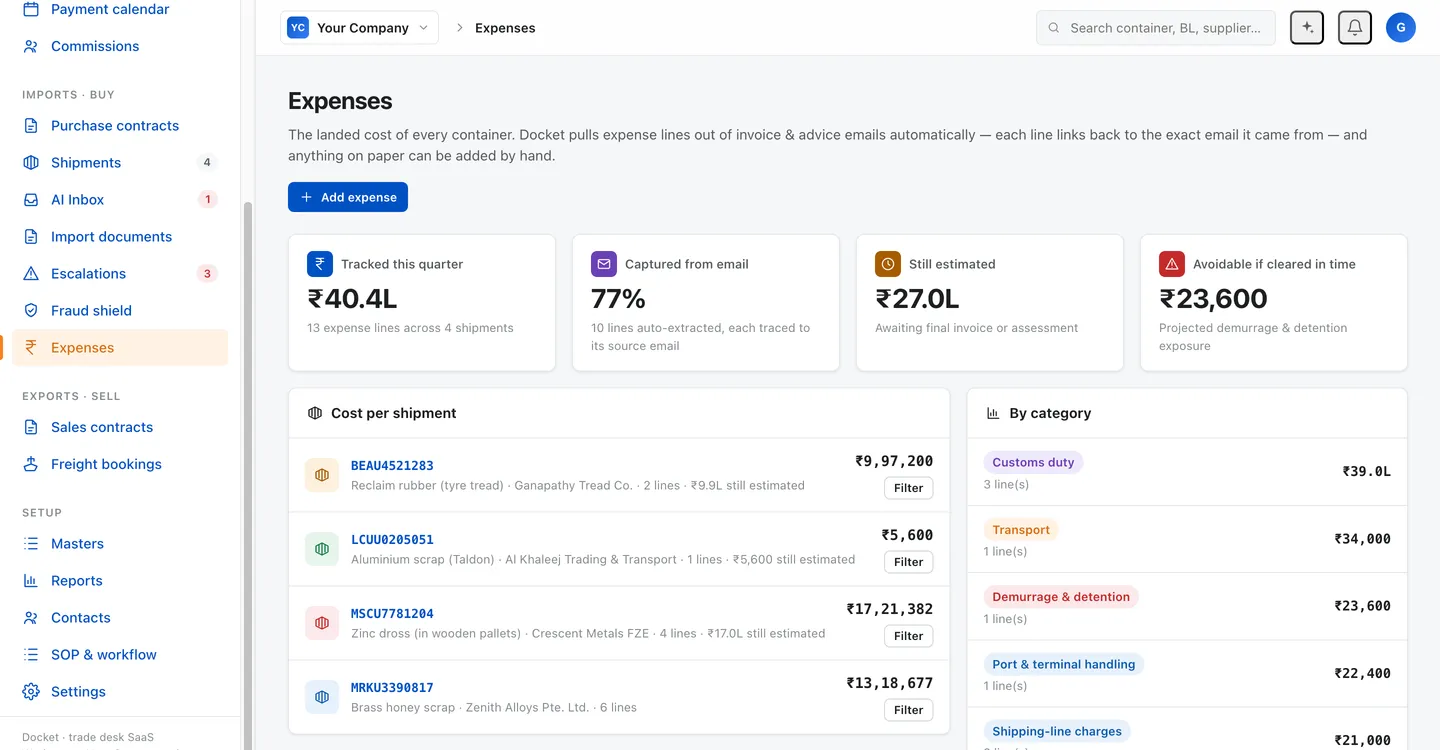
This is also the cleanest way to see where customs value stops and the landed cost of the consignment starts. Duty is the largest single line in landed cost and it is never part of customs value. Demurrage and detention are landed cost and Article 8 provides no addition for them. The two numbers answer different questions and a desk needs both.
And neither of them answers when the duty falls due, which is a third question with its own mechanism. Where the cargo is dutiable and goes into a licensed warehouse, duty and GST are suspended until the goods are removed for local use — so the value may be settled months before the payment is.
The exchange rate is not yours to pick
Article 9 settles a question that costs real money on a large consignment. Where currency must be converted, the rate is the one “duly published by the competent authorities of the country of importation”, and the moment it is taken from, time of exportation or time of importation, is set by each member.
Nhava Sheva makes the practical version of this visible: the terminal’s dollar-denominated charges are collected in rupees at the bank rate prevailing on the date the vessel entered port limits, not on the invoice date. Same principle, different tariff. Neither rate is the one your treasury desk booked.
You can make them explain it
Article 16 is short and under-used:
Upon written request, the importer shall have the right to an explanation in writing from the customs administration of the country of importation as to how the customs value of the importer’s goods was determined.
If a declaration has been reassessed upward and nobody will say on what basis, that sentence is the request to make.
What this means for the desk
The valuation questions that go wrong are not clever ones. They are an assist nobody recorded, a royalty nobody flagged as a condition of sale, a delivered price nobody asked the supplier to break out, and a related-party purchase nobody declared as one. Every one of them is knowable from the purchase contract and the invoice, weeks before the declaration is filed.
That is a chasing problem rather than a classification problem: someone has to ask the supplier for the breakdown and keep asking until it arrives. Getting the pack complete and correct before filing is what import document checking software is for, and the same deadline that governs it is the one the bill of entry has to be filed against.
Questions traders ask
What is customs value?
The value customs duty is calculated on. Under the WTO Agreement on Implementation of Article VII of GATT 1994, which the great majority of trading countries apply, the primary basis is the transaction value: "the price actually paid or payable for the goods when sold for export to the country of importation adjusted in accordance with the provisions of Article 8". Six further methods exist in a fixed order for the cases where transaction value cannot be used.
What is the difference between customs value and landed cost?
Customs value is what one authority charges duty on. Landed cost is what the consignment costs you by the time it is in your yard. They overlap and they are not the same set of lines: duty itself is part of landed cost and never part of customs value, and demurrage, detention and inland haulage after arrival sit in landed cost while Article 8 provides no addition for them. Working one out does not give you the other.
Are freight and insurance included in customs value?
That depends on the importing country, and the Agreement says so on purpose. Article 8.2 requires each member to provide in its own legislation for the inclusion or exclusion, in whole or in part, of the cost of transport to the port of importation, the loading and handling charges associated with it, and the cost of insurance. So the same cargo on the same invoice can carry a different duty base in two countries, which is why any tool that assumes a CIF base is wrong somewhere.
Which charges are left out of customs value?
Construction, erection, assembly, maintenance or technical assistance carried out after importation; the cost of transport after importation; and the duties and taxes of the importing country. The Interpretative Note to Article 1 attaches one condition to all three: they are excluded "provided that they are distinguished from the price actually paid or payable". An invoice that rolls them into one figure leaves them in the duty base.
Can I ask customs how they valued my goods?
Yes, in writing. Article 16 of the Agreement reads: "Upon written request, the importer shall have the right to an explanation in writing from the customs administration of the country of importation as to how the customs value of the importer's goods was determined."
Sources
- WTO Agreement on Implementation of Article VII of GATT 1994 (Customs Valuation Agreement), Articles 1, 8, 9 and 16 — the transaction value, the Article 8 additions, the member's choice on freight and insurance, the currency conversion rule and the importer's right to a written explanation · checked 2026-09-25
- WTO Customs Valuation Agreement, Annex I — Interpretative Notes, General Note and Note to Article 1, paragraph 3 — the sequential order of the valuation methods and the charges excluded only when distinguished from the price · checked 2026-09-25
- WTO, Customs Valuation technical information — the Agreement's status and coverage · checked 2026-09-25
- Docket operational baseline, import–export desk · checked 2026-08-08