Alcohol and tobacco import documents: Singapore
Singapore is a free port where almost nothing carries duty: only liquor, tobacco, motor vehicles and petroleum are dutiable. So this cargo is gated on money, not on a document. Duty is charged on alcohol content and on stick weight rather than on the invoice; cigarette weight is rounded up per stick; and the only pause button is a Licensed Warehouse licence held before arrival.
- HS chapters
- 22 — Beverages, spirits and vinegar · 24 — Tobacco and manufactured tobacco substitutes
- Beyond the standard pack
- Customs import permit through TradeNet, obtained before the goods are imported — an In-Payment permit where duty and GST are paid at import, or an In-Non-Payment permit where they are suspended · A Licensed Warehouse licence, held by your company over designated premises, if the duty is to be suspended rather than paid at import · A tobacco licence from the Health Sciences Authority before importing, wholesaling or retailing tobacco products · Singapore Customs approval of the Singapore Duty-Paid Cigarette mark, per brand and per variant, before the first import of that variant · Commercial invoice, packing list and bill of lading or air waybill, produced for verification on request · Certificate of origin where a preferential tariff is claimed on a dutiable import
Every other cargo page on this site turns on a document somebody else issues. Metal scrap needs a pre-shipment inspection certificate, plastic waste needs a measurement under a contamination threshold, used clothing turns on the eight-digit tariff line, food turns on who made it, medicines turn on who holds the registration, and cosmetics turn on a notification nobody evaluates.
Liquor and tobacco turn on money.
Singapore is a free port, and the practical meaning of that is narrower than the phrase suggests: duty applies to four categories of goods and no others. They are intoxicating liquors, tobacco products, motor vehicles, and petroleum products and biodiesel blends. Everything else is non-dutiable and carries GST only. Two of those four categories are this page’s cargo. So for almost every container arriving in Singapore the duty line on the entry is zero, and for this one it is usually the largest figure on the page.
The duty is charged on the contents, not on the invoice
The rates are specific, not ad valorem: a fixed amount per unit of weight or quantity rather than a percentage of what you paid. That single structural fact undoes the instinct a trader brings from every other cargo.
Liquors charged per litre of alcohol work like this:
Duties payable = Total quantity (litres) × (Customs duty + Excise duty) × Alcoholic strength (%)
Singapore Customs’ own example is 75 litres of stout at 5% strength, with customs duty of S$16 and excise duty of S$60 per litre of alcohol: 75 × (16 + 60) × 5% = S$285. The price paid for the stout appears nowhere. Negotiate the invoice down and you have moved the GST, which is levied on the CIF value including the duty, and left the duty exactly where it was.
Tobacco splits in two. Everything that is not a cigarette is weight × rate, so 100 kg of tobacco stems at S$535 per kg is S$53,500. Cigarettes are counted:
Duties payable = Number of sticks × Weight per stick (rounded up to nearest gramme) × Excise duty rate
That rounding is the sharpest edge on the page. Customs’ example takes 100 sticks weighing 1.5 g each at S$0.589 per gramme per stick, rounds the weight up to 2 grammes, and arrives at S$117.80. On the actual 1.5 g the figure would be S$88.35. The difference is a third of the duty bill, produced by a rule in the regulation rather than by anything on the commercial documents. And because the rounding is applied per stick, it does not average out over a large consignment. It scales with it.
A desk that computes the duty from the invoice value, the way it does for every other cargo, is not slightly wrong on this one. It is wrong in a direction it cannot see from the paperwork.
The only pause button is a licence, not a document
There is a way to land dutiable goods in Singapore without paying the duty, and it is the Licensed Warehouse Scheme. Approved companies may store imported dutiable goods for an indefinite period in premises licensed by Singapore Customs, and while the goods are inside, duty and GST are suspended. They become payable only when the goods are removed and enter Singapore’s customs territory for local use or consumption.
Read the first three words again. The scheme licenses approved companies over designated premises. It is not a document you obtain for a shipment, and it is not something a declaring agent can arrange while a box sits in the stack. A desk either holds the licence before the vessel sails or it does not have the option at all. The consequence of discovering that at the quay is a duty bill payable now rather than on sale, on cargo whose selling season may be months away.
The non-dutiable equivalent, the Zero-GST Warehouse Scheme, suspends GST only. Same shape, one tax.
On dutiable cargo, some permit fields cannot be amended at all
Every Singapore import needs a customs permit through TradeNet before the goods arrive. For most cargo a mis-keyed field is an inconvenience: amend it or cancel it and take a new one.
For this cargo it may not be available. Singapore Customs states plainly that some permit fields cannot be amended where controlled, prohibited or dutiable goods are involved, and publishes the non-amendable fields as a separate list. What remains when the field is locked is a set of corrective routes, none of which is “fix the entry”:
- a Short-Payment permit to account for a shortfall in duty or GST;
- a refund request through TradeNet for an overpayment or a payment made on the wrong permit;
- a replacement permit where the wrong importer was declared, and on an In-Non-Payment approved-premises permit only the importer name and UEN may change, with every other field held;
- a voluntary disclosure where none of the above applies.
Each of those is a process with a queue. And once the permit has been used for cargo clearance, amendment or cancellation is generally not allowed at all. Meanwhile the terminal storage charge and the carrier’s free time are both running on their own clocks, which care nothing about which form is in which queue.
Every stick, and the approval is per variant
Since 1 January 2009 every cigarette intended for sale and consumption in Singapore must carry the Singapore Duty-Paid Cigarette mark, and the requirement applies to every individual stick.
The operational part is the approval that stands in front of it. Importers must obtain Singapore Customs’ approval before importing any new cigarette brand or variant for sale in Singapore, and the submission is unusually physical: clear photographs of the stick against a ruler, plus the measured specifications: the distance of the marking from the lighted end, the height of the block letters, the typeface and colour, and the height, thickness and spacing of the vertical bars. Customs responds within 7 working days provided the information is complete.
The unit of approval is the variant, which is the same trap the cosmetics page describes under a different regulator: a brand extension is a new application, not a line on an existing one. A desk that treats “we already import this brand” as covering a new variant has a container arriving against an approval that does not reach it.
Tobacco carries a licence on top. The Health Sciences Authority requires a licence before importing, wholesaling or retailing tobacco products, and the statute behind it moved this year: the Tobacco (Control of Advertisements & Sale) Act was renamed the Tobacco and Vaporisers Control Act from 1 May 2026, consolidating the vaporiser frameworks with enhanced penalties for import and supply.
The penalty clause reads differently when the cargo is dutiable
Making an incorrect declaration under section 128(1)(a) of the Customs Act carries a fine of up to S$10,000 or the equivalent of the duty and GST payable, whichever is higher, or imprisonment of up to 12 months, or both. The same penalties attach to an incorrect or incomplete declaration of value, to failing to declare goods, and to failing to produce trade documents on request.
For most cargo the S$10,000 is the operative half of that sentence, because the GST on a container is rarely larger. For liquor and tobacco the “whichever is higher” clause is the one that bites: specific duty rates on a full container run well past S$10,000, so the identical clerical error carries a materially larger exposure here than on any other cargo this site covers. Minor offences may be compounded up to S$5,000 each; the serious ones are prosecuted.
Singapore Customs’ own list of common offences is worth reading as a checklist rather than as a warning, because every item on it is a document-assembly failure: insurance charges omitted when declaring the GST payment permit, free gifts from the supplier not declared, undeclared goods found inside the container, and the invoice, bill of lading or certificate of origin not produced for verification on request.
What a desk has to hold together
Strip out the regulator and what is left on this cargo is arithmetic and sequencing, which is exactly the work that goes wrong quietly.
The duty figure has to be computed from the alcohol content or the stick weight before the vessel arrives, because it decides whether the shipment goes to a licensed warehouse or straight to duty-paid. The licence and the SDPC approvals have to exist already, per variant, which means somebody has to notice that a new variant is on the packing list. The permit has to be right the first time, because the amendment route may be closed. And the invoice, packing list and bill of lading have to be producible on request, not findable eventually.
None of that is a document anyone issues. All of it is chasing, checking and dating, and it is the part of the job that demurrage and detention software that counts the storage clock has to be told about rather than told by. Document packs routinely run about eight days late against free time, and a week of demurrage on one container has cost about US$12,000, which on this cargo arrives on top of a duty bill that was always going to fall due.
The jobs Docket does on this cargo
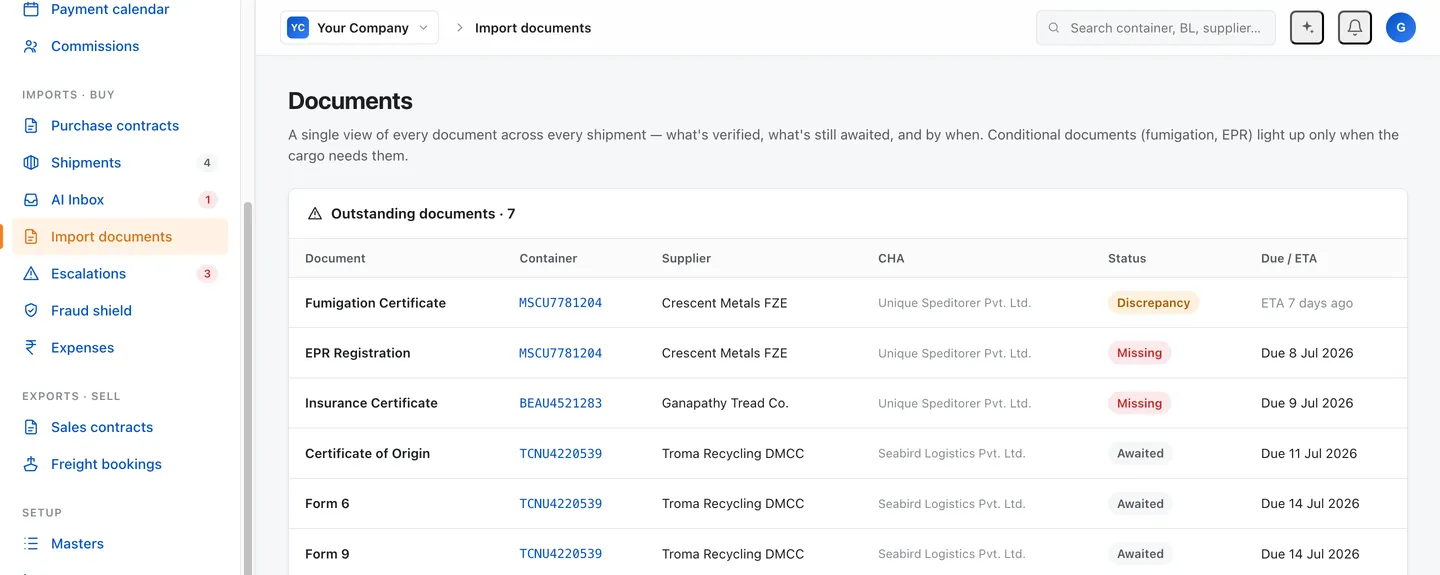
- Checks every document is present & correct — BL, invoice, COO, packing list, insurance — verified against your checklist, per container.
- Tracks every expense — traced to its email — Duty, port charges, CHA fees, detention — pulled from invoice emails, so each container's landed cost is live. Every line links to the email it came from.
- Builds your payment calendar itself — Loading confirmed → payables scheduled from your terms; receivables follow the sales contract. Currencies kept separate.
- Logs everything in a full audit trail — Every check, reminder, commitment and dollar on record — with the raw email behind it, one click away.
- Chases suppliers daily — schedules, prices, docs — Loading schedules until confirmed, prices every morning, and whoever owes the missing document.
Questions importers of this cargo ask
What documents do I need to import alcohol into Singapore?
Fewer than you would expect, because there is no product approval to obtain. You need a customs import permit through TradeNet before the goods arrive, the commercial invoice, packing list and bill of lading to produce on request, and a certificate of origin if you are claiming a preferential tariff. What there is instead of a document set is a duty bill, and the one thing that defers it — a Licensed Warehouse licence — is held by the company over approved premises, not issued per shipment.
Which goods are dutiable in Singapore?
Four categories and no others: intoxicating liquors, tobacco products, motor vehicles, and petroleum products and biodiesel blends. Everything else imported into Singapore is non-dutiable and carries GST only, levied on the CIF value including duties where any apply. That is why alcohol and tobacco behave unlike every other cargo on this site: for almost all Singapore imports the duty line is zero, and for these two it is usually the largest number on the entry.
How is liquor duty calculated in Singapore?
On alcohol content, not on price. Where a liquor is charged per litre of alcohol, duties payable are the total quantity in litres multiplied by the customs and excise duty rates multiplied by the alcoholic strength. Singapore Customs' own worked example takes 75 litres of stout at 5% strength with customs duty of S$16 and excise duty of S$60 per litre of alcohol, giving 75 × (16 + 60) × 5% = S$285. Nothing in that formula is the price you paid, so negotiating the invoice down moves the GST and leaves the duty where it was.
How is cigarette duty calculated, and why is it more than the weight?
Duties payable are the number of sticks multiplied by the weight of each stick multiplied by the excise duty rate — with the weight rounded up to the next gramme. Singapore Customs' example is 100 sticks weighing 1.5 g each at S$0.589 per gramme: the weight is rounded to 2 grammes and the duty is 100 × 2 × 0.589 = S$117.80, where the actual 1.5 g would have come to S$88.35. The rounding is applied per stick, so it does not average out across a consignment — it scales with it.
What is a Licensed Warehouse and when does it help?
It is the only way to hold dutiable goods in Singapore without paying the duty. The Licensed Warehouse Scheme lets approved companies store imported dutiable goods for an indefinite period in premises licensed by Singapore Customs, with duty and GST suspended while the goods are inside, payable only when they are removed and enter customs territory for local use. The catch is in the word approved: the scheme licenses the company and the designated premises, so it is a thing you either have before the vessel arrives or do not have at all.
Can I fix a mistake on a dutiable import permit?
Often not by amending it. Singapore Customs states that some permit fields cannot be amended where controlled, prohibited or dutiable goods are involved, and lists the List of Non-Amendable Fields separately. The routes that remain are a Short-Payment permit to account for a shortfall in duty or GST, a refund request through TradeNet for an overpayment or a payment on the wrong permit, a replacement permit where the wrong importer was declared, and a voluntary disclosure where none of those applies. All of them take time, and the container is at the terminal while they do.
What does the Singapore Duty-Paid Cigarette mark require?
That every individual cigarette stick intended for sale and consumption in Singapore carries the SDPC mark, which has been the position since 1 January 2009 under the Customs Regulations. The part that catches a desk is the approval step: importers and manufacturers must obtain Singapore Customs' approval before importing or producing any new cigarette brand or variant for sale in Singapore, submitting photographs of the stick against a measuring device and the full mark specifications, and Customs responds within 7 working days provided the information is complete. The unit of approval is the variant, so a brand extension is a new application.
What is the penalty for getting a dutiable declaration wrong?
Making an incorrect declaration under section 128(1)(a) of the Customs Act carries a fine of up to S$10,000 or the equivalent of the duty and GST payable, whichever is higher, or imprisonment of up to 12 months, or both. For most cargo the S$10,000 is the operative half of that sentence. For dutiable cargo the duty itself can be the larger number, so the same clerical error on a container of spirits is a materially bigger exposure than on a container of clothing. Singapore Customs may compound minor offences up to S$5,000 per offence.
How does dutiable cargo turn into demurrage?
Through the payment, not through the paperwork. There is no product approval to wait for, so the thing that strands a box of liquor or tobacco is a permit that cannot be amended, a duty figure nobody computed before arrival, or a Licensed Warehouse arrangement that was assumed rather than held. Document packs routinely run about eight days late against free time, and a week of demurrage on one container has cost about US$12,000 — on top of a duty bill that was always going to be due.
Sources
- Singapore Customs, Duties and Dutiable Goods Overview — customs duty is levied on imported goods and excise duty on goods manufactured in or imported into Singapore; "Goods not subject to customs or excise duty are non-dutiable, although GST may still apply unless exempted"; duties are charged at an ad valorem rate (a percentage of the customs value) or a specific rate (a fixed amount per unit of weight or quantity); "There are four categories" of dutiable goods: intoxicating liquors, tobacco products, motor vehicles, and petroleum products and biodiesel blends. Worked examples: liquors charged per litre of alcohol are "Total quantity (litres) × (Customs duty + Excise duty) × Alcoholic strength (%)", so 75 litres of stout at 5% strength with customs duty S$16 and excise duty S$60 per litre of alcohol gives 75 × (16 + 60) × 5% = S$285; liquors charged on dutiable content are "Dutiable content (kg) × Customs duty rate", so 1 kg of alcoholic composite concentrate containing 0.2 kg of powdered alcohol at S$113 per kg gives S$22.60; all tobacco products except cigarettes are "Weight (kg) × Excise duty rate", so 100 kg of tobacco stems at S$535 per kg gives S$53,500; cigarettes are "Number of sticks × Weight per stick (rounded up to nearest gramme) × Excise duty rate", so 100 sticks weighing 1.5 g each at S$0.589 per gramme per stick are rounded to 2 grammes and give 100 × 2 × 0.589 = S$117.80. Last updated on 9 March 2026 · checked 2026-10-07
- Singapore Customs, List of Dutiable Goods — cigarette duty is "Total sticks × Weight of each stick (rounded up to next gram) × Excise duty rate", with the worked example "100 sticks weighing 1.5 g each; excise duty = S$0.589/g: Duties payable = 100 × 2 × 0.589 = S$117.80"; non-cigarette tobacco is total weight × rate, so 100 kg of tobacco stems at S$535/kg gives S$53,500. Last updated on 9 March 2026 · checked 2026-10-07
- Singapore Customs, Depositing Goods in Licensed or Zero-GST Warehouses — "When you store goods in a licensed or zero-GST warehouse, duty and GST are suspended until the goods are removed for local use. The type of warehouse determines which taxes are deferred." The Licensed Warehouse (LW) Scheme "allows approved companies to store imported dutiable goods for an indefinite period in a designated area licensed by Singapore Customs, known as licensed premises"; the dutiable goods it names are liquor, tobacco, motor vehicles, petroleum and biodiesel blends; "Duty and Goods and Services Tax (GST) are suspended while the goods are in the licensed warehouse" and "You will only pay duty and GST when the goods are removed from the licensed warehouse and enter Singapore's customs territory for local use or consumption." The Zero-GST Warehouse Scheme covers non-dutiable goods and suspends GST only. Last updated on 25 March 2026 · checked 2026-10-07
- Singapore Customs, Import Procedures Overview — "All goods imported into Singapore are regulated under the Customs Act, the Goods and Services Tax (GST) Act and the Regulation of Imports and Exports Act (RIEA)"; "Imported goods are subject to GST and/or duty, and a customs permit is required to account for the import and tax payment"; "Importers must obtain the relevant customs permit before the goods are imported into Singapore"; prevailing GST is levied on the CIF value, "which includes duties (if dutiable) and all costs incidental to the sale and delivery of the goods into Singapore". On permit errors: "Some permit fields cannot be amended if controlled, prohibited or dutiable goods are involved", with a separate List of Non-Amendable Fields; a wrong value of goods is corrected by taking up a Short-Payment permit to account for the shortfall, over-payment or wrong payment by a refund request via TradeNet, a wrong importer by a replacement In-Payment permit, and "If none of the above corrective options apply, lodge a Voluntary Disclosure"; amendment or cancellation "is generally not allowed once the permit has been used for cargo clearance". On penalties: making an incorrect declaration under section 128(1)(a) of the Customs Act carries a "Fine up to S$10,000 or the equivalent of duty/GST payable (whichever is higher), or imprisonment up to 12 months, or both", with the same penalties for incorrect or incomplete declaration of value under section 128(1)(c), failure to declare goods under section 128B(1)(a), failure to declare value under section 128B(1)(b) and failure or refusal to produce trade documents under section 128C; "For minor offences, Singapore Customs may compound offences up to S$5,000 per offence." Named common offences include insurance charges omitted when declaring a GST payment permit, free gifts from overseas suppliers not declared, undeclared goods found inside containers, and invoice, bill of lading or certificate of origin not produced for verification upon request · checked 2026-10-07
- Singapore Customs, Singapore Duty-Paid Cigarette Mark — "Since 1 January 2009, all cigarettes intended for sale and consumption in Singapore must bear the Singapore Duty-Paid Cigarette (SDPC) mark, in compliance with the Customs Regulations" and "This applies to every individual cigarette stick"; "Importers and manufacturers must obtain approval from Singapore Customs before importing or producing any new cigarette brand or variant for sale in Singapore"; the application requires clear photographs of the cigarette sample placed against a ruler or measuring device and detailed SDPC mark specifications for each sample, including the distance from the lighted end, the height of the block letters, typeface and colour of the marking, and the height, thickness, spacing, typeface and colour of the vertical bars; "Singapore Customs will review your submissions and respond within 7 working days, provided all information is complete." Last updated on 24 February 2026 · checked 2026-10-07
- Health Sciences Authority, Tobacco regulation — "You must apply for a licence before importing, wholesaling or retailing tobacco products in Singapore"; "The Tobacco and Vaporisers Control Act (TVCA), renamed from the Tobacco (Control of Advertisements & Sale) Act from 1 May 2026, consolidates enforcement, rehabilitation, and educational frameworks for vaporiser users — including those involving specified psychoactive substances (SPS) such as etomidate — with enhanced penalties for possession, use, import, and supply of vaporisers" · checked 2026-10-07
- Docket operational baseline, import–export desk — desk time per container and the document-pack lateness against free time · checked 2026-10-07