Certificate of origin: the paper that sets your duty rate
A certificate of origin states the country where goods were produced. Non-preferential certificates prove nationality for quotas and trade remedies. Preferential certificates claim a lower or zero duty rate under a trade agreement. The preferential kind is worth real money, is time-limited, and gets refused for small mismatches. It is the document most often missing when the box lands.
- Certificate of Origin
- A document certifying the country in which goods were produced, issued by a chamber of commerce or a designated authority, used by customs to apply duty rates, quotas, trade remedies and preferential tariff treatment.
A certificate of origin states the country where goods were produced. Customs uses it to decide what you pay. The non-preferential kind proves nationality for quotas, anti-dumping duty and marking rules. The preferential kind claims a lower or zero rate under a trade agreement, and on a container of steel or plastics that single sheet is often worth more than the freight.
What is a certificate of origin?
Origin is not where the container was loaded and it is not where the seller is registered. Origin is where the goods were obtained or last substantially transformed. A trader buying Turkish-rolled coil from a Dubai seller shipping out of Jebel Ali has Turkish-origin goods, a UAE contract and an Emirati port. Customs cares about the first one.
The certificate is issued by a chamber of commerce or by an authority the importing country recognises, on the strength of a declaration by the exporter and the evidence behind it: manufacturer’s invoices, mill certificates, production records, bills of materials. The issuer certifies the declaration. It does not visit the mill.
Two families exist and they do different jobs.
Non-preferential certificates answer the question “what nationality are these goods?” That answer drives quota counting, anti-dumping and countervailing duty, government procurement rules, marking requirements and trade sanctions. Everyone issues them and almost every shipment can get one.
Preferential certificates answer a narrower question: “do these goods qualify for the reduced rate under this specific agreement?” Form D under the ASEAN Trade in Goods Agreement. EUR.1 movement certificates under the European Union’s agreements. Form A under the old Generalised System of Preferences arrangements. Each one is tied to an agreement, has its own form, its own rules and its own issuing authorities.
Preferential or non-preferential: which one do you need?
| Non-preferential | Preferential | |
|---|---|---|
| What it proves | Nationality of the goods | Eligibility for a reduced or zero duty rate |
| Legal basis | National law, WTO Agreement on Rules of Origin | A specific free trade agreement between the two countries |
| Typical issuer | Chamber of commerce | Designated authority named in the agreement |
| Form | General format, varies by country | Prescribed form: Form D, EUR.1, and others named in the agreement |
| Money at stake | Indirect: quotas, trade remedies, marking | Direct: the duty line on your bill of entry |
| Rules to satisfy | Where it was made | Where it was made, plus origin criteria, direct consignment and validity windows |
| Consequence of a defect | Query, delay | Full duty paid, and the difference is rarely refundable in practice |
The trap sits in the last row. A defective non-preferential certificate slows a clearance. A defective preferential certificate turns a zero-rated consignment into a full-rate one, and by the time you find out, the goods are cleared and the money is gone.
What has to be true for a preferential certificate to hold?
Three conditions, and all three fail quietly.
The goods have to meet the origin criterion. Trade agreements define origin either as wholly obtained, or as a change in tariff classification at the heading or subheading level, or as a minimum share of regional value content, or as a specific processing rule for that product. The World Customs Organization’s Harmonized System is what those rules are written against, so classification errors become origin errors. Get the HS code wrong and you can satisfy a rule that does not apply to your goods.
The consignment has to travel the way the agreement allows. Most agreements require direct consignment, with a carve-out for transhipment where the goods stay under customs control and undergo nothing beyond unloading, reloading and preservation. Route the box through a third-country warehouse for repacking and the preference dies even though the goods never changed.
The certificate has to be valid and present. Preferential certificates carry a validity window from the date of issue. Retroactive issue is allowed under many agreements and is flagged on the face of the document, and a retrospectively issued certificate draws more scrutiny than a clean one. If it is not with the customs house agent when the entry is filed, you either wait or you pay full rate and argue later.
Why does the certificate of origin turn up late?
Because it is the one document in the pack that a third party has to sign.
The commercial invoice is written by the seller. The packing list is written by the seller. The bill of lading comes from the carrier at loading. The certificate of origin needs the seller to compile evidence, submit it to a chamber or an authority, wait for issue, and then courier the result. That queue sits outside the seller’s control, which means it sits well outside yours.
Document packs routinely run about eight days late against port free time, and a week of demurrage on one container runs about US$12,000. The certificate of origin is the paper most often at the back of that queue.
There is a second-order cost that does not show up as demurrage. When the certificate is missing, the honest move is to file the entry at full duty to get the box out, then chase a refund. The refund route exists on paper in most jurisdictions and is slow enough in practice that desks write the money off.
What gets a certificate of origin rejected?
Customs reads the origin certificate against the invoice, the packing list and the bill of lading at the same time. Any disagreement between them is a query.
The descriptions differ. The invoice says “HDPE granules”, the certificate says “plastic raw material”, and an officer has to decide whether these are the same goods.
The quantity or weight differs. 25.00 MT on one document and 25.400 MT on another. Gross and net used interchangeably across two documents.
The HS code on the certificate does not match the code on the entry. This one is fatal for preference, because the origin rule is written against the code.
The consignee is a different legal entity from the importer on the bill of entry. Group companies get filed as one name in the seller’s system and as another in yours.
The signature or the issuing body is not on the importing country’s list of registered specimen signatures and seals. This is invisible from your side until it is refused.
The vessel and voyage details on the certificate do not match the bill of lading, which breaks the direct-consignment evidence.
Every one of these is checkable before the container sails, on a screen, in a few minutes. Almost nobody checks them before the container sails.
How do you run the certificate of origin properly?
Decide origin at contract time. Put the agreement, the form type, the origin criterion and the issuing authority into the purchase contract as named terms. “Certificate of origin to be provided” is not a term. “Form D under ATIGA, issued by the designated authority, origin criterion stated, original couriered within 7 days of bill of lading date” is a term.
Ask for the draft before issue. A chamber-issued certificate is expensive to amend and slow to reissue. A draft costs an email.
Check it against the invoice, the packing list and the bill of lading as one set. Same description, same quantities, same HS code, same parties, same vessel and voyage.
Set the courier deadline off the last free day, not off the shipment date.
Keep the evidence. Origin verification requests arrive months or years after clearance, and the importer carries the exposure even though the exporter made the declaration. Mill certificates and production records that were easy to get during the deal are hard to get two years later.
Where Docket sits
Docket does not issue certificates of origin. A chamber of commerce or a designated authority does that, and no software gets to skip that queue.
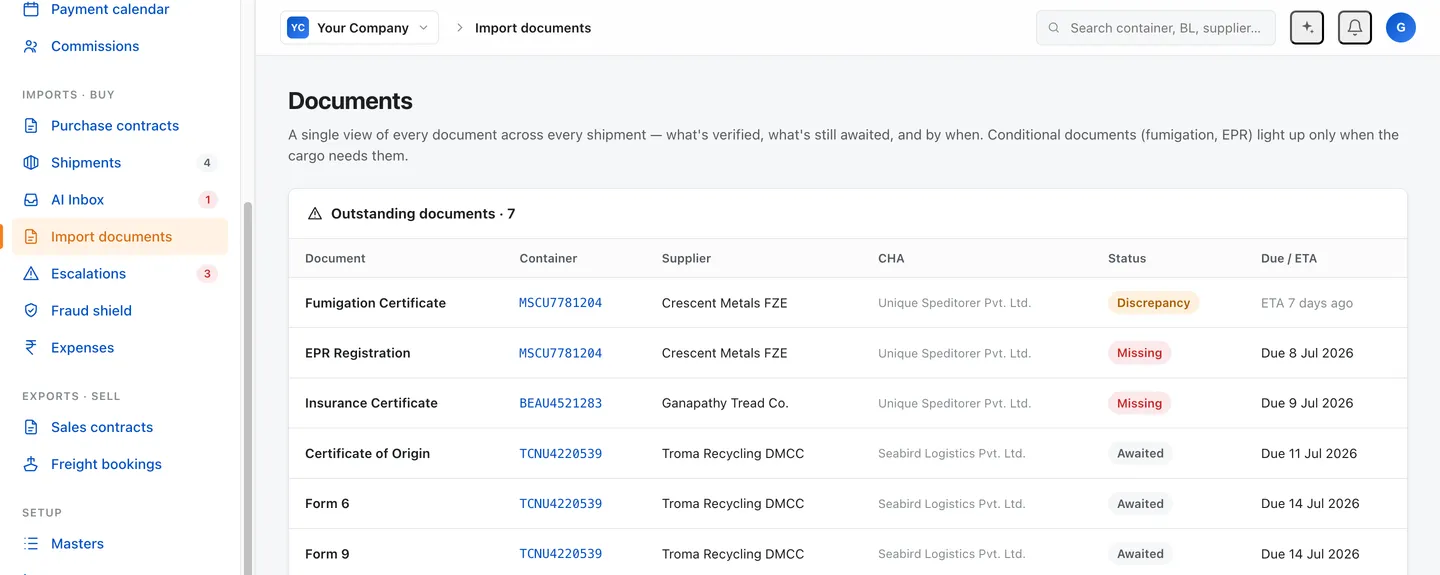
What Docket does is treat the certificate as a dated obligation instead of an attachment, which is how its import document checking works on every paper in the pack. It reads the purchase contract, works out which documents the shipment needs and who owes each one, and then chases them daily. It checks the certificate against the invoice, the packing list and the bill of lading and flags the fields that disagree before the entry is filed. When the exporter stops replying, it escalates on channels they already use: email, then WhatsApp at 24 hours, SMS at 48, an AI voice call at 72.
The chase runs about 2.2 hours per container, of which supplier follow-ups took 30 to 45 minutes and doc-pack preparation and checking took 45 to 90 minutes. Docket automates about 85% of the chasing and about 65% of the doc-pack drafting.
The goal is one date. Have the certificate in the customs house agent’s hands before the entry has to be filed, so the container clears at the rate you priced the deal at.
Sources
- WTO Agreement on Rules of Origin (Marrakesh Agreement, Annex 1A)
- World Customs Organization, Revised Kyoto Convention, Specific Annex K (Origin)
- World Customs Organization, Harmonized System Nomenclature (tariff classification underpinning origin rules)
- Docket operational baseline, import–export desk