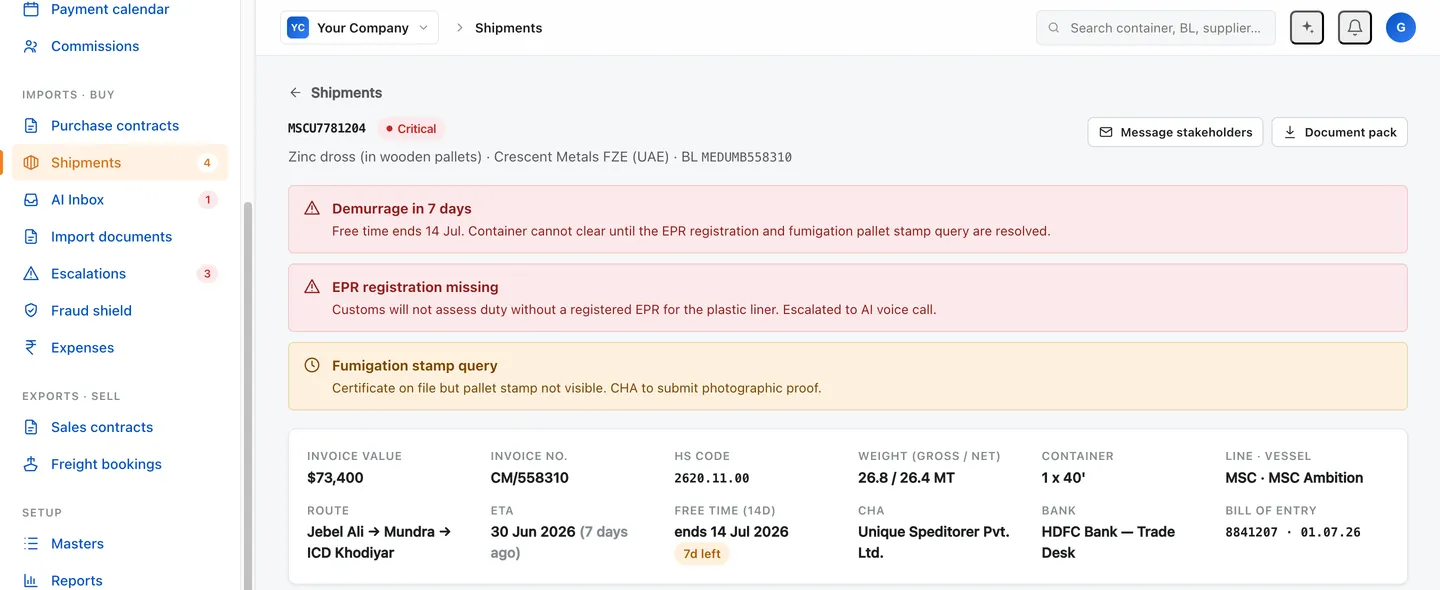
Free time: the clock that starts without asking you
Free time is the grace period a carrier or terminal allows before demurrage and detention start charging. It begins at discharge, not when you are notified, and it counts calendar days. It is set by tariff or by your service contract, so it differs by carrier, port, direction and equipment. Document packs routinely run about eight days late against it.
- Free time
- The grace period allowed before demurrage or detention begins to accrue, measured in calendar days from discharge and set by the carrier's tariff or by the importer's service contract.
Free time is the only part of the demurrage equation you can settle before the cargo moves, and the part most importers never look at until they are already paying. It starts at discharge. It counts calendar days. It is negotiable at contract time and almost never negotiated.
Two clocks, and one of them is rigged
Every shipment runs two clocks at once.
The port’s clock starts on discharge. It does not know or care whether your exporter has couriered the originals, whether the bank has released documents against payment, or whether the fumigation stamp arrived. It counts calendar days, weekends and public holidays included unless the tariff says otherwise.
The paperwork clock starts whenever the last party in the chain decides to act. There are usually six of them: exporter, bank, carrier, terminal, CHA, transporter. None of them reports to you, and none of them is measured on the date that matters to you.
When the second clock loses, you pay for a container that was never physically delayed. On a normal desk, document packs run about eight days late against free time. That is not a story about congestion. That is a story about a PDF.
When does free time start, and when does it stop?
Three timestamps decide the whole thing, and only one of them is under your control.
Start: discharge. The box comes off the vessel and onto the stack. Some tariffs run from the discharge of the container, some from the completion of vessel discharge, and the difference can be a day or two on a big call. Read which one yours says.
Stop, for demurrage: gate-out. The box leaves the terminal. The equipment interchange receipt at the gate is the timestamp that counts, not the delivery order date. The same event starts the detention clock, so gate-out does not end the charges — it changes which one is running.
Stop, for detention: empty-in. The empty is returned to the depot the carrier nominates and accepted there. A depot that turns your truck away has not stopped your clock.
Notice what is missing from that list. The notice of cargo availability is not a trigger. Customs assessment is not a trigger. Your supplier finally couriering the originals is not a trigger. None of the events your team actually watches has any effect on the clock that bills you.
Free time is not a standard number
This is the most common mistake in the whole subject. Free time is set by the carrier’s tariff or, better, by your service contract, and it varies along five axes.
| Variable | Why it moves free time |
|---|---|
| Carrier | Two lines calling the same berth publish different tariffs, and a line short of equipment on the lane gives fewer days |
| Port and terminal | Gateway ports and inland depots run different allowances, and moving to an ICD can change the count |
| Direction | Import and export allowances are set separately and are rarely equal |
| Equipment | Dry, reefer, flat rack and open top differ. Reefers are the tight end, because plug points are scarce |
| Your contract | Negotiated free time overrides the published tariff, and it is free to ask for |
Because it varies, we publish free-time data per port only where we hold a sourced row for a named carrier. Where we do not have it, the page says so rather than showing a number that would be wrong for your lane. A confidently wrong free-time table is worse than an empty one, because somebody will plan a shipment against it.
The terminal’s own allowance is a different matter, because a port tariff is a published document rather than a negotiated term. Jebel Ali, for instance, allows an ordinary import container ten free days of storage counted from discharge before the terminal starts charging for the ground it stands on — the Jebel Ali terminal free time and storage rates are set out in full. That allowance is not your carrier’s, and an importer who clears late pays both.
Demurrage free time, detention free time, or a combined allowance?
Carriers structure the grace period in one of two shapes, and the shape changes how a slow document pack hurts you.
| Separate allowances | Combined allowance | |
|---|---|---|
| How it is granted | X days inside the terminal, Y days outside | One pool of days covering both sides of the gate |
| Slow paperwork costs you | Demurrage days only | Demurrage days and the turnaround days you were counting on |
| Slow turnaround costs you | Detention days only | The same shared pool |
| Common on | Merchant haulage bookings | Carrier haulage bookings |
| What to check in the tariff | Two separate day counts | One count, and where the clock switches charge type |
Under a combined allowance the two failures compound. A pack that lands three days late does not just cost three days of demurrage. It eats three days your transporter needed to get the empty back, and the charge that follows is detention, billed at a different rate, by the same carrier, on the same box. Importers read that second invoice as a separate problem. It is the same problem, arriving twice.
How do I find out what my free time actually is?
Ask three questions, and insist on paper for each.
1/ Which document governs? The carrier’s published tariff, or a service contract you signed. If you have a contract, the contract wins. If nobody on the desk can produce it, you are on tariff, whatever anybody remembers agreeing.
2/ What are the day counts, per direction, per equipment type? Not “about a week.” The number, and whether it counts calendar days or working days.
3/ What are the escalation steps after the free days end? Almost every tariff steps the rate up as the days run. The headline per-diem is the cheap one. Day nine is the one that shows up on the invoice.
The Ocean Shipping Reform Act of 2022 amended the Shipping Act of 1984 and pushed the Federal Maritime Commission to write billing rules. The resulting Demurrage and Detention Billing Requirements rule prescribes what an invoice must contain, when it has to be issued, and how long the billed party has to dispute it. Those elements include the free time itself and the dates it ran. (The part of that rule limiting who could be billed, 46 CFR 541.4, was set aside in September 2025 and removed in January 2026. Everything else stands.) If your carrier’s invoice does not tell you which free-time allowance it applied and when it started, that is a question you are entitled to ask.
How to actually use free time
Four things, in order of how much they pay back.
1/ Count backwards from the last free day. Call the last free day D. Every document deadline on the shipment is expressed as D minus something, and the owner of each document is named. Most desks do the opposite: they count forwards from the booking, which produces a plan that is comfortable in week one and impossible in week four.
2/ Put the Bill of Entry deadline before D, not on it. In India the filing is due by the end of the day before the vessel arrives, which sits ahead of the free-time clock entirely. Any plan that treats customs as a step after arrival is already late.
3/ Chase on a schedule, not on a feeling. The pattern that works is fixed and boring. Ask, then follow up at 24 hours on a channel the counterparty actually reads, at 48 hours on another, and put a voice call on it at 72. Silence is the signal, and silence has to trigger something on its own.
4/ Negotiate the days at contract time. Extra free days cost a carrier little on a lane where they want your volume, and they are worth more than a small rate reduction if your document pack is habitually late. Also negotiate the Incoterm: buying FCA or FOB and controlling the carriage yourself means you pick the line and the free time, instead of inheriting whatever your supplier’s forwarder agreed with a carrier you have no relationship with.
What this costs when it goes wrong
Free time is short. Desk capacity is shorter.
Docket’s operational baseline puts about 2.2 hours of work on a single container: 30 to 45 minutes of supplier follow-ups, 45 to 90 minutes of document-pack preparation and checking, 20 to 30 minutes of status tracking and reporting, and 10 to 15 minutes of payment tracking. On top of that sits a fixed 1 to 2 hours a day of price collection from suppliers, which belongs to the desk rather than to any one container.
A 500-container desk consumes about 1,100 hours a month on that work. Seven people at about 176 hours each provide 1,232 hours. The desk runs at roughly 90% capacity on grunt work before anyone buys or sells anything.
That is why packs run eight days late. Not carelessness. Arithmetic. There is no spare hour in the month for the fourth follow-up to a supplier who has stopped replying, so the fourth follow-up does not happen, so the pack lands after D.
Common misconceptions
“Free time starts when I get the arrival notice.” It starts at discharge. The notice is a courtesy and it is frequently late.
“Weekends do not count.” Most tariffs count calendar days. Check yours before you plan a Friday discharge.
“Free time is five days.” There is no standard. It is per carrier, per port, per direction, per equipment type, per contract.
“Our forwarder gets us extra days.” Sometimes, on their own contract, for their own volume. Whether any of that reaches your shipment is a question with a written answer. Ask for it.
“Extending free time is expensive.” Asking is free. Carriers trade free days against volume commitments all the time, and a desk that never asks pays the tariff by default.
Where Docket sits
Docket does not grant free time, does not talk to the terminal, and cannot extend a clock that has already started. Free time is the carrier’s to give and yours to negotiate.
What Docket does is treat the last free day as the fixed point everything else is planned against; that is the job of its free time tracking software. It reads the purchase contract, derives D from discharge, builds the document checklist backwards from D, names the party who owes each item, and chases them daily: email first, WhatsApp at 24 hours, SMS at 48, an AI voice call at 72. On channels those parties already use. Nobody signs up for a portal.
On the baseline desk, that takes a container from about 2.2 hours of desk work to roughly 20 minutes, an 85% cut in the cost of the chase. Document-pack drafting automates at about 65%, because the judgement calls stay with your team.
The goal is narrow and checkable: have the pack complete inside free time, so there is nothing to pay and nothing to dispute.
Sources
- US Federal Maritime Commission, Interpretive Rule on Demurrage and Detention (46 CFR § 545.5)
- US Federal Maritime Commission, Demurrage and Detention Billing Requirements final rule (46 CFR part 541)
- Ocean Shipping Reform Act of 2022, amending the Shipping Act of 1984
- Docket operational baseline, import–export desk