Medical device import documents: Singapore
A medical device into Singapore needs a dealer's licence before import and, unless it is Class A, registration on the Singapore Medical Device Register before supply. The licence takes 10 working days; a Class D registration on the full evaluation route takes 310. And a parallel importer bringing in a device somebody else registered needs HSA's prior approval for every single consignment.
- HS chapters
- 90 — Optical, photographic, measuring, checking, medical or surgical instruments · 30 — Pharmaceutical products (certain dressings, sutures and diagnostic reagents) · 84 and 85 — Machinery and electrical equipment (imaging and active devices)
- Beyond the standard pack
- An importer's licence under the Health Products (Medical Devices) Regulations 2010, held by the Singapore importer · A wholesaler's licence as well, if the goods will be supplied on rather than sold to an end user · Evidence of a quality management system: ISO 13485 certification from a body accredited by the Singapore Accreditation Council, or a declaration of conformity for Class A only · Registration of the device on the Singapore Medical Device Register, for Class B, C and D · HSA's prior approval for each consignment, where the device is the same as one another company registered · Annual retention payment per registered device, by class, to keep the registration alive · Cargo clearance permit per consignment through TradeNet, which these regulations do not reference
Every other cargo page on this site turns on a thing: a certificate for scrap, a contamination measurement for plastic waste, the eight-digit line for used clothing, who made the food, who holds the medicine’s registration, a mark that belongs to whoever registered the appliance. Medical devices into Singapore turn on a date, and the date is not yours. HSA decides what class your device is, the class decides which evaluation route it takes, and the route decides the month in which you are first allowed to sell it.
The licence that gets the container in takes ten working days. The registration that lets the contents be supplied can take three hundred and ten.
Two licences, and the first one only opens the door
The Health Products (Medical Devices) Regulations 2010 require a dealer’s licence before a company manufactures, imports or wholesales a medical device. There are three of them, each $1,110 a year, each a ten-working-day application, and they are not substitutes for one another.
HSA’s own wording on the importer’s licence is narrow and deliberate: it “allows the dealer to bring a medical device into Singapore”. That is the whole permission. The next sentence on the same page is the one that costs people money. “Licensed importers require a Wholesaler’s licence for wholesale supply.”
So an importer who buys one licence has bought the right to land the goods, clear them and hold them. Supplying them on to a distributor, a hospital group or another dealer is a separate licence with a separate application. Two exceptions narrow it further rather than widening it: a licensed manufacturer may wholesale what it manufactured without a wholesaler’s licence, and a licensed importer may supply ships and aircraft with the medical stores they are required by law to carry. Neither helps a trading desk. What does not need a wholesaler’s licence at all is supply to an end user, across a retail counter for instance.
Behind the licence sits the quality system. HSA “will assess if you meet Good Distribution Practice requirements before issuing your licence”, and the application carries either an ISO 13485 certificate from a certification body accredited by the Singapore Accreditation Council, or, for a company dealing only in Class A devices, a declaration of conformity. Regulation 2B(1)(a) says what the standard is for: staff, premises, equipment and facilities “necessary to prevent the deterioration of the medical device while it is in the applicant’s ownership, possession or control”. It is a storage and handling test, which means a desk that moves its warehouse has a licence problem before it has a logistics one.
The class is assigned, not chosen, and it is assigned upwards
Part I of the Third Schedule lists four classes “in ascending order of the health risk posed to an end-user”: Class A low risk, Class B moderately low, Class C moderately high, Class D high. Class A is exempt from product registration. Everything else has to be on the Singapore Medical Device Register before it may be supplied.
Which class a device lands in is HSA’s decision, taken on the device’s intended purpose, and regulation 24(2) sets out how. Two of its four principles are worth reading before a purchase order goes out.
if the medical device may be assigned into 2 or more classes of medical devices, the Authority shall assign the medical device into such of those classes as represents the highest health risk posed to an end-user of the medical device
That is the rule resolving ambiguity, and it resolves it against you. A device that a supplier’s regulatory affairs team reads as Class B and HSA could read as Class C is a Class C device, which moves the full-route fee from $3,900 to $6,250 and the clock from 160 working days to 220. The second principle: a device “designed to be used in combination with another medical device” is classified separately, so a console and its single-use probe are two registrations with two classes and two expiry dates, arriving in one carton.
The general criteria in Part II are mostly about contact and duration: invasive, non-invasive or surgically invasive; transient use (not exceeding 60 minutes), short-term (between 60 minutes and 30 days) or long-term (exceeding 30 days); active or not; whether it incorporates a therapeutic substance or non-viable animal tissue. None of that is on an HS code and none of it is on a commercial invoice.
And as with the electrical goods regime, the operative detail is not in the law. Regulation 24(3)(b) sends the Authority to “the risk classification rules for medical devices set out on the Authority’s website”. The statutory criteria are stable; the rules that apply them are a web page.
Where the trading desk gets caught: approval per consignment
This is the finding that makes medical devices different from every other cargo on this site, and it is in a single sub-paragraph.
Regulation 2B(1)(b) lists the circumstances in which HSA will issue an importer’s licence. The last of them, (viii), covers a device that “is in all respects the same as a registered medical device, the registrant of which has not authorised the applicant to import the registered medical device”. In plain words, a parallel import. Regulation 2B(2)(b) then attaches two conditions to that case. Comply with Good Distribution Practice or ISO 13485, and:
must obtain the Authority’s prior approval for each consignment of the medical device to be imported.
Each consignment. Not the company once, not the model once. Every shipment of that device needs its own prior approval, and the application “must be made in the form and manner specified on the Authority’s website”.
Read that as an operations problem rather than a legal one and it is the first genuinely per-shipment regulatory step on this site. A competent authority approval that attaches to a company is a renewal date in a drawer. An approval that attaches to a consignment sits on the critical path of that consignment, which means it sits against free time, which means it can be late. Document packs routinely run about eight days late against free time, and a week of demurrage on one container has cost about US$12,000. This is the one cargo page on the site where the document that is missing may be a government approval for this box, not a certificate somebody should have obtained last quarter.
The registrant’s own authorisation is the alternative route, under 2B(1)(b)(vii): a device “authorised for import by the registrant”. If the registrant will give you that, the per-consignment approval requirement does not apply to you. Whether they will is a commercial question with a regulatory price attached, and it is worth asking before the first order rather than after the tenth.
Registration is a calendar, not a document
A dealer’s licence renews annually. A device registration does not expire on its own schedule but has to be paid for annually: $39 a year for a Class B device, $67 for a Class C, $134 for a Class D, as retention in the Singapore Medical Device Register. Miss the retention deadline and the regulations provide a prescribed time for cancellation of the registration for non-payment.
So a catalogue of eighty devices across three classes is eighty retention payments, a handful of licence renewals, and, for anything parallel-imported, one approval per consignment, indefinitely. None of those dates arrives with a shipment to remind anyone. That is a payment calendar problem wearing regulatory clothes, and it is the shape the pharmaceutical regime takes too, where the product registration may be held by somebody else entirely.
One more number worth planning against. HSA’s published turnaround times are its own share of the elapsed time and nothing else: “Turnaround time (TAT) excludes the time taken for you to respond to our requests for clarification or additional information”, which it calls the applicant’s stop-clock. A Class D full-route registration is 310 working days of HSA, plus however long your supplier takes to answer each query. The difference between those two totals is the part a desk can actually shorten, and it is the part nobody is measuring.
What is not a medical device
The scope boundary is a claim, not a technology. HSA regulates health products with a physical or mechanical effect used to diagnose, alleviate or treat a condition, or to measure or monitor a function of the body: an X-ray machine, a contact lens, a blood pressure monitor. Then it draws the line:
Products used to maintain or support general well-being without specific medical claims, such as body toning equipment, magnetic accessories and massagers, are not medical devices.
A massage gun sold as a massage gun is outside the regime. The same hardware sold with a claim about treating a muscle injury is inside it. This matters at the pack level because a single consignment of consumer wellness goods can hold both, the commercial invoice will describe them identically, and the marketing copy that moved one of them across the line was written by somebody who has never seen a permit.
Unregistered devices also move legitimately in two directions the regulations name. A device imported solely for re-export may be supplied under regulation 9, if HSA granted the importer’s or wholesaler’s licence for that purpose, which is the transhipment case, and it is a licence condition rather than an afterthought. And Class A devices may be supplied unregistered under regulation 10B, but only where they came through a licensed manufacturer, a licensed importer or a licensed wholesaler. The exemption is from registration, never from the licensing chain.
Where Docket sits
Docket does not register devices, does not assign risk classes and cannot shorten HSA’s evaluation. The Authority’s decision is the Authority’s.
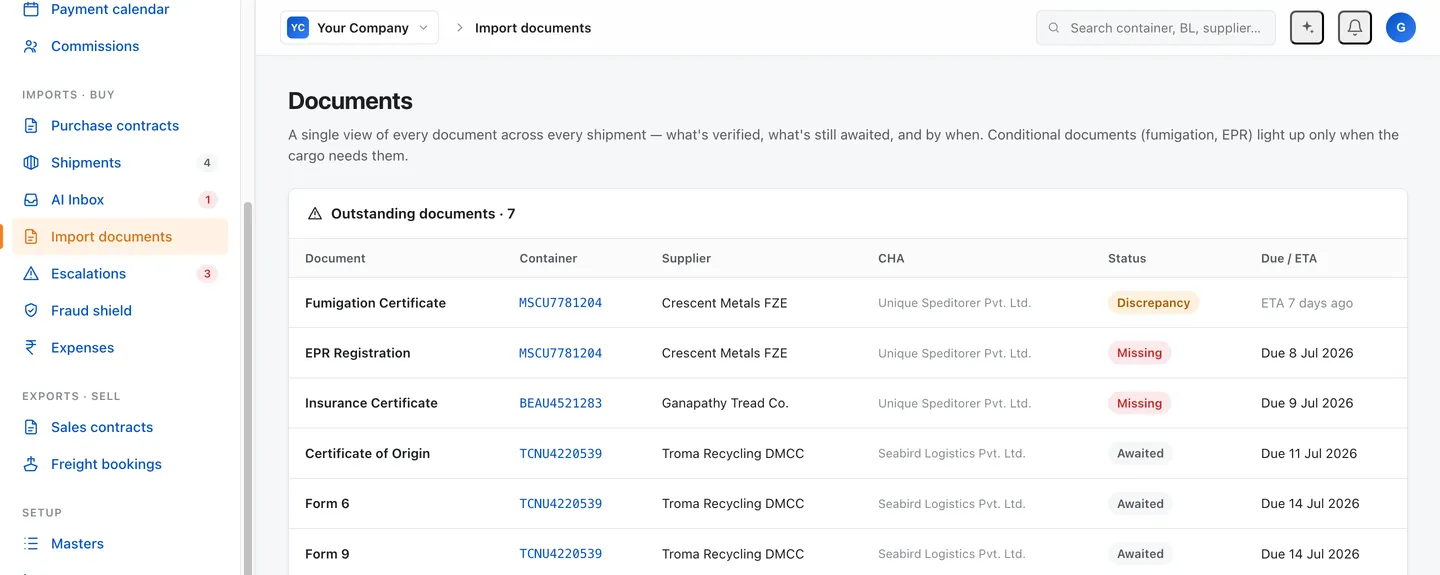
What it does is hold the three clocks this cargo runs on as objects with dates, and chase the only one that has a counterparty on it. The purchase contract names the devices; Docket holds each one’s registration number, its class, its retention date and, where the device is parallel-imported, the consignment approval that this shipment needs, so the approval is applied for against the loading schedule rather than against the vessel’s arrival. It reads the supplier’s ISO 13485 certificate and declarations against the model on the order and names the mismatch while the goods are still at the factory, which is part of its import document checking software. About 2.2 hours of desk work goes into a container, and 45 to 90 minutes of that is exactly this: reading one document against another.
And it chases the queries. The applicant’s stop-clock is the only part of a 310-working-day registration a desk controls, and it is lost in the same way every other deadline on this site is lost: an email to a regulatory contact at the manufacturer, no reply, and nobody whose job it was to notice. Email, then WhatsApp at 24 hours, then SMS, then a voice call, on the channels those people already use.
A demurrage and detention system that counts the agency hold too earns its keep here for one reason: on this cargo the hold can be waiting on a consignment approval nobody applied for, and that is a document deadline rather than a shipping one.
The jobs Docket does on this cargo
- Checks every document is present & correct — BL, invoice, COO, packing list, insurance — verified against your checklist, per container.
- Chases suppliers daily — schedules, prices, docs — Loading schedules until confirmed, prices every morning, and whoever owes the missing document.
- Builds your payment calendar itself — Loading confirmed → payables scheduled from your terms; receivables follow the sales contract. Currencies kept separate.
- Escalates on WhatsApp / call when it's urgent — Email first. Then WhatsApp, SMS and an AI voice call — automatically.
- Logs everything in a full audit trail — Every check, reminder, commitment and dollar on record — with the raw email behind it, one click away.
Questions importers of this cargo ask
What documents do I need to import medical devices into Singapore?
A dealer's licence first — specifically an importer's licence, which HSA issues after assessing your quality management system against Good Distribution Practice. Then, unless the device is Class A, its registration on the Singapore Medical Device Register before you supply it. Behind the licence sits an ISO 13485 certificate from a certification body accredited by the Singapore Accreditation Council, or a declaration of conformity if you deal only in Class A devices. The ordinary cargo clearance permit through TradeNet is separate, and the Medical Devices Regulations do not reference it.
What is a medical device dealer's licence?
The licence HSA requires before a company may manufacture, import or wholesale medical devices in Singapore. There are three and they are not interchangeable: an importer's licence "allows the dealer to bring a medical device into Singapore", a wholesaler's licence allows supply by wholesale including export and supply for re-supply, and a manufacturer's licence covers making, fabricating, packaging and labelling. Each is $1,110 a year, new or renewal, with a 10-working-day turnaround and $168 for an amendment.
Do I need both an importer's and a wholesaler's licence?
If you import and then supply on, yes. HSA puts it plainly: "Licensed importers require a Wholesaler's licence for wholesale supply." The exceptions are narrow — a licensed manufacturer may wholesale what it manufactured without a wholesaler's licence under regulation 5, and a licensed importer may supply to ships and aircraft without one under regulation 11B. A wholesaler's licence is also not required to supply an end user, such as across a retail counter.
Which medical devices are exempt from registration in Singapore?
Class A low-risk devices. HSA: "All medical devices will require registration with us before they can be supplied in Singapore, except for Class A low risk medical devices, which are exempted from product registration." The exemption is conditional, not free: regulation 10B allows the supply of an unregistered Class A device only where it was manufactured under a manufacturer's licence, imported by the supplier under an importer's licence, or obtained from a licensed wholesaler. Supply it outside those channels and the exemption does not apply.
How is a medical device's risk class decided?
By HSA, on the device's intended purpose, and against general criteria in the Third Schedule — whether it is invasive, non-invasive or surgically invasive, whether use is transient, short-term or long-term, whether it is active, and whether it incorporates a therapeutic substance or non-viable animal tissue. Two principles catch importers. Where a device could be assigned to two or more classes, regulation 24(2)(b) requires the Authority to assign "such of those classes as represents the highest health risk". And a device designed for use in combination with another is classified separately, so one consignment can carry two registrations.
How long does HSA take to register a medical device?
It depends entirely on the class and the evaluation route, and the spread is the point: a Class B immediate-route registration is granted on submission, a Class B full route takes 160 working days, Class C full 220, and Class D full 310. A Class D device containing a registrable drug on the full route is $75,600 and the same 310 working days. And those are the regulator's share only — HSA states that turnaround time "excludes the time taken for you to respond to our requests for clarification or additional information", which it calls the applicant's stop-clock.
Can I parallel import a medical device somebody else registered?
Yes, and it is the one regime on this site with an approval attached to each shipment. Regulation 2B(1)(b)(viii) covers a device that "is in all respects the same as a registered medical device, the registrant of which has not authorised the applicant to import" it. Regulation 2B(2)(b) then requires that applicant to comply with Good Distribution Practice or ISO 13485 and to "obtain the Authority's prior approval for each consignment of the medical device to be imported". Not once per model. Once per consignment, every time.
Is a massager or a fitness tracker a medical device in Singapore?
Not usually. HSA defines medical devices as health products with a physical or mechanical effect used to diagnose, alleviate or treat a condition, or to measure or monitor a bodily function, and then draws the line explicitly: "Products used to maintain or support general well-being without specific medical claims, such as body toning equipment, magnetic accessories and massagers, are not medical devices." The claim moves the product across the line, not the hardware. One consignment can hold both, and only half of it needs a registration.
How does this turn into demurrage?
Through the per-consignment approval, mostly. Every other control in this regime attaches to a company or a model and is settled long before a vessel sails, but a parallel importer's consignment approval has to be obtained for that shipment, and free time does not wait for it. Document packs routinely run about eight days late against free time, and a week of demurrage on one container has cost about US$12,000. The quieter failure is the registration: goods landed, duty paid, and a device that may not lawfully be supplied until a date HSA set.
Sources
- Health Products (Medical Devices) Regulations 2010 (G.N. No. S 436/2010), made under the Health Products Act 2007, current version as at 22 October 2026 — regulation 2B(1), the requirements for issue of an importer's licence, including 2B(1)(a) on staff, premises, equipment and facilities "necessary to prevent the deterioration of the medical device while it is in the applicant's ownership, possession or control" and 2B(1)(b)(viii), a device that "is in all respects the same as a registered medical device, the registrant of which has not authorised the applicant to import the registered medical device"; regulation 2B(2), under which such an applicant "must be able to comply with the requirements of the Good Distribution Practice Standard for Medical Devices or ISO 13485" and "must obtain the Authority's prior approval for each consignment of the medical device to be imported"; regulation 5, under which a licensed manufacturer may wholesale its own device without a wholesaler's licence; regulation 9, the exception for a device imported solely for re-export where the Authority has granted an importer's or wholesaler's licence for that purpose; regulation 10B, the exception permitting supply of an unregistered Class A device only where manufactured, imported or obtained through licensed channels; regulation 11B, the exception for wholesale to ships or aircraft by a licensed importer; regulation 24(1) and the Third Schedule Part I, listing the classes "in ascending order of the health risk posed to an end-user" as Class A (low risk), Class B (moderately low risk), Class C (moderately high risk) and Class D (high risk); regulation 24(2), the assignment principles — intended purpose, the highest health risk where two or more classes are possible, separate classification of devices designed to be used in combination, and the most critical of two or more intended purposes; regulation 24(3), under which the Authority has regard to the general criteria in Part II of the Third Schedule and to "the risk classification rules for medical devices set out on the Authority's website"; and Third Schedule Part II Division 1, defining transient use as not exceeding 60 minutes, short-term use as between 60 minutes and 30 days, and long-term use as exceeding 30 days · checked 2026-10-22
- Health Sciences Authority, Medical devices — regulatory overview, importer, wholesaler and manufacturers' licensing, and apply for a medical device dealer's licence, read 22 October 2026 — "We require companies to obtain a dealer's licence before manufacturing, importing or supplying medical devices. All medical devices will require registration with us before they can be supplied in Singapore, except for Class A low risk medical devices, which are exempted from product registration"; "HSA will assess if you meet Good Distribution Practice requirements before issuing your licence"; "An importer's licence allows the dealer to bring a medical device into Singapore. Licensed importers require a Wholesaler's licence for wholesale supply"; the QMS evidence required on application, being an ISO 13485 certificate "issued by a certification body accredited by the Singapore Accreditation Council (SAC)" or, for a company dealing in Class A devices only, a declaration of conformity; and the scope boundary, "Products used to maintain or support general well-being without specific medical claims, such as body toning equipment, magnetic accessories and massagers, are not medical devices" · checked 2026-10-22
- Health Sciences Authority, Fees and turnaround time for medical devices, read 22 October 2026 — a dealer's licence application or renewal at 10 working days, and the full evaluation route at 160 working days for a Class B device, 220 for Class C and 310 for Class D; plus the stop-clock note, "Turnaround time (TAT) excludes the time taken for you to respond to our requests for clarification or additional information ('applicant's stop-clock')" · checked 2026-10-22
- Health Sciences Authority, Fees and turnaround time for medical devices (the fee schedule on the same page), read 22 October 2026 — dealer's licence $1,110 for a new application or annual renewal and $168 for an amendment; $560 application fee on any Class B, C or D device registration; Class B evaluation routes immediate $1,000 (granted immediately upon submission), abridged $2,010 at 100 working days and full $3,900 at 160; Class C immediate $3,340, expedited $3,340 at 120, abridged $3,900 at 160 and full $6,250 at 220; Class D expedited $5,930 at 180, abridged $6,250 at 220 and full $12,000 at 310; Class D with a registrable drug, abridged $10,600 at 220 and full $75,600 at 310; annual retention in the Singapore Medical Device Register at $39 for Class B, $67 for Class C and $134 for Class D; and change of registrant $880 at 40 working days · checked 2026-10-22
- Docket operational baseline, import–export desk — document-pack lateness against free time, the cost of a week of demurrage on one container, and the desk time a container consumes