Therapeutic product import documents: Singapore
Singapore gates a therapeutic product import on two approvals. Your company needs an importer's licence (TPIL), issued 10 working days after a Good Distribution Practice audit of your premises. The product needs a registration, which takes 110 to 320 working days and may belong to somebody else, whose authorisation letter your licence needs. A registration dies if its annual fee goes unpaid.
- HS chapters
- 30 — Pharmaceutical products · 29 — Organic chemicals (active pharmaceutical ingredients) · 21 — Miscellaneous edible preparations (certain health supplements)
- Beyond the standard pack
- Importer's licence for therapeutic products (TPIL), held by the Singapore company before any consignment moves, valid 12 months from approval · Wholesaler's licence for therapeutic products (TPWL) where the same company also wholesales, bundled with the TPIL at a lower combined fee · Evidence that the product is on HSA's Register of Therapeutic Products, checked per formulation, dosage form, presentation and strength — each is a separate registration · Authorisation letter from the product registrant, where the products are not registered under your own company · Good Distribution Practice standard operating procedures, GDP records or recording templates, and a store approval letter, all submitted with the licence application · Current layout plan of the premises showing the receiving bay and the quarantined, released, rejected, returned, recalled and outgoing-staging areas, with the warehouse address and its dimensions · A named Responsible Person, who must be a registered pharmacist where the company deals in pharmacy-only or prescription-only medicines, or in unregistered products for patients' use · Consignment approval from HSA's Therapeutic Products Branch, in addition to the licences, before importing an unregistered product for a patient's use · Cargo clearance permit per consignment through TradeNet, lodged after the Competent Authority authorisation is in place
Every other cargo page on this site turns on something about the goods. Metal scrap needs a certificate, plastic waste needs a measurement under a contamination threshold, used clothing turns on the eight-digit tariff line, and food turns on who made it.
Medicines turn on something stranger. The thing that decides whether your consignment can legally arrive is, often enough, whether a company you do not control paid an annual fee you never see a notice for.
Two approvals that get mistaken for one
Singapore separates the licence to do the activity from the approval of the thing. Both have to exist before a consignment moves, and they behave nothing alike.
The importer’s licence for therapeutic products, the TPIL, is yours. Your company applies, HSA audits your premises against the Good Distribution Practice standard, and in HSA’s own words the licence “will only be approved and issued 10 working days from the date of audit close out if your company is found to have complied with the required GDP standard.” It costs S$560 on its own, or S$1,000 bundled with a wholesaler’s licence, and it lasts 12 months from approval.
The product registration is a different animal. It attaches to the product, not to you; it is held by a registrant; and HSA’s own published turnaround times put it at 50 working days of screening plus 60 to 270 working days of evaluation depending on the route: roughly five to fifteen months of regulator time, before counting what HSA calls the applicant’s stop-clock.
If you are not the registrant, the bridge between the two is one document, and HSA lists it among the things your licence application must contain:
Authorisation letter from the product registrant, if your products are not registered under your company.
That single line is the whole commercial relationship compressed into an attachment. A desk that cannot get an email answered in the ordinary course has to get a signed authorisation out of the same counterparty, and the licence does not issue without it.
The gate is a date somebody else picks
The usual mental model of a licence application is a queue: you file, you wait a published number of days, you get an answer. The TPIL does not work like that.
HSA says that when your licence application is received, it will inform you of the date for a GDP audit of your premises. The ten working days run from the close-out of that audit, not from your submission. So the only published number in the process is the last and shortest span in it, and the span in front of it, scheduling an on-site audit of your warehouse, has no stated duration at all.
What the audit wants is also not a document set in the usual sense. The application asks for a layout plan carrying the warehouse’s full address, its length and width, and separately indicated areas for receiving, quarantined product, released product, rejected product, returned product, recalled product and outgoing staging. That is a request for a building, drawn. A desk can chase a certificate out of a supplier; it cannot chase a receiving bay.
Restricted-activity importers get a lighter version. Where the import is solely for supply to ships or aircraft leaving Singapore, solely for export, or for non-clinical use, you need the TPIL but not the wholesaler’s licence, you may take a single-consignment licence at S$111 valid six months, and you are outside the routine GDP audit cycle, though HSA is explicit that the record-keeping duties still bind you.
Six strengths is six registrations
HSA’s registration overview contains a sentence that reshapes how a buying desk should read a supplier’s catalogue:
Different formulations, dosage forms, presentations and strengths of the same chemical or biologic entity are considered different products, and will require separate registrations.
So “is it registered in Singapore?” is not a question with a yes. A molecule in three strengths across two presentations is six registrations, each with its own registration date, its own anniversary, its own S$330 annual retention fee and its own independent cancellation risk. An order that mixes SKUs can be compliant in four lines and impossible in two, and the commercial invoice will not show you which is which.
The 60-day cliff, and why it is not your notice
This is the part worth building a process around, because the consequence is severe and the warning goes to somebody else.
HSA retains a product on the Register “for so long as the registrant continues to pay a retention fee and complies with the registration requirements.” The fee falls due on every anniversary of the registration date. Retention notices go out 60, 30 and 15 calendar days before; reminders at 1, 15 and 30 days after. And then:
Your product registration will be cancelled if we do not receive your retention fee within 60 days after the payment due date.
With no way back:
Once a product registration is cancelled, you will need to submit a new application for the product to be registered again. We are unable to accommodate any requests for reinstatements once the product registration has been cancelled.
Read those two together against the registration timeline. A missed S$330 payment converts, with no appeal, into a fresh application at 50 working days of screening plus 60 to 270 of evaluation. An importer with a signed purchase contract and a vessel booked has no remedy at all, because the thing that lapsed was never theirs to pay.
And there is a worse moment inside it. HSA states the fee “would be charged to the current product registrant on the retention fee due date, regardless of any pending change of registrant applications.” So during a transfer, exactly when a distributor is being replaced and the outgoing party has the least incentive to pay, the deadline sits with the party on the way out and the consequence lands on the party coming in. Nobody’s shipping plan carries that date, because it is not in any shipping document.
Where the clock meets the terminal
Singapore Customs is unambiguous about the sequencing: controlled goods “require proper authorisation (advance notification, licence or certificate approval) from Competent Authorities (CA) before they may be imported to Singapore,” and the Health Products Regulation Group of HSA is one of those authorities. The permit declaration your declaring agent lodges through TradeNet depends on that authorisation.
Which means the failure here is not the ordinary document failure the category writes about. There is no missing paper to produce at this end. The registration either stands or it does not, and if it does not, the permit cannot be lodged while the box sits discharged with the terminal’s meter running. Document packs routinely run about eight days late against free time, and a week of demurrage on one container has cost about US$12,000, before the reefer power on anything cold-chain, and before the product’s own stability window, which is the one clock on this page that destroys the cargo rather than billing for it.
What belongs in the contract, not the checklist
The pattern this cargo teaches is that the document pack is downstream of questions a checklist cannot ask. Four of them belong in the purchase contract:
- Which SKUs are registered, by registration number, not “the product is registered”.
- Who the registrant is, and whether an authorisation letter for your TPIL already exists or has to be obtained.
- The retention anniversary of every SKU you are buying, so the dates sit in your own calendar rather than in the registrant’s inbox.
- Who tells you if a registration is cancelled or suspended, and within how long, because HSA’s notices do not come to you.
Where Docket sits
None of the four questions above is a document check. They are standing facts about a counterparty that have to be captured once, at contract stage, and then re-verified on dates that have nothing to do with any shipment.
That is the shape of work this product is built for: the purchase contract as the place the facts are recorded, a payment and renewal calendar derived from them rather than typed, and a chase that starts weeks before anyone would have thought to look: on the registrant’s anniversary, not on the vessel’s ETA. The regulator’s own sequence of notices at minus 60, minus 30 and minus 15 days is a schedule a machine should be holding. Right now, on most desks, it is held by nobody at all.
The jobs Docket does on this cargo
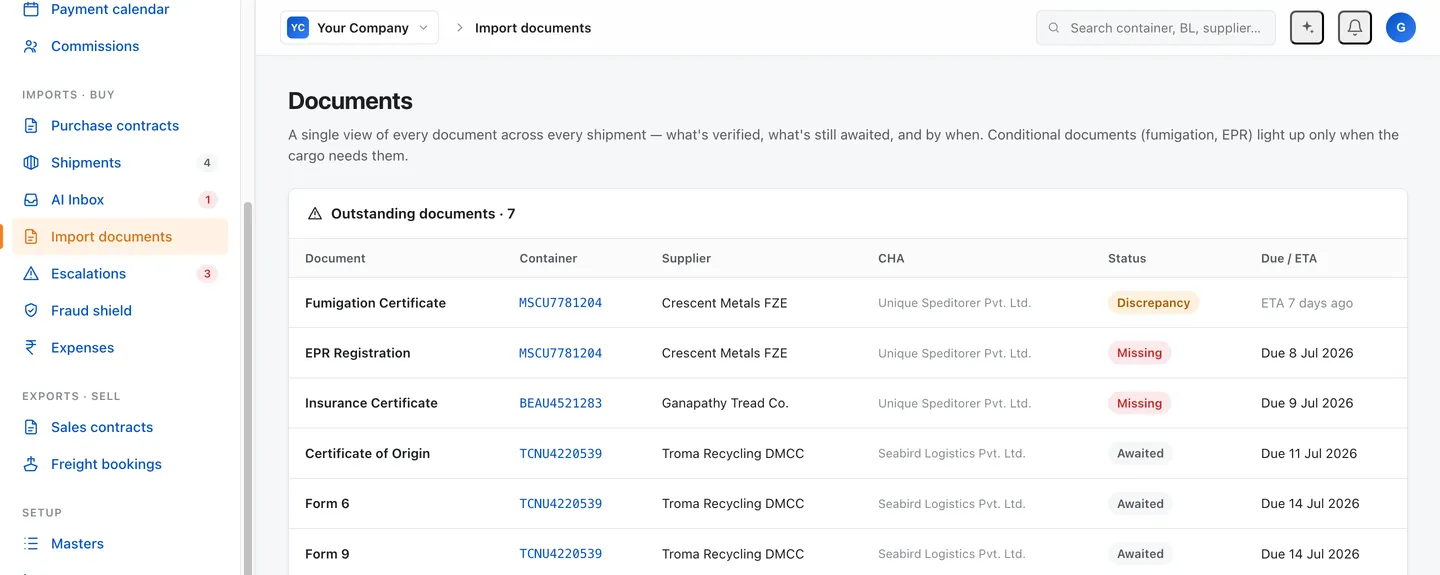
- Checks every document is present & correct — BL, invoice, COO, packing list, insurance — verified against your checklist, per container.
- Chases suppliers daily — schedules, prices, docs — Loading schedules until confirmed, prices every morning, and whoever owes the missing document.
- Escalates on WhatsApp / call when it's urgent — Email first. Then WhatsApp, SMS and an AI voice call — automatically.
- Builds your payment calendar itself — Loading confirmed → payables scheduled from your terms; receivables follow the sales contract. Currencies kept separate.
- Tracks every expense — traced to its email — Duty, port charges, CHA fees, detention — pulled from invoice emails, so each container's landed cost is live. Every line links to the email it came from.
Questions importers of this cargo ask
What do I need to import therapeutic products into Singapore?
Two approvals that are easy to confuse. Your company needs an importer's licence for therapeutic products (TPIL) from HSA, which requires compliance with the Good Distribution Practice standard and is issued 10 working days from the date of audit close-out. Separately, the product has to be registered on HSA's Register of Therapeutic Products. If you are not the registrant, your licence application has to include an authorisation letter from whoever is. Then, per consignment, a cargo clearance permit through TradeNet.
How long does an HSA importer's licence take?
The regulator's own turnaround time is 10 working days from the date of technical assessment completion or inspection close-out. The part that is not a stated number is the audit: HSA informs you of the date for a Good Distribution Practice audit of your premises once the application is received, and the licence is only approved and issued 10 working days after that audit closes out, and only if you were found compliant. So the honest answer to a supplier asking when you can receive cargo is that it depends on a date the regulator picks and a result you do not control.
Do I need a licence if I only import for export, or for ships?
You need an importer's licence, but not a wholesaler's licence, and the import licence can be for restricted activity only, at a lower fee. HSA names three restricted activities: importing therapeutic products solely for supply to ships or aircraft leaving Singapore, importing solely for export, and importing for non-clinical use. A restricted-activity licence can be taken as an annual licence for multiple consignments or as a single-consignment licence valid six months, which costs S$111. Restricted-activity importers are also not subject to the routine GDP audits, though HSA is explicit that the record-keeping obligations still apply.
What happens if the product registration lapses?
The registration is cancelled, and it cannot be brought back. HSA retains a product on the Register so long as the registrant keeps paying the annual retention fee, which falls due on each anniversary of the registration date at S$330 per product. If payment is not received within 60 calendar days after the due date, the registration is cancelled — and HSA states that once cancelled you must submit a new application and that it is unable to accommodate requests for reinstatement. A new application means screening at 50 working days plus evaluation at 60 to 270 working days depending on the route.
Is one registration enough for a product line?
No, and this is the line that catches desks buying a range rather than an item. HSA states that different formulations, dosage forms, presentations and strengths of the same chemical or biologic entity are considered different products and require separate registrations. A medicine supplied in three strengths and two presentations is six registrations, six retention fees and six independent 60-day cliffs, each with its own anniversary date. The question to put to the registrant is not whether the product is registered, but which SKUs are.
Who pays the retention fee if the registrant is changing?
The current registrant, on the day it falls due. HSA says the retention fee is charged to the current product registrant on the retention fee due date regardless of any pending change-of-registrant applications. So a transfer in progress is the highest-risk moment in the whole arrangement: the party being replaced holds a deadline whose consequence lands on the party replacing them, and nobody's shipment plan has the date in it.
How does this turn into demurrage?
Because the gate is in front of the vessel and the clock is behind it. Singapore Customs states that controlled goods require authorisation from the Competent Authority before they may be imported, so the TradeNet permit cannot be lodged until HSA's side is in order. If the registrant's retention lapsed, or the authorisation letter never arrived, there is no document you can produce at this end to fix it, while the box is discharged and the terminal is billing. Document packs routinely run about eight days late against free time, and a week of demurrage on one container has cost about US$12,000 — plus, on cold-chain cargo, the reefer power and the product's own stability window.
Sources
- Health Sciences Authority, Overview of importer, wholesaler and manufacturer's licences — an importer's licence for therapeutic products (TPIL) and a wholesaler's licence (TPWL) are required to import and wholesale respectively; compliance with the Good Distribution Practice standard is required before the licences are granted; a Responsible Person must be named and must be a registered pharmacist where the company deals in pharmacy-only or prescription-only medicines or unregistered products for patients' use; a consignment approval from the Therapeutic Products Branch is required prior to the import of an unregistered product for a patient's use; three restricted activities (supply to ships or aircraft leaving Singapore, export only, non-clinical use) need the TPIL but not the TPWL · checked 2026-10-05
- Health Sciences Authority, Apply for a licence — documents required include the current premises layout plan with warehouse address, dimensions and the receiving, quarantined, released, rejected, returned, recalled and outgoing-staging areas; an 'Authorisation letter from the product registrant, if your products are not registered under your company'; GDP standard operating procedures, GDP records or recording templates, and a store approval letter. GDP compliance is mandatory for all importers and wholesalers; HSA informs the applicant of the GDP audit date once the application is received, and 'The licence will only be approved and issued 10 working days from the date of audit close out if your company is found to have complied with the required GDP standard' · checked 2026-10-05
- Health Sciences Authority, Therapeutic products fees and turnaround time — new importer's licence (full scope) S$560, wholesaler's licence S$560, bundled importer and wholesaler S$1,000, restricted-activity single-consignment licence S$111 with six-month validity; amendment S$57 without site inspection and S$330 with; licence turnaround 10 working days from technical assessment completion or inspection close out; licences valid 12 months from approval. Product registration: screening S$610 at 50 working days, with evaluation at 180 working days (NDA abridged), 60 (NDA verification), 270 (NDA full), 240 (GDA abridged) and 120 (GDA verification); annual registration retention S$330 per registered product. Turnaround times exclude the applicant's stop-clock · checked 2026-10-05
- Health Sciences Authority, Retain, cancel or transfer therapeutic product registrations — a registration remains in force 'for so long as the registrant continues to pay a retention fee and complies with the registration requirements'; the retention fee due date falls on every anniversary of the date of registration; 'Your product registration will be cancelled if we do not receive your retention fee within 60 days after the payment due date'; 'Once a product registration is cancelled, you will need to submit a new application for the product to be registered again. We are unable to accommodate any requests for reinstatements'; the fee 'would be charged to the current product registrant on the retention fee due date, regardless of any pending change of registrant applications'; a GIRO account set-up may take up to four weeks · checked 2026-10-05
- Health Sciences Authority, Registration overview — a local company registered with ACRA is required to proceed with a registration; 'Different formulations, dosage forms, presentations and strengths of the same chemical or biologic entity are considered different products, and will require separate registrations' · checked 2026-10-05
- Singapore Customs, Controlled and Prohibited Goods for Imports — 'Controlled goods require proper authorisation (advance notification, licence or certificate approval) from Competent Authorities (CA) before they may be imported to Singapore'; the Health Products Regulation Group and the Tobacco Regulation Branch of the Health Sciences Authority are named Competent Authorities · checked 2026-10-05
- Docket operational baseline, import–export desk — desk time per container and the document-pack lateness against free time