Declaring agent: who files your Singapore import permit
A declaring agent is an entity holding a Declaring Agent Account with Singapore Customs, which allows it to lodge declarations via TradeNet. It is Singapore's customs broker, and an importer can appoint one or register as its own. Either way Singapore Customs requires the permit before the goods are imported, so the deadline sits ahead of the vessel, not after it.
- Declaring Agent
- An entity registered with Singapore Customs under a Declaring Agent Account, permitted to lodge customs permit declarations through TradeNet on its own behalf or for a trader. The declarations are filed by registered Declarants who have passed the Customs Competency Test for Declarants.
In Singapore, the person who files your customs declaration is called a declaring agent. Not a broker, not an agent, and not a Customs House Agent. The word matters because the account behind it is a specific registration, and the registration is what decides whether your permit can be lodged at all.
What the account actually is
A Declaring Agent Account is an entity registration with Singapore Customs. In Singapore Customs’ own words, it allows an entity to lodge declarations via TradeNet. TradeNet is the single window through which every permit application goes, reached either through front-end software from an approved vendor or through the Government Front-End Application.
Two registrations sit behind one declaration. The company holds the DA Account. The person who submits the declaration is registered under it as a Declarant, and has to pass the Customs Competency Test for Declarants before being registered.
You can appoint one, or become one
Singapore Customs gives an importer both routes. A declaring agent can apply for customs permits on your behalf, or you can apply yourself, which means registering your own company as a declaring agent and obtaining a TradeNet user ID.
Doing it in-house is a real commitment rather than a form. Every DA must maintain a valid Inter-Bank GIRO arrangement with Singapore Customs, and Singapore Customs notes that the bank’s approval usually takes three to four weeks. Accounts are then assessed under the DA Governance Framework, which looks at personnel management, training on customs procedures, the company’s processes and SOP documentation, and its information management and controls. The assessment sets both the renewal period, at one, two or three years, and the security requirement, which ranges from full security to a waiver for most transactions.
The permit is not one document
An import permit in Singapore is a permit type, and the type follows what you are doing with the goods rather than what the goods are. In-Payment permits cover GST on goods imported for local consumption and duty with GST on dutiable goods. In-Non-Payment permits cover movements where the money is not collected at that point: into a licensed or zero-GST warehouse under an approved premises or scheme, into a free trade zone for storage, duty and GST relief for entitled persons such as embassies, temporary consignments for events, repairs, testing or exhibition, and goods going for destruction, re-export or shut-out.
Choosing the wrong type is not a clerical matter. It changes what is payable and when.
The deadline is the vessel, not the agent
The operative sentence for an import desk is short. Singapore Customs states that importers must obtain the relevant customs permit before the goods are imported into Singapore.
Read that against how a shipment actually runs and the consequence is direct. Your declaring agent cannot lodge a declaration it does not have the documents for. The invoice, the packing list, the bill of lading and the classification all have to be complete and correct before the permit, and the permit has to be there before arrival. So the deadline that governs the desk sits several days ahead of the vessel, and everything upstream of it belongs to parties who do not work for you.
That is also why free time is the wrong thing to plan against on its own. Free time tells you how long you have after discharge. The Singapore permit rule tells you the work was supposed to be finished before that clock even started.
What it is called elsewhere
The role is the same across markets and the words are not. In India it is the Customs House Agent, and the CHA entry carries the full vocabulary table for each market the site writes for. In Dubai it is the clearing agent, filing through Mirsal 2. In the United States it is a licensed customs broker filing an entry summary. A buyer comparing tools across markets is comparing the same job under four names.
Where Docket sits
Docket is not a declaring agent and does not lodge your TradeNet declaration. That is your agent’s registration and their liability.
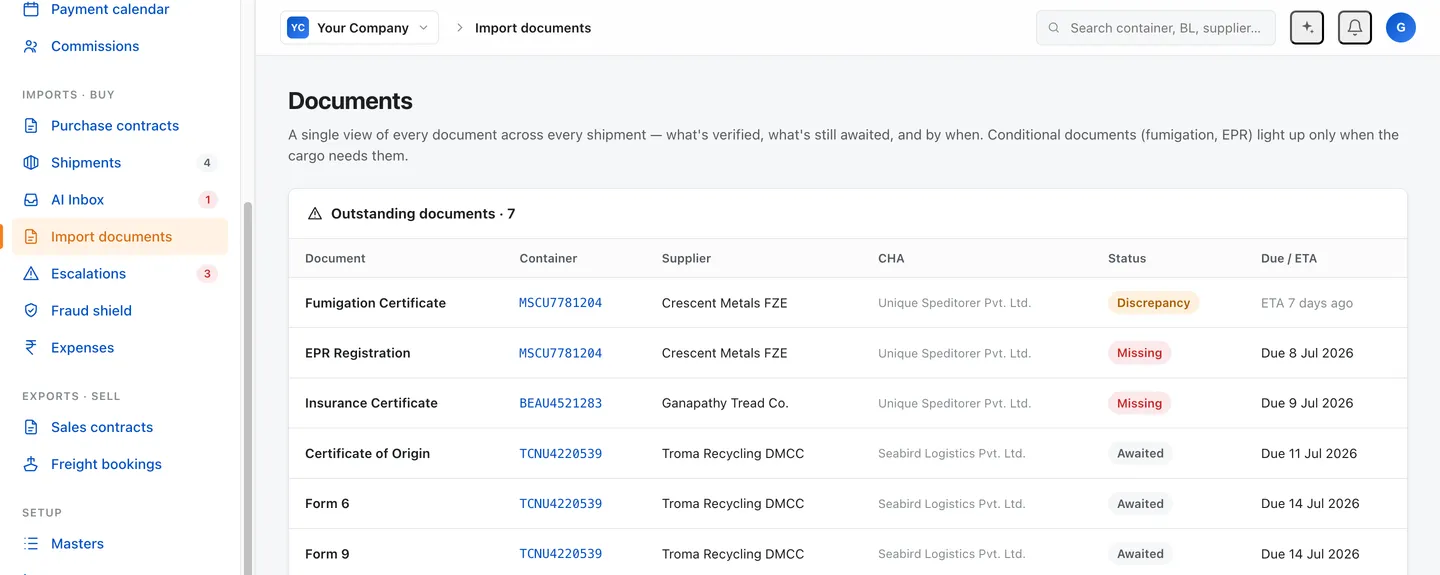
What Docket does is make sure the declaration is not the thing waiting. It reads the purchase contract, knows which documents this lane and this cargo need, chases the supplier, the bank and the inspection agency for each one daily, and checks each document against the contract as it lands, which is what import documentation software is for. The agent then gets a complete, checked pack days before the permit is due, rather than a folder and a phone call on the morning the vessel berths.
Questions traders ask
What is a declaring agent in Singapore?
An entity that holds a Declaring Agent Account with Singapore Customs, which allows it to lodge declarations via TradeNet. It is the role that a Customs House Agent fills in India, a clearing agent in Dubai and a licensed customs broker in the United States. The account belongs to the company; the declarations are submitted by individuals registered under it as Declarants.
Do I need a declaring agent to import into Singapore?
No, but you need somebody with a Declaring Agent Account. Singapore Customs lets you either appoint a declaring agent to apply for permits on your behalf, or apply yourself by registering as a declaring agent and obtaining your own TradeNet user ID. Importing regularly at volume is what usually tips a desk towards doing it in-house; most importers appoint an agent.
What is the difference between a declaring agent and a freight forwarder?
They are different jobs that are often sold by the same company. Forwarding is the movement of the cargo. Declaring is the permit declaration lodged through TradeNet under a registered Declaring Agent Account, by a person who has passed the Customs Competency Test for Declarants. Your forwarder may hold the account, or may be passing your declaration to somebody who does.
When does the Singapore import permit have to be obtained?
Before the goods are imported. Singapore Customs states that importers must obtain the relevant customs permit before the goods are imported into Singapore, which puts the real deadline ahead of the vessel rather than after it. Everything the declaration depends on, the invoice, the packing list, the bill of lading and the classification, has to be complete and correct before that point.
What does a declaring agent need in order to be registered?
A Declaring Agent Account with Singapore Customs, and a valid Inter-Bank GIRO arrangement with Singapore Customs, which Singapore Customs notes usually takes the bank three to four weeks to approve. Accounts are assessed under the DA Governance Framework, which sets the renewal period at one, two or three years and the security requirement anywhere from full security to a waiver for most transactions.
Sources
- Singapore Customs, Declaring Agent Account: a DA Account 'allows an entity to lodge declarations via TradeNet'; all DAs must maintain a valid Inter-Bank GIRO arrangement with Singapore Customs (bank approval usually three to four weeks); the DA Governance Framework assesses personnel management, training on customs procedures, processes and procedures, SOP documentation, and information management and controls, and sets renewal at every one, two or three years with security from full security to partial or full waiver · checked 2026-09-11
- Singapore Customs, Obtain a Customs Import Permit: a Declaring Agent can apply for customs permits on your behalf, or you may apply yourself by registering as a DA; applications are submitted through TradeNet using front-end software from an approved vendor or the Government Front-End Application; registration requires a UEN and an activated Customs Account · checked 2026-09-11
- Singapore Customs, Import Procedures: 'Importers must obtain the relevant customs permit before the goods are imported into Singapore' · checked 2026-09-11
- Singapore Customs, Types of Import Permits: In-Payment permits for GST and for Duty and GST; In-Non-Payment permits including Approved Premises/Schemes, Storage in FTZ, GST Relief and/or Duty Exemption, temporary consignments, destruction, re-export and shut-out · checked 2026-09-11
- Singapore Customs, Declaring Agent Authorisation: individuals must pass the Customs Competency Test for Declarants (SC401) before being registered as Declarants · checked 2026-09-11