Dual-use goods: Singapore import and re-export permits
Singapore's Strategic Goods (Control) Act controls export, transhipment, transit, brokering and the electronic transfer of technology. It does not list import. So a dual-use machine can be imported without a strategic goods permit, and then cannot leave again without one. The import-side paperwork exists because the exporting country asked for it, and its deadlines run from arrival.
- Beyond the standard pack
- Import Certificate (IC) from Singapore Customs, where the exporting country controls the goods or asks for one — valid one year, about 2 working days to issue · Delivery Verification (DV), applied for when the exporter requests it, within 14 days after the goods arrive in Singapore · Cargo clearance permit through TradeNet before arrival, with the ICDV number declared against each item and ICDV items never combined with non-ICDV items on one permit · A strategic goods permit (individual or bulk) for any export, transhipment or transit, obtained before the goods move · End-User Statement, where goods imported under an IC are to be re-exported and the IC did not say so · The exporting country's export licence, or its written confirmation that it does not control the re-export · Singapore Customs' written approval before re-exporting anything imported under an IC · A determination of the goods' status against the Strategic Goods Control List, held on file: either your own, or Customs' answer to an Application for Determination
Every other cargo page on this site turns on a document the importer has to produce. Metal scrap needs a pre-shipment inspection certificate, plastic waste needs a contamination measurement, used clothing turns on the eight-digit tariff line, food on who made it, medicines on who holds the registration, cosmetics on a notification nobody evaluates, and liquor on arithmetic.
Strategic and dual-use goods invert the whole pattern. Singapore’s controls on this cargo are not about bringing it in. They are about what happens to it afterwards.
Import is not on the list of controlled activities
The Strategic Goods (Control) Act has been in force since 1 January 2003, and Singapore Customs sets out the activities that trigger its permit and registration requirements: export, transhipment, transit, intangible transfer of technology, and brokering. Each is defined. Export is taking goods out by land, water or air. Transhipment is unloading from an inbound conveyance onto one that leaves, with no local consignee. Transit is coming in and going out on the same conveyance without being unloaded. The intangible transfer is an electronic transmission of controlled technology, or making it readable from a computer in Singapore by somebody abroad. Brokering is arranging a deal in goods that will move between two foreign countries.
Import is not among them.
So a machine tool that sits squarely inside the Control List can be imported into Singapore, cleared, delivered and installed without a strategic goods permit, and the first moment it needs one is the day somebody decides to sell it on to a buyer in another country. For a trading desk that buys to re-sell, which is most of the desks this site is written for, that is the wrong way round from how the rest of the compliance work behaves.
The paperwork that does come in with the box is somebody else’s law
There is an import-side document, and reading who requires it explains everything about how it behaves. An Import Certificate is needed, Customs says, where “The goods to be imported into Singapore are controlled by the exporting country” or where that country asks for one.
It is a document Singapore issues so that a foreign government will let the goods go. Your supplier’s export licence at the other end is conditional on it. That is why it looks unlike the rest of the permit regime here: Customs will turn one round in about two working days, it stays valid for a year, and the goods have to arrive inside that year or the certificate has to be extended at least fourteen days before it lapses.
On the clearance side the handling is unusually specific. The ICDV number goes against each item on the TradeNet permit, and ICDV items are not to be combined with non-ICDV items on the same permit. A consolidated permit covering a mixed consignment is the ordinary efficient thing to do and it is the wrong thing to do here.
The fourteen-day clock nobody diarises
The second half of the mechanism is the Delivery Verification. The exporter asks for it, Customs endorses that the goods landed where the certificate said they would, and the endorsed document goes back to the exporter as proof the consignment did not end up elsewhere.
The deadline is the line worth copying out: apply “within 14 days after the goods have arrived in Singapore.”
Arrival. Not clearance, not delivery, not invoice date. The same event that starts the terminal’s storage clock and the carrier’s free time starts this one, and the two are owed to entirely different people for entirely different reasons. A desk that is heads-down getting the box out of the port in week one has a paperwork deadline running underneath that work which nothing in the terminal’s system will remind it about. Miss it and the exporter does not get the proof its own regulator is waiting for, which is a problem that lands on the next order rather than this one.
The certificate decides where the goods may go afterwards
An Import Certificate is not only a permission to receive. Under an approved one, Customs’ conditions are that you may not import the goods into any country besides Singapore, may not dispose of them before they enter Singapore, and may not export them after import, except with Customs’ written approval.
For a re-export the route depends on what the certificate itself said. If it stated the re-export, you apply for an export permit. If it did not, you need Customs’ approval, an End-User Statement, and either the exporting country’s export licence or its written confirmation that it does not control the re-export. On strategic goods, a strategic goods permit sits on top of all of that.
Three documents and a foreign regulator’s cooperation, for a box already sitting in your warehouse. The decision that created that position was made months earlier, by whoever filled in the intended destination on the Import Certificate application.
There are no HS chapters on this page, and that is the finding
Every other cargo page here opens with the tariff chapters the cargo sits in. This one cannot, because the Control List is not written in tariff codes. Customs’ instruction for working out whether goods are caught is to “compare its description and technical specifications with the items listed in the Strategic Goods Control List”, and “If your product meets the stated criteria, it is classified as controlled strategic goods.”
Specifications. Which means two machines with the same commercial description, the same HS code and the same supplier can fall on opposite sides of the line because one of them exceeds a threshold written into the List. A classification process keyed to tariff codes, which is what most import desks run, cannot see this distinction at all.
Customs publishes a Determination Database of products it has assessed before and labels it “for general reference only”, so a competitor’s answer on a similar machine is background and not cover. Self-determination is the default and Customs says an application is unnecessary where you can do it yourself. Where you cannot, an Application for Determination takes one product and up to 30 days, “depending on product complexity and the completeness of your submission”, and the clock starts only once every document has arrived.
Thirty days is the number to hold against the rest of this site. Ten free days at Jebel Ali, three at NSICT Nhava Sheva, four inbound demurrage working days on one carrier’s Singapore tariff. A determination can outlast all of them, and nothing stops while it runs.
The list moves on 1 December 2026
Customs’ overview names the Strategic Goods (Control) Order 2026 as the instrument updating the list of strategic goods and technology, with effect from 1 December 2026. The List lives in the Schedule to that Order and carries items controlled by four multilateral regimes: the Australia Group, the Missile Technology Control Regime, the Nuclear Suppliers Group and the Wassenaar Arrangement.
A part can move inside the List without anything about the part changing. The threshold moved. Which makes a determination a dated document rather than a permanent one, and makes a standing order placed in November a different compliance proposition in December.
There is also a catch-all. Customs describes the Act as reaching goods or technology “intended, or even likely, to be used for WMD activities” even where they are not listed. So “it is not on the List” is an answer about the List and not a complete answer about the Act, and the thing that completes it is what you know about the buyer.
What the penalties look like
Transferring strategic goods without a valid permit carries, on a first conviction, a fine of up to S$100,000 or three times the value of the goods, whichever is greater, imprisonment of up to two years, or both. Breaching a permit or registration condition carries up to S$50,000, up to twelve months, or both. Goods can be seized and forfeited, and Customs may offer to compound an offence for a sum not exceeding S$10,000.
The “three times the value” construction is the one to notice, because it is the same shape as the liquor and tobacco exposure on the alcohol and tobacco page, where the fine is the duty payable or S$10,000, whichever is higher. On low-value cargo the cash figure binds. On a container of controlled instruments the multiplier does, and it is not capped by anything on the invoice.
What Docket does with this
Docket does not classify goods against the Control List and does not apply for permits. The determination is yours or Customs’.
What it does is hold the dates. The Import Certificate’s one-year window and its fourteen-days-before-expiry extension. The Delivery Verification’s fourteen days from arrival, counted from the same event as the storage clock, so the two appear on one calendar instead of in two systems. The determination you already hold, against the part number it was given for, so the next order on the same line does not restart the question. And the chase on the supplier for the specification sheet the determination needs, which is the document that holds these shipments up.
The rest is the ordinary argument of this site. Two clocks race on every shipment, the paperwork and the port, and demurrage and detention software that counts from the arrival date is only useful if it knows about every deadline that starts there. On this cargo one of them is owed to a government on the other side of the ocean.
The jobs Docket does on this cargo
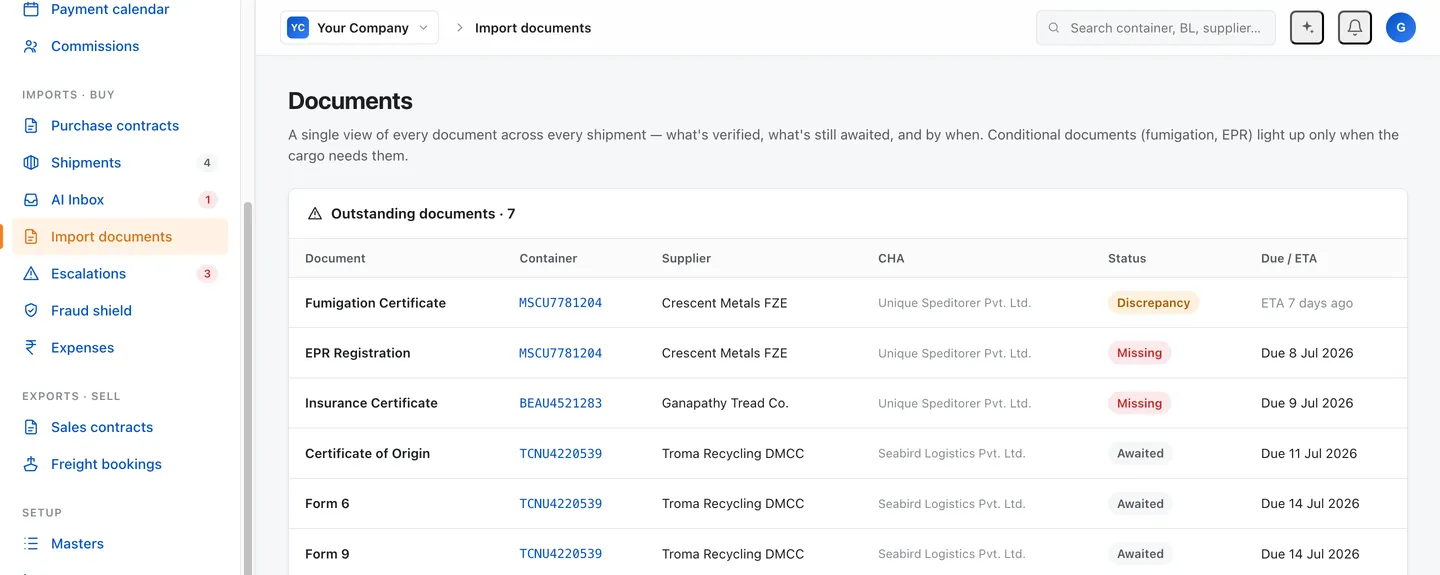
- Checks every document is present & correct — BL, invoice, COO, packing list, insurance — verified against your checklist, per container.
- Chases suppliers daily — schedules, prices, docs — Loading schedules until confirmed, prices every morning, and whoever owes the missing document.
- Escalates on WhatsApp / call when it's urgent — Email first. Then WhatsApp, SMS and an AI voice call — automatically.
- Logs everything in a full audit trail — Every check, reminder, commitment and dollar on record — with the raw email behind it, one click away.
- Tracks every expense — traced to its email — Duty, port charges, CHA fees, detention — pulled from invoice emails, so each container's landed cost is live. Every line links to the email it came from.
Questions importers of this cargo ask
Do I need a strategic goods permit to import dual-use goods into Singapore?
On Singapore's own account of the Act, no. Singapore Customs lists the activities that need a permit or registration under the Strategic Goods (Control) Act as export, transhipment, transit, intangible transfer of technology and brokering. Import is not among them. What you may still need is an Import Certificate, and that one exists because the country shipping to you controls the goods at its end.
What is an Import Certificate and who asks for it?
An Import Certificate is a document Singapore Customs issues to you, the importer, so that your supplier's government will release the goods. Customs' condition for it is that "The goods to be imported into Singapore are controlled by the exporting country" or that the exporting country requires one. It takes about 2 working days once documents and payment are in, it is valid for one year, and the goods have to be imported inside that year.
What is Delivery Verification and when is it due?
A Delivery Verification is Customs' endorsement that the goods landed where the Import Certificate said they would, and it goes back to the exporter as proof. You apply for it when the exporter asks, and the deadline is the part worth diarising: "within 14 days after the goods have arrived in Singapore". That clock starts at the same event the terminal's storage clock starts at.
Can I re-export goods I imported under an Import Certificate?
Not on your own say-so. Customs' instruction is that you must get its approval before re-exporting goods imported under an IC. If the IC already stated the re-export you can apply for an export permit; if it did not, you need Customs' approval plus an End-User Statement and either the exporting country's export licence or its confirmation that it does not control the re-export. Strategic goods need a strategic goods permit for the re-export on top of that. Under an approved IC you also may not import the goods anywhere but Singapore, dispose of them before they arrive, or export them afterwards, except with Customs' written approval.
How do I know whether my goods are on the Strategic Goods Control List?
By specification, not by name and not by tariff code. Customs' instruction is to "compare its description and technical specifications with the items listed in the Strategic Goods Control List", and "If your product meets the stated criteria, it is classified as controlled strategic goods." Two machines with the same commercial description and the same HS code can fall on opposite sides of the line because one exceeds a threshold in the List and the other does not.
Can I rely on someone else's classification?
Not safely. Customs publishes a Determination Database of products it has assessed before and says it is "for general reference only". Self-determination is the default, and Customs says an application is unnecessary if you can determine the status yourself. If you cannot, an Application for Determination covers one product and takes "up to 30 days, depending on product complexity and the completeness of your submission", counted only from the point where every document has been received.
Is the control list changing?
Yes. Singapore Customs' overview names the Strategic Goods (Control) Order 2026 as the instrument that updates the list of strategic goods and technology, effective 1 December 2026. The List sits in the Schedule to that Order and draws on four multilateral export control regimes: the Australia Group, the Missile Technology Control Regime, the Nuclear Suppliers Group and the Wassenaar Arrangement. A part that was outside the List under the previous Order can be inside it under the new one without anything about the part changing.
What are the penalties?
For transferring strategic goods without a valid permit, Customs states a fine of up to S$100,000 or three times the value of the goods, whichever is greater, imprisonment of up to 2 years, or both, on a first conviction. Breaching a permit or registration condition carries up to S$50,000, up to 12 months, or both. Goods can be seized and forfeited. The same exposure applies to breaching an Import Certificate condition or giving false or misleading information on one.
How does this turn into demurrage?
Through the determination, mostly. A permit you know you need is a lead time you can plan. A classification you are not sure of is an Application for Determination of up to 30 days, and nothing at the terminal pauses while it runs. The 14-day Delivery Verification deadline runs from arrival too. Document packs routinely run about eight days late against free time, and a week of demurrage on one container has cost about US$12,000.
Sources
- Singapore Customs, Strategic Goods Control Overview — the Strategic Goods (Control) Act regulates the transfer and brokering of strategic goods and related technology and was implemented on 1 January 2003; its subsidiary legislation includes the Strategic Goods (Control) Regulations, the Strategic Goods (Control) Order 2026, "which updates the list of strategic goods and technology, effective 1 December 2026", and the Strategic Goods (Control) (Brokering) Order 2019; strategic goods are items and technology that "can be used to produce WMD and missiles capable of delivering them", covering arms and military equipment and dual-use commercial items, with a catch-all provision reaching goods or technology "intended, or even likely, to be used for WMD activities" even where unlisted; the activities needing permit or registration compliance are export, transhipment, transit, intangible transfer of technology and brokering, each defined on the page; penalties under section 5 for transferring without a valid permit are, on a first conviction, a fine of up to S$100,000 or three times the value of the goods, whichever is greater, imprisonment of up to 2 years, or both; section 9 breaches of permit or registration conditions carry up to S$50,000, up to 12 months, or both; goods may be seized and forfeited and "Singapore Customs may offer to compound offences for a sum not exceeding S$10,000 per offence". Last updated 2 October 2026 · checked 2026-10-08
- Singapore Customs, Import Certification and Delivery Verification — an Import Certificate is needed where "The goods to be imported into Singapore are controlled by the exporting country" or the exporting country requires one; processing "typically takes 2 working days" after documents and payment are received, and on approval the importer keeps a copy and forwards one to the exporter; the import permit is obtained through TradeNet before the goods arrive, with the ICDV number declared on each item and ICDV and non-ICDV items not combined on one permit; a Delivery Verification is applied for "if requested by the exporter" and must be applied for "within 14 days after the goods have arrived in Singapore", then sent to the exporter "without delay" once endorsed; each IC is "valid for 1 year, and goods must be imported within this period", extensions are submitted "at least 14 days before expiry", changes to IC information must be notified "immediately", a transfer of ownership at least 14 days beforehand and a cancellation at least 14 days before expiry; "You must obtain Singapore Customs' approval before re-exporting goods imported under an IC", and where the IC did not state the re-export this requires Customs' approval plus an End-User Statement and the foreign export licence or a confirmation that the exporting country does not control the re-export, with a strategic goods permit also required for strategic goods; under an approved IC the holder must not import the goods into any country besides Singapore, dispose of them before they enter Singapore, or export them after import "except with Customs' written approval"; breaching an IC condition or giving false or misleading information carries a fine of up to S$100,000 or three times the value of the goods, whichever is greater, up to 2 years' imprisonment, or both. Last updated 5 October 2026 · checked 2026-10-08
- Singapore Customs, Determination of Strategic Goods — to establish whether goods are controlled, "compare its description and technical specifications with the items listed in the Strategic Goods Control List", and "If your product meets the stated criteria, it is classified as controlled strategic goods"; the Determination Database of previously assessed products is "for general reference only"; "Submitting an application is unnecessary if you can determine the status yourself"; an Application for Determination covers one product per application, requires "A valid manufacturer's website (not just a retailer or product page)" along with specifications, brochures and data sheets and disclosure of whether the product is "specially designed for specific equipment", and takes "up to 30 days, depending on product complexity and the completeness of your submission", processed only after all required documents are received. Last updated 26 August 2026 · checked 2026-10-08
- Singapore Customs, Strategic Goods Control List Overview — the List "specifies the list of military and dual-use goods, software, and technologies regulated under the Strategic Goods (Control) Act", and goods and technology that "meet the technical specifications described in the Strategic Goods Control List" are subject to controls under the Act; the List sits in the Schedule to the Strategic Goods (Control) Order, structured in two parts each split into divisions, with the List of Military Goods in Division 2 of Part 1; the List includes items controlled by four multilateral export control regimes, the Australia Group, the Missile Technology Control Regime, the Nuclear Suppliers Group and the Wassenaar Arrangement. Last updated 6 October 2026 · checked 2026-10-08
- Docket operational baseline, import–export desk