Landed cost tools for an import desk: three kinds
Three kinds of software answer to the words landed cost. Allocation modules inside an ERP spread a container total across SKUs. Trade-compliance suites price the duty term from rate data. Evidence capture collects the invoiced charges as they arrive and matches each to a shipment. The first two start from a number somebody already has, and the vendor pages say so in their own words.
Search for landed cost software and the results are not one category. They are three, sold with the same two words and answering different questions. A desk that buys the wrong one gets a tool that works exactly as advertised and still leaves the job undone.
The cleanest way to tell them apart is to take a definition none of them will argue with. Descartes, whose business is trade data, defines landed cost as “the total cost that must be paid for a good or item being imported into the country” and puts the arithmetic like this:
Landed Cost = import tariffs and duties + customs fees + shipping costs + other overhead expenses
Four terms. One of them, duties, has a published rate you can look up before the goods ship. The other three arrive as invoices, from different parties, over the weeks after arrival. Each category owns a different part of that line, and the part that is hardest is not the part most of them own.
Kind one: the allocation module inside an ERP
This is the biggest group and the one that owns the phrase. VISCO, Blue Link and Aquilon all sell it, usually as a feature of an inventory and accounting system rather than a product of its own. What it does is take the charges belonging to a shipment and spread them across the items on it, so stock is valued correctly and margin per product is knowable.
They are good at this. Blue Link offers the “ability to allocate landed costs proportionately — different percentages based on weight, container etc.” VISCO says that when a shipment goes “In Transit” it begins “to gather costs and accruals against that Venture”, and reports “accurate landed costs, projected landed costs, and profitability analysis at the transaction level”. Aquilon lets you “estimate expenses and set your prices correctly” before the shipment arrives.
Now read the seam. Blue Link’s own sentence is that the software “automatically tracks and accounts for the landed costs identified by your company”. Aquilon’s is that once the items land, “you can fine-tune those numbers for perfect accuracy before you finalize the receipt”. In both sentences the automation begins after a person has identified a charge and typed it in. That is not a criticism of the software. Allocation is fiddly and worth automating. It is a statement about where the module’s boundary sits, written by the people who built it.
Aquilon is also the vendor that states the underlying problem most plainly: “You should not have to wait for a stack of bills to arrive weeks after your stock is already sold.” That is the right problem. The answer offered is a better estimate at the purchase order and a true-up at receipt, which helps and does not make the bills arrive any sooner.
Kind two: the trade-compliance suite
The second group is trade data and compliance: Descartes, and the enterprise suites a buyer meets alongside it. Here the product is classification and rate coverage: what the HS code is, what duty, tariff and VAT apply in each country, kept current as they change. For an importer working many tariff lines across several jurisdictions, this is real work and it is hard to do by hand.
What it prices is the first term of the formula. Duty is knowable in advance precisely because it is published, and that is also why it is the term software can own end to end. The other three terms in Descartes’ own equation, being customs fees, shipping costs and other overheads, are not rate lookups. They are somebody else’s invoice, and no rate database contains them.
There is a second trap in the duty term for anyone importing into more than one market: the duty base is not universal. Article 8.2 of the WTO Customs Valuation Agreement leaves it to each member whether freight and insurance are included in the customs value, so the same cargo at the same rate produces a different duty in Singapore than it does where the base is CIF. Our landed cost calculator makes the duty base an input for that reason rather than assuming one.
Kind three: evidence capture
The third kind barely registers as a category because most desks do it by hand and do not think of it as software at all. It is the collection step: the freight invoice from the forwarder, the bill from the customs broker, the delivery order, the transporter’s charge, the insurer’s premium, the carrier’s demurrage line, arriving as email attachments, across weeks, in no order, and each one needing to be matched to the right container before either of the other two kinds of tool has anything to work with.
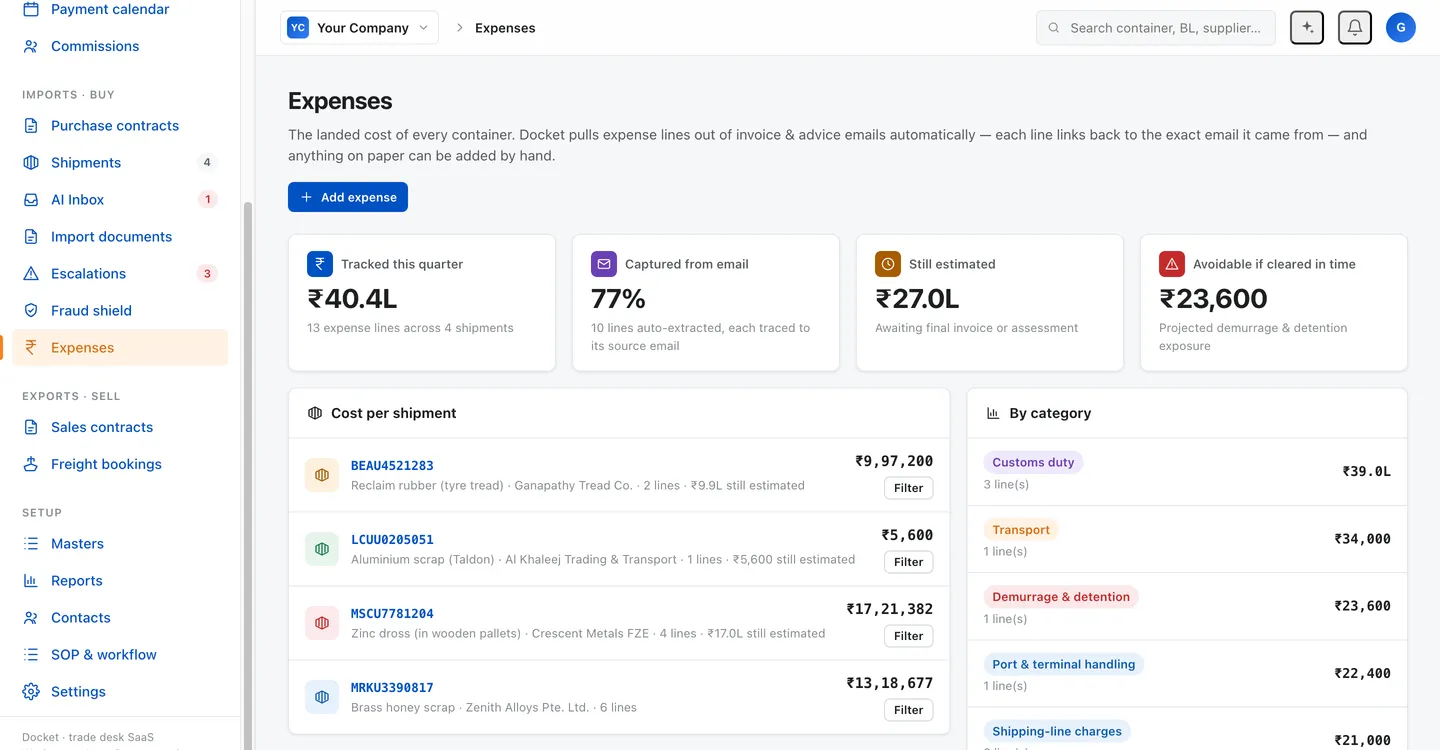
This is the job Docket takes: landed cost reconciliation where each charge is pulled from the mailbox it arrived in, traced back to the email and the party that sent it, and posted against the shipment with that evidence attached. The output is a container total that is complete and checkable, which is exactly the input the allocation module has been waiting for.
It is also where estimated versus actual landed cost stops being a reporting feature and becomes a question about collection. A variance report can only compare what it has. If three invoices are still unopened in a shared inbox, the actual is not wrong, it is absent, and the report will not say so.
The column that is missing from every comparison
Comparison tables for this category compare allocation bases, integrations, reporting and price. Here is the column they leave out.
| The question | Allocation module in an ERP | Trade-compliance suite | Evidence capture |
|---|---|---|---|
| What it produces | Cost per SKU, valued stock, margin per product | Classification and the duty, tariff and VAT rate | A complete, sourced charge list per container |
| Which term of the formula | Spreads all four, once known | Term one: duties | Terms two to four, as invoiced |
| Where the charge comes from | “identified by your company” (Blue Link) | Maintained rate data, for duty only | The mailbox the invoice arrived in |
| Does it collect the charge? | No | No | Yes |
| What it needs before it can start | A complete container total | An HS code and a destination | Nothing; it starts at the inbox |
Read down the “does it collect the charge?” row and the shape of the market is clear. Two of the three kinds are downstream of a step nobody sells, and the desk is doing that step in a spreadsheet at seven in the evening.
What the empty column costs
Payment tracking alone runs 10 to 15 minutes per container, inside roughly 2.2 hours of desk work per container across the whole job. That is the visible cost, and it is the smaller one.
The larger cost is the charges that close late. Demurrage is the clearest case: a week of it on one container has cost US$12,000, and it reaches the desk as a carrier invoice long after the box has gone. A landed cost signed off before that invoice landed was signed off wrong, and by then the stock is often sold at a margin computed from the wrong number. The tool that prevents it is not a landed cost tool at all. It is demurrage and detention software, working the document pack backwards from the last free day so the charge is never raised.
Docket is priced per shipment, $10 up to 50 a month, $8 from 51 to 300 and $6 above 300, with a shipment billing at most two containers. Against one late demurrage line that comparison is not close, and against the allocation module it is not even a comparison, because that module is a different tool doing a different job, downstream, correctly, once somebody hands it a number it can trust.
What to do with this before your next demo
Ask each vendor one question and watch where the demonstration starts. If the first click is on a field that already contains a number, you are looking at kind one or kind two, and you should buy it for what it does well. The question to keep asking afterwards is who, on your desk, is going to put the number there, and whether that person’s afternoon is the thing you meant to buy back.
Questions this raises
What is the difference between landed cost software and a trade-compliance suite?
They own different terms of the same formula. A trade-compliance suite classifies the goods and prices the duty, tariff and VAT from maintained rate data across many countries, the term you can know in advance because it is published. Landed cost software inside an ERP takes the charges for a shipment and spreads them across the items so stock is valued correctly. Neither one goes and gets the freight invoice, the broker's bill or the demurrage line. Those arrive by email, from different parties, over weeks.
Does landed cost software collect the charges by itself?
Read the vendor's own wording before you assume it does. Blue Link's page says it "automatically tracks and accounts for the landed costs identified by your company". The automation is the allocation; the identifying is yours. Aquilon's page says that once items land "you can fine-tune those numbers for perfect accuracy before you finalize the receipt", which is a person at receipt time. The automation in this category is real and it starts one step after collection.
What should I ask a landed cost software vendor first?
Where does the charge come from? Not how it is allocated, not which basis is supported, not how the report looks. Ask them to show the path from a forwarder's invoice sitting unopened in a shared mailbox to a line against the right container, and ask who does each step. Most demonstrations begin after that path, with the number already in a field.
Do I need all three kinds?
Most desks end up with two. Whatever values your stock and posts to the ledger already does the allocation, and replacing it is rarely worth it. If you import across many tariff lines and jurisdictions, rate data earns its keep. What is usually missing is the part in the middle: somebody collecting the invoiced charges and matching each to a shipment with the email it came from attached.
Where does demurrage fit in the landed cost?
It is a charge like any other and it lands late, which is the problem. A week of demurrage on one container has cost US$12,000, and it arrives as a carrier invoice after the box has moved, often after the stock has been sold. A landed cost that was closed before that invoice arrived was closed wrong, and the fix is upstream: get the document pack complete inside free time so the charge never exists.
Sources
- Descartes, What is Landed Cost? (knowledge centre definition and the four-term formula) · checked 2026-09-15
- Blue Link ERP, Landed Cost Tracking System page ("the landed costs identified by your company"; allocation proportionately by weight, container) · checked 2026-09-15
- VISCO Software, Landed Cost Tracking page (costs and accruals gathered against a Venture; projected versus actual landed cost) · checked 2026-09-15
- Aquilon Software, Landed Cost Tracking page (estimate before arrival, fine-tune at receipt) · checked 2026-09-15
- WTO Agreement on Implementation of Article VII of GATT 1994 (Customs Valuation Agreement), Article 8.2 · checked 2026-09-07
- Docket operational baseline, import–export desk · checked 2026-08-08