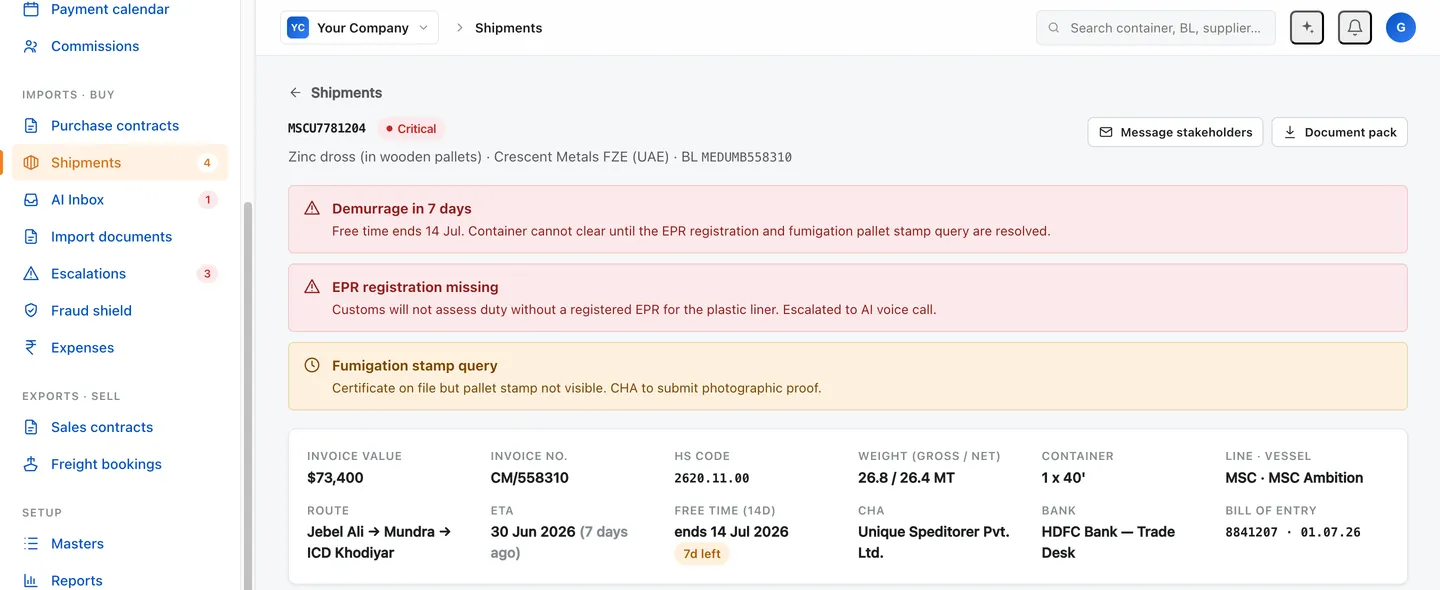
Demurrage software counts one clock. The port runs another
Software sold as demurrage and detention software counts the carrier's free time and shows one last free day. An import container usually runs a second clock too: the terminal's own storage tariff, published, and not counted the same way. Jebel Ali gives 10 free days from discharge; NSICT at Nhava Sheva gives 3 from the day after landing, excluding customs holidays. Both are DP World terminals.
Every product in this category shows you a date. The last free day, in a coloured chip, with a countdown beside it. It is the single most reproduced interface element in container logistics software, and on a large share of shipments it is answering a different question from the one the desk asked.
The date is the carrier’s. The container is also standing on somebody’s ground, and that party has a tariff of its own.
Two bills, two owners, one box
An import container that clears late can generate two separate charges for overlapping days. The carrier bills demurrage for the use of its container. The terminal bills a terminal storage charge for the use of its yard.
American rules put both under one definition, which is where a good deal of the confusion starts. 46 CFR § 541.3 defines demurrage or detention as charges assessed by carriers or terminal operators “related to the use of marine terminal space (e.g., land) or shipping containers, but not including freight charges”. One sentence, two objects: land, or box.
That definition is tidy in a US trade, where the carrier commonly bills both and the importer sees one line. Ship into Jebel Ali or Nhava Sheva and the tidiness disappears. The terminal has a published scale of rates, the carrier has your service contract, and the two documents do not agree about anything: not the number of free days, not the day the count starts, and not which days count.
Three days, or ten, from the same company
Take the two terminals, and read their own numbers.
Jebel Ali allows an ordinary import full container 10 free days, counted from the date of discharge from the vessel. After that it is AED 82 a day up to 20ft and AED 164 over 20ft for five days, then AED 153 and AED 306. The bands are in DP World’s published UAE Region tariff book and are set out in full on the Jebel Ali port page.
Nhava Sheva International Container Terminal allows 3. Section 9 of its scale of rates, in the edition indexed by 0.39% with effect from 1 May 2026, prices import FCL and LCL storage at nothing for days 0 to 3, then:
| Days | Up to 20ft | Above 20ft to 40ft | Above 40ft |
|---|---|---|---|
| 0–3 | Free | Free | Free |
| 4–15 | US$9.33 | US$18.66 | US$27.99 |
| 16–30 | US$18.64 | US$37.28 | US$55.92 |
| Beyond 30 | US$37.28 | US$74.56 | US$111.84 |
Both terminals are operated by DP World. JNPA’s own listing of its container terminals names the operator for NSICT, and the UAE tariff book is published by the same group. One company, two ports, and a free allowance that differs by more than a factor of three.
There is no regional rule to infer here, and no company policy to carry between lanes. The number belongs to the terminal.
The clocks do not count the same days
This is the part that decides disputes, and it is almost never written down outside the tariff itself.
NSICT’s note to Section 9 says the storage period “shall be reckoned from the day following the day of landing”, and that free dwell time “shall be exclusive of customs notified holidays and port non-working days”. Jebel Ali counts from the date of discharge. A carrier’s demurrage free time is ordinarily counted in plain calendar days from discharge.
Put those together on one shipment and you get two free periods that start on different days and burn days at different rates. A public holiday at Nhava Sheva costs a demurrage day and no storage day. Over a long weekend the two last free days can drift two or three days apart, in either direction depending on the port.
Three more clauses in the same section change the number materially, and none of them is visible in a countdown chip: hazardous containers are charged storage 25% above the ordinary slab, over-high and over-dimensional containers three times it, and dollar-denominated charges are recovered in rupees at the reference rate prevailing on the day the vessel entered port limits rather than the day of the invoice.
The test to run on a vendor
None of this is a reason not to buy software. It is a reason to ask one question before you do, and the answer sorts the category faster than a feature list.
Whose free time is the date on the screen?
There are three honest answers and one bad one.
- The carrier’s, from a data feed. Most common. Fine, as long as you know it and hold the terminal’s tariff somewhere else.
- The terminal’s, from its tariff. Rare, and useful mainly at ports that publish.
- The earlier of the two, held per lane. What the desk needs.
- We show the last free day. This is the bad answer, because it means nobody has asked the question, and the number on the screen is whichever one the integration happened to carry.
Ask it of any demurrage and detention software you are evaluating, including ours, and ask where the terminal side is stored. A product that cannot say is not wrong about the carrier’s date; it is silent about the second bill, which is the one that arrives after the argument about the first has been settled.
Why a second clock does not change the work
Holding two dates instead of one is a data problem and it is solved by typing. What neither date does is move itself.
The reason a container is still on the ground on day eleven is almost never that nobody knew the date. It is that a document pack was not finished: the bill of lading not released, the delivery order unsettled, the declaration queued behind an invoice a supplier has not sent. Packs routinely run about eight days late against free time, and a week of demurrage on a single container has cost US$12,000 — before the terminal’s storage bill is added to it.
Counting backwards from the earlier of two clocks is the arithmetic. Getting six parties to produce nine documents before that date is the job, and it is done by asking, and asking again, on the channels those people answer. That is the part how to choose demurrage and detention software comes down to, and it is why the date on the screen, whichever clock it came from, was never the product.
Questions this raises
Does demurrage and detention software track terminal storage charges?
Usually not. The category grew out of container visibility, and what it counts is the carrier's free time, because that is the number a carrier's data feed carries. Terminal storage sits in a published tariff at the port, which nothing subscribes you to. Ask a vendor directly whether the last free day it shows you is the carrier's, the terminal's, or the earlier of the two.
How many free days does a terminal give before storage charges start?
There is no standard. Jebel Ali allows an ordinary import full container 10 free days counted from the date of discharge. Nhava Sheva International Container Terminal allows 3, counted from the day following the day of landing and excluding customs notified holidays and port non-working days. Both terminals are operated by DP World. The figure has to be held per port, not per company and not per region.
Is terminal storage the same as demurrage?
It is the same idea billed by a different party for a different asset. The terminal charges for the ground the container occupies; the carrier charges demurrage for the container itself. American billing rules put both under one definition, which is why the words get used interchangeably, but outside the US they arrive as two invoices with two sets of free days.
Which clock should a desk plan against?
The earlier of the two, per lane. Working to a single last free day means working to the wrong one whenever the other expires first, and because the two clocks start on different days and count holidays differently, which one expires first can change from shipment to shipment on the same route.
Sources
- Nhava Sheva International Container Terminal Private Limited, Scale of Rates, indexed SOR at 0.39% with effect from 1 May 2026 vide IPA letter no. IPA/P&P/WPI/2025 dated 27 March 2026, indexing the rates set with effect from 6 May 2024 under JNPA order No. JNPA/FIN/TARIFF/2024-25/590 — Section 9 'Dwell time charges: Charges for Container storage', notes 1, 6, 7 and 8, and clause 2.6 on currency conversion · checked 2026-09-18
- Jawaharlal Nehru Port Authority, Container Terminals — names DP World as the operator of Nhava Sheva International Container Terminal and of Nhava Sheva (India) Gateway Terminal · checked 2026-09-17
- DP World UAE Region Tariff Book, November 2023 edition, § 119 (Free Time) and § 511 (Container Storage Rates), published for Jebel Ali Port and Port Rashid · checked 2026-09-08
- 46 CFR § 541.3, Definitions: 'Demurrage or detention' means any charges, including 'per diem' charges, assessed by ocean common carriers, marine terminal operators, or non-vessel-operating common carriers 'related to the use of marine terminal space (e.g., land) or shipping containers, but not including freight charges' · checked 2026-09-17
- Docket operational baseline, import–export desk