Prior notice: the food filing due before the ship arrives
Prior notice is the filing FDA requires before an article of food arrives in the United States: no fewer than eight hours before arrival by water, four by air or rail and two by road. The time runs from FDA's confirmation, not from your submission. Food arriving without it is refused and becomes general order merchandise, and neither agency is liable for the storage.
- Prior notice
- A notice the importer, owner or ultimate consignee must submit to FDA before an article of food arrives in the United States, confirmed for review by FDA a set number of hours before arrival depending on the mode of transport. Arriving without it makes the food subject to refusal of admission.
Every clock on this site counts forward. Free time starts at discharge and runs until the box moves. Prior notice is the other kind: it counts backwards from arrival, and by the time the arrival notice reaches the desk the deadline has usually passed.
The rule is short enough to quote. A prior notice for an article of food must be submitted to FDA and confirmed by FDA for review:
(1) If the article of food is arriving by land by road, no less than 2 hours before arriving at the port of arrival; (2) If the article of food is arriving by land by rail, no less than 4 hours …; (3) If the article of food is arriving by air, no less than 4 hours …; or (4) If the article of food is arriving by water, no less than 8 hours before arriving at the port of arrival.
The three words that move the deadline
“Confirmed by FDA for review” is doing the work in that sentence, and the next paragraph says why:
Your prior notice will be considered submitted and the prior notice time will start when FDA has confirmed your prior notice for review.
So the eight hours are not eight hours before you file. They are eight hours before FDA’s reply comes back carrying a Prior Notice Confirmation Number. A filing sent with eight hours to spare and confirmed with seven is an untimely prior notice, and untimeliness is one of the three failures that produce the same consequence as filing nothing.
There is a filing window at the other end too, and the two channels disagree about it. A notice submitted through ABI/ACE/ITDS may not go in more than thirty calendar days before the anticipated date of arrival; through the FDA Prior Notice System Interface, not more than fifteen. Same consignment, two earliest dates, depending on which door the filing goes through.
What refusal is, in practice
Not a penalty notice. A custody change.
Food that arrives without adequate prior notice is “subject to refusal of admission under section 801(m)(1)”. Unless CBP agrees to immediate export under its own supervision, the article “must be held within the port of entry”, and then:
An article of food that has been refused … shall be considered general order merchandise as described in section 490 of the Tariff Act of 1930, as amended (19 U.S.C. 1490).
Which means the consignment joins the sequence general order sets out: moved under a custodial bond to a warehouse the importer did not choose, not entered, not delivered to the importer, owner or ultimate consignee. And then the costs clause, which is one sentence and the whole commercial point:
Neither FDA nor CBP are liable for transportation, storage, or other expenses resulting from refusal.
The same clause appears again in § 1.285 for food from an unregistered facility, which is held under a different authority with an identical outcome. A perfect prior notice does not cure an unregistered supplier; that is a second check, on the supplier rather than on the filing.
The ten days after, and the five after that
The exits are real and dated. Where food is refused for no prior notice and is not exported, the notice must be submitted “within 10 calendar days from the date the notice of refusal was issued”, or within ten days of the response to a request for FDA review. Miss all of those and the article is handled under the general order rules in 19 CFR part 127, except that it “may only be sold for export or destroyed”. The ordinary route, entering it for consumption later, is closed.
If the cargo does go back out, one piece of housekeeping is dated too: the prior notice “should be cancelled within 5-business days of exportation”.
Transit cargo is not exempt, and part of a consignment may be
Two scope rules catch desks out in opposite directions.
The subpart reaches further than consumption entries. It applies to food imported or offered for import “for use, storage, or distribution in the United States”, and then names, expressly, food for transshipment through the United States to another country, food for future export, and food for use in a US Foreign Trade Zone. A box that will never be entered still needs the filing.
And it reaches less far than “food”. Meat food products, poultry products and egg products that are at the time of importation under the exclusive jurisdiction of the US Department of Agriculture are outside the subpart altogether. So a mixed consignment can need prior notice on some lines and not on others, which is a document-pack problem rather than a filing one: somebody has to decide, line by line, which rule each item sits under.
Why this is a desk problem and not a broker problem
Because the filing is cheap and the information in it is not.
The deadline is hours, not days, and the inputs come off the supplier’s documents: the article, the manufacturer, the shipper, the grower where there is one, the country of production, the anticipated arrival. A pack that routinely runs about eight days late against free time will not reliably produce an accurate filing eight hours before a vessel berths, and an inaccurate one is refused on the same authority as a missing one.
This also sits beside, not inside, the other pre-arrival filing a US import carries. An importer security filing is due against lading at the foreign port; prior notice is due against arrival at the US one. Two filings, two clocks, two sets of data, and a single late supplier email can break both.
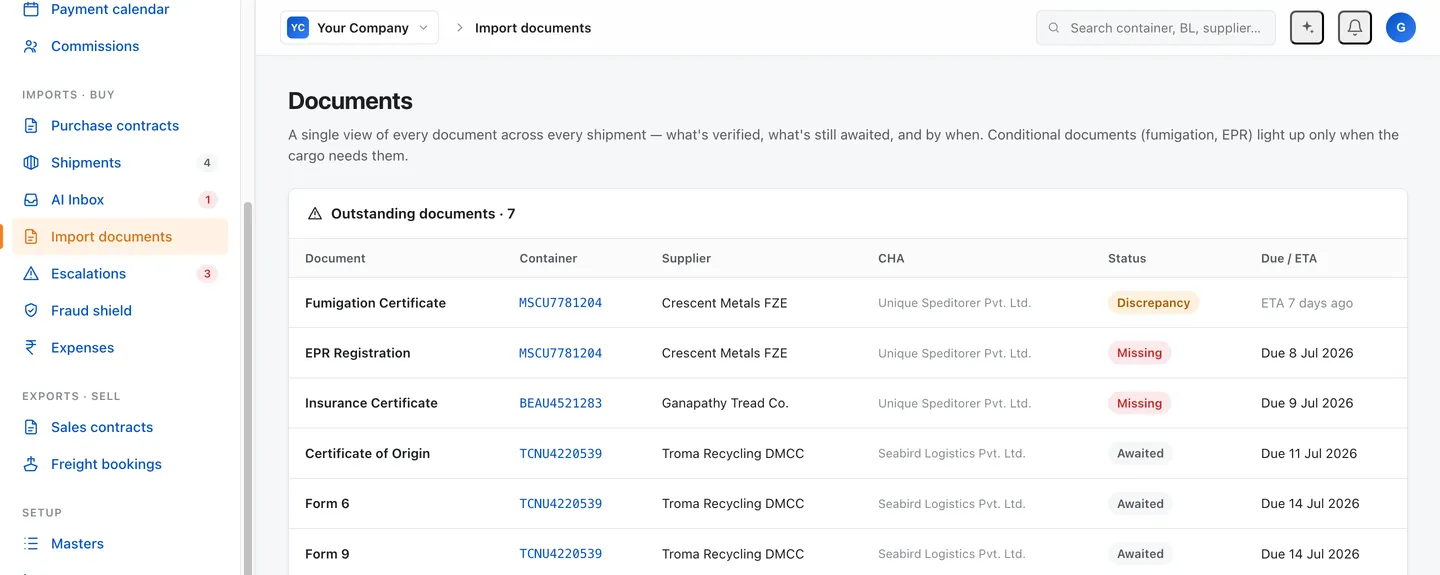
That is the case for chasing the documents on a schedule derived from the vessel rather than from the supplier’s convenience — which is what import document checking software is for, and what the demurrage clock starts charging for the moment the cargo is held.
Questions traders ask
How many hours before arrival is FDA prior notice due?
It depends on how the food is travelling, and the regulation sets four deadlines: no less than two hours before arrival by land by road, four hours by land by rail, four hours by air, and eight hours by water. For food arriving by international mail the notice must be submitted before the food is sent to the United States at all.
When does the prior notice clock actually start?
At FDA's confirmation, not at your submission. The regulation says the notice "will be considered submitted and the prior notice time will start when FDA has confirmed your prior notice for review", and that confirmation arrives as a reply message carrying a Prior Notice Confirmation Number. So a filing sent eight hours before a vessel arrives and confirmed seven hours before it is an untimely prior notice, with the consequences that follow.
How early can prior notice be filed?
Thirty calendar days before the anticipated date of arrival through ABI/ACE/ITDS, or fifteen through the FDA Prior Notice System Interface. The two channels have different look-ahead windows for the same consignment, so the earliest date a filing can be made depends on which door it goes through.
What happens if prior notice is missing or late?
The food is subject to refusal of admission under section 801(m)(1), and refusal is a custody event rather than a fine. Unless CBP agrees to immediate export under its supervision, the article "must be held within the port of entry", it is treated as general order merchandise under section 490 of the Tariff Act of 1930, and it must move under a custodial bond. The regulation is explicit about who pays: "Neither FDA nor CBP are liable for transportation, storage, or other expenses resulting from refusal."
Can I fix a refusal by filing the prior notice late?
There is a route and it has its own deadline. Where food is refused for no prior notice and is not exported, the notice "must be submitted in accordance with §§ 1.280 and 1.281(c) within 10 calendar days from the date the notice of refusal was issued", or within ten days of the response to a request for FDA review. If neither a resubmission, a review request nor an export happens, the article is dealt with under the general order rules and "may only be sold for export or destroyed".
Does prior notice apply to food that is only transiting?
Yes, and that is the part most often missed. The subpart applies to food imported or offered for import "for use, storage, or distribution in the United States", and then names, expressly, food for transshipment through the United States to another country, food for future export, and food for use in a US Foreign Trade Zone. A box that is never entered for consumption still needs the filing.
Which foods are outside prior notice?
Four carve-outs matter commercially. Meat food products, poultry products and egg products that are at the time of importation under the exclusive jurisdiction of the US Department of Agriculture are excluded, so the same consignment can need prior notice for one line and not for another. Food imported then exported without leaving the port of arrival is also outside it, as is food an individual carries for personal use.
What if the facility that made the food is not registered?
Then there is a second hold on a different authority, with the same practical effect. Food from a foreign facility required to register under section 415 and not registered is subject to being held under section 801(l), must be held within the port of entry unless immediately exported, is treated as general order merchandise, and carries the same costs clause: "Neither FDA nor CBP will be liable for transportation, storage, or other expenses resulting from any hold." A prior notice that is itself perfect does not cure an unregistered supplier.
Sources
- 21 CFR part 1 subpart I, Prior Notice of Imported Food, as in effect 30 October 2026 — § 1.279(a), prior notice must be submitted and "confirmed by FDA for review" no less than 2 hours before arrival by road, 4 by rail, 4 by air and 8 by water; § 1.279(b), no more than 30 calendar days before anticipated arrival via ABI/ACE/ITDS and no more than 15 via FDA PNSI; § 1.279(d), "the prior notice time will start when FDA has confirmed your prior notice for review", by a reply carrying a PN Confirmation Number · checked 2026-11-03
- 21 CFR § 1.277, Scope — the subpart applies to all food "imported or offered for import into the United States for use, storage, or distribution in the United States", naming "food for transshipment through the United States to another country, food for future export, and food for use in a U.S. Foreign Trade Zone"; § 1.277(b) excludes food for an individual's personal use, personal gifts made in a residence, "Food that is imported then exported without leaving the port of arrival until export", and meat, poultry and egg products under the exclusive jurisdiction of USDA at the time of importation · checked 2026-11-03
- 21 CFR § 1.283, Consequences of inadequate prior notice — no prior notice, inaccurate prior notice and untimely prior notice each make the food "subject to refusal of admission under section 801(m)(1) of the act (21 U.S.C. 381(m)(1))"; refused food "shall be considered general order merchandise as described in section 490 of the Tariff Act of 1930, as amended (19 U.S.C. 1490)" and "must be moved under appropriate custodial bond unless immediately exported under CBP supervision"; § 1.283(a)(4) Costs: "Neither FDA nor CBP are liable for transportation, storage, or other expenses resulting from refusal."; § 1.283(a)(5), prior notice "should be cancelled within 5-business days of exportation"; § 1.283(a)(6), otherwise the article is dealt with under 19 CFR part 127 and "may only be sold for export or destroyed"; § 1.283(c)(1), post-refusal submission "within 10 calendar days from the date the notice of refusal was issued" · checked 2026-11-03
- 21 CFR § 1.285, Food from unregistered facilities — subject to being held under section 801(l) (21 U.S.C. 381(l)), "must be held within the port of entry for the article unless directed by CBP or FDA", "shall be considered general order merchandise as described in section 490 of the Tariff Act of 1930", and § 1.285(e) Costs: "Neither FDA nor CBP will be liable for transportation, storage, or other expenses resulting from any hold." · checked 2026-11-03
- 21 CFR § 1.284, Other consequences — importing in violation of section 801(m) is "a prohibited act under section 301(ee) of the act (21 U.S.C. 331(ee))", exposing a person to a civil action under section 302, criminal prosecution under sections 301 and 303, and debarment under section 306 · checked 2026-11-03
- Docket operational baseline, import–export desk — document packs running about eight days late against free time, and about 2.2 hours of desk work per container · checked 2026-11-03