Arrival notice: what it tells you, and what it does not
An arrival notice is the message a carrier or its agent sends the party named on the bill of lading to say a shipment is arriving or has arrived. It is a commercial notification, not a legal trigger. Import demurrage free time normally runs from discharge, so the clock is usually already running by the time the notice is read.
- Arrival Notice
- A notification sent by the carrier or its agent to the consignee and notify party named on the bill of lading, stating that a shipment is due to arrive or has arrived, and setting out the charges to be settled before the cargo is released.
The arrival notice is the first piece of paper most import desks touch on a shipment, and it is the one most likely to be mistaken for a starting gun.
It is a notification. The carrier or its agent tells the consignee and the notify party named on the bill of lading that a shipment is arriving or has arrived, usually with the vessel and voyage, the container numbers, the discharge date and a list of charges to settle before anything is released. Useful, and worth reading the day it lands. But it confers nothing, and it does not define a deadline.
The notice is not the clock
Import demurrage free time runs from an event at the terminal, normally discharge from the vessel. The notice is sent around that event, sometimes before it and sometimes after, and the gap between the two is the part that costs money. By the time somebody opens the notice, the free time allowance may already be one or two days spent.
The clearest evidence that these are two different facts is that the US billing rule insists on both. Under 46 CFR § 541.6(b), a demurrage or detention invoice must carry the allowed free time in days, the start date of free time, the end date of free time and, listed separately for imports, the container availability date. A rule that needed only one date to settle when the clock started would not require two.
So the date that governs an import desk’s work is the last free day, derived from discharge and the free days in the applicable tariff or service contract. The arrival notice is evidence about that date. It is not the date.
What the notice does affect
In US trade the notice has a role, and it is a narrower one than importers hope. The Federal Maritime Commission’s interpretive rule at 46 CFR § 545.5(c)(2)(iii) says the Commission may consider whether and how carriers and terminals give cargo interests notice that cargo is available for retrieval: the type of notice, who received it, the format, how it was distributed, its timing and its impact. The same rule, at § 545.5(c)(2)(i), looks at whether free time is tied to the point at which the goods actually become accessible.
That matters when a charge is already on the table and you are arguing it was unreasonable. It is a factor in a dispute, not a mechanism that stops a charge accruing. The practical reading: a notice that arrived late is worth keeping, and it is worth nothing if the pack was not ready anyway.
Notice, then order
The step that releases the cargo is the delivery order, issued once the charges on the notice are settled and the bill of lading is surrendered or released. The sequence on an import is ordinary and easy to state:
- The vessel discharges. Free time starts.
- The arrival notice reaches the consignee and notify party, with the charges to settle.
- Those charges are settled and the bill of lading is released.
- The delivery order is issued, and the customs declaration has to be filed and cleared.
- The container is picked up, inside free time or not.
Every step between 1 and 5 depends on a document arriving from somebody else, and none of them wait for each other politely. That is the whole problem: the clock in step 1 runs against a queue of people who are not watching it.
The notify party field is doing more work than it looks
Because the notice goes where the bill of lading says it goes. Name a forwarder who does not pass it on, or a mailbox nobody has opened since the person who owned it left, and the carrier has discharged its obligation while your desk knows nothing. There is no pause while it sits in the wrong inbox, and no carrier will reconstruct the free days you lost.
Two habits fix most of it. Check the notify party on every bill of lading draft, before it is issued, as part of the pack check. And stop treating the notice as the trigger for work that could have started at booking: the container numbers, the vessel, the documents the declaration needs and the party who owes each one are all knowable well before arrival.
Where software should sit on this
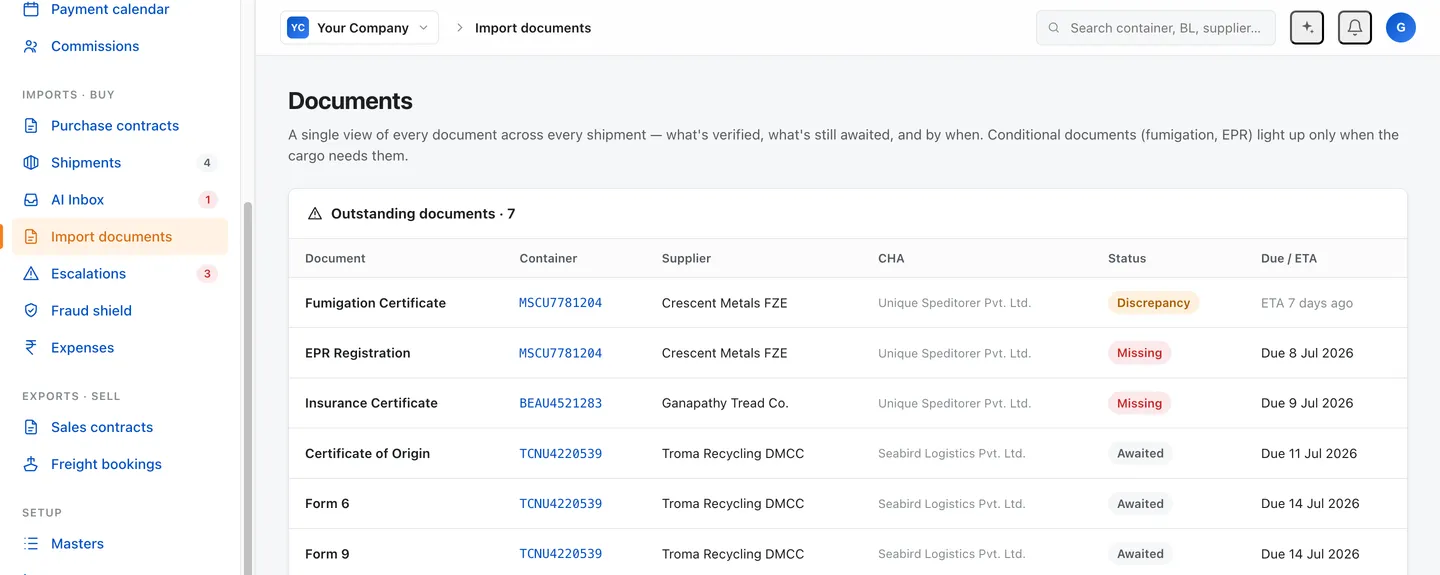
Not on the notice. The useful place is upstream of it. A desk that begins when the arrival notice lands has already lost the days that mattered, which is why document pack deadline tracking works backwards from the last free day instead of forwards from the notice: derive the date from discharge and the contract terms, put a deadline on every document in the pack, and chase the party who owes each one daily until it arrives.
The arrival notice then becomes what it should always have been: a checkpoint that confirms what the desk already knew, rather than the moment it finds out.
Questions traders ask
What is an arrival notice?
A message from the carrier or its agent to the consignee and notify party named on the bill of lading, saying a shipment is due to arrive or has arrived. It typically carries the vessel and voyage, the container numbers, the bill of lading number, the expected or actual discharge date, and the charges to be settled before release. It is a commercial notification, not a document that grants you anything.
Does the arrival notice start the free time clock?
Normally not. Import demurrage free time runs from an event in the terminal, usually discharge from the vessel, and the notice is sent around that event rather than defining it. The US billing rule treats the two as separate facts: 46 CFR 541.6 requires a demurrage or detention invoice to carry the start date of free time and, separately, the container availability date for imports. If one date settled both questions there would be no reason to require both fields.
What is the difference between an arrival notice and a delivery order?
The arrival notice tells you the cargo is coming. The delivery order is the instruction that releases it. The notice is information; the order is authority, and it is issued after the charges on the notice are settled and the bill of lading is surrendered. A desk that has the notice and not the order has nothing it can present at the terminal gate.
Who sends the arrival notice, and who gets it?
The carrier or its local agent sends it, to the consignee and the notify party as they are named on the bill of lading. Which is why the notify field matters more than it looks: if it names a forwarder who does not forward it, or an address nobody reads, the notice is delivered and useless. The clock does not pause while it sits in the wrong inbox.
What if the arrival notice never arrived?
The charge still accrues, and chasing the notice after the fact is not usually a defence. What the notice does affect, in US trade, is reasonableness: the Federal Maritime Commission's interpretive rule at 46 CFR 545.5 says the Commission may consider whether and how carriers and terminals give cargo interests notice that cargo is available for retrieval, and looks at the type of notice, who received it, its format, how it was sent and when. It is a factor in an argument you are having after paying, not a switch that stops the meter.
Sources
- 46 CFR § 545.5(c)(2)(iii), Notice of cargo availability: in assessing the reasonableness of demurrage practices, the Commission may consider whether and how regulated entities provide notice to cargo interests that cargo is available for retrieval, including the type of notice, the recipients, the format, the method of distribution, the timing and the impact · checked 2026-09-12
- 46 CFR § 545.5(c)(2)(i), Cargo availability: whether demurrage practices tie free time allocations to the point at which goods become accessible for retrieval · checked 2026-09-12
- 46 CFR § 541.6(b), Contents of invoice: required minimum information includes the allowed free time in days, the start date of free time, the end date of free time and, for imports, the container availability date, listed as separate required fields · checked 2026-09-12
- 46 CFR § 541.3, Definitions: 'Demurrage or detention' means any charges, including 'per diem' charges, assessed by ocean common carriers, marine terminal operators or non-vessel-operating common carriers related to the use of marine terminal space or shipping containers, but not including freight charges · checked 2026-09-12
- 46 CFR § 541.7, Issuance of invoice: a billing party must issue a demurrage or detention invoice within thirty calendar days from the date on which the charge was last incurred · checked 2026-09-12
- Docket operational baseline, import–export desk