Agri commodity imports: two agencies between the ship and the gate
Agricultural cargo clears through two agencies after customs. Plant quarantine wants an import permit applied for ten days before shipment and an original phytosanitary certificate from the exporting country; FSSAI wants the importer licensed and a sample tested, report due in five days. Both run inside free time. The permit is the one document only the importer can produce.
- HS chapters
- 07–08 — Edible vegetables, fruit and nuts · 09–12 — Coffee, tea and spices; cereals; milling products; oil seeds · 15 — Animal or vegetable fats and oils
- Beyond the standard pack
- Plant quarantine import permit (PQ Form 06, applied for at least ten days before shipment) for Schedule V and VI commodities · Original phytosanitary certificate from the exporting country's plant protection authority (PQ Form 21, or Form 22 on re-export) · Fumigation or treatment certificate where the permit or the schedule demands it · FSSAI import clearance through FICS: the importer's own FSSAI licence, label compliance, sampling and the laboratory report
Most cargo clears through one authority. Agricultural cargo clears through three: customs for the duty, plant quarantine for the pests, and the food authority for what people will eat. Each has its own document, its own inspection, and its own place in the queue, and all three sit between the vessel’s discharge and the gate. Free time does not know that.
The permit that only you can produce
The Plant Quarantine Order 2003 makes commodities in its Schedules V and VI importable only under an import permit. The application goes to the issuing authority in PQ Form 06 at least ten days before the consignment ships. The permit is then checked at the port of entry against what arrived.
Every other document in the pack is produced by somebody else: the supplier, the carrier, the chamber, the exporting country’s plant protection authority. The permit is the importer’s own application, on the importer’s own calendar, and it has to exist before the goods are loaded. A desk that works its checklist forwards from the booking meets the permit at the arrival notice. A desk that works backwards from the shipment date meets it where the Order does.
The certificate from the other end
Clause 3(20) requires an original phytosanitary certificate, issued by an authorised officer in the exporting country in PQ Form 21, or in Form 22 where the goods are being re-exported from a country that is not their origin. It says the consignment was inspected and found free of the quarantine pests India names, and where the schedule demands a treatment, that the treatment was done.
It is the agricultural pack’s equivalent of the scrap trade’s inspection certificate: issued abroad, at loading, by a body the importer does not control, and read first by the officer at the port. Its description and quantity have to agree with the packing list and the invoice. A certificate for the wrong botanical name, or for a quantity that does not match the bill of lading, is a certificate that fails at the desk that matters.
Treatment, at your cost, inside free time
Where fumigation, disinfection or disinfestation is required, clause 3(17) puts it on the importer: arranged at the importer’s own cost, through an agency the Plant Protection Adviser approves, under an authorised officer’s supervision, with the fees in Schedule IX. A treatment ordered at the port is a day or two of the free time you were counting on for something else.
The second agency
Food goes through FSSAI as well. The Food Import Clearance System sits inside the customs single window, so the Bill of Entry is referred to the food authority automatically. Its steps are fixed: the importer’s own FSSAI licence checked, documents scrutinised, the goods visually inspected, and sampling according to the authority’s risk profile. Where a sample goes to a laboratory, the Import Regulations require the report within five days of the laboratory receiving it, a rule the 2025 amendment restated with effect from 1 May 2026. A conforming report produces the no-objection certificate. A non-conforming one produces a report that stops the clearance.
Five days is the laboratory’s clock, not the whole of it. Add the referral, the sampling visit and the drawing of the sample, and a sampled consignment can spend most of a short free-time allowance waiting for a result nobody on the desk can hurry.
Where the demurrage comes from
Document packs routinely run about eight days late against free time on ordinary cargo. On agricultural cargo the late document is more often the one only the importer could have produced, the permit, or the one that has to be right to the botanical name, the certificate. And the clearance itself has two inspections and a laboratory in it. A week of demurrage on one container has cost about US$12,000; on a perishable lot the demurrage is the smaller loss.
Who owes what, and when
| Document | Who produces it | When it can exist |
|---|---|---|
| Import permit (Schedule V and VI commodities) | The importer, from the issuing authority | Applied for at least ten days before shipment |
| Phytosanitary certificate (PQ Form 21 or 22) | Exporting country’s plant protection authority | At inspection before loading |
| Fumigation or treatment certificate | Approved fumigator at origin, or at the port | At loading, or on arrival at your cost |
| Commercial invoice, packing list | Supplier | At stuffing |
| Bill of lading | Carrier | After loading |
| FSSAI licence, labels, sample result | The importer, then FSSAI | Licence before import; result after arrival |
Where Docket sits
Docket does not apply for the permit, does not inspect cargo, does not sample food and does not talk to the authorities. Those are the importer’s applications and the authorities’ decisions.
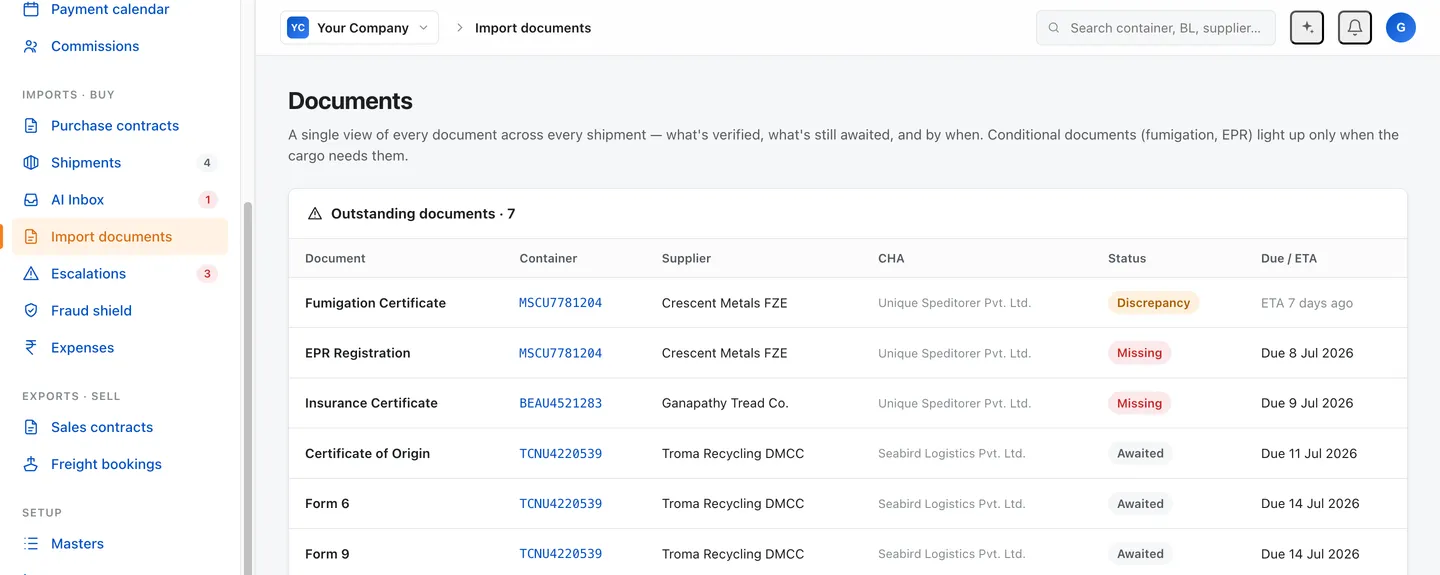
What Docket does is read the purchase contract, take the commodity and the lane, and derive the document set, permit and certificate included, with the party who owes each one and the date it has to exist. The permit lands on the payment and deadline calendar at contract date minus the Order’s ten days, not at the arrival notice. The exporter is chased for the phytosanitary and treatment certificates before loading, daily, on email and then WhatsApp, SMS and an AI voice call. Each certificate that arrives is read against the invoice and the packing list, and the botanical name or quantity that disagrees is named while the vessel is at sea. Every date is counted back from the last free day, with the laboratory’s five days already taken out of it.
That is the import document checking and supplier follow-up jobs on the cargo with the most parties between the ship and the gate. About 85% of the chasing and about 65% of the checking is built to run without a person. The decision to ship before the permit is in hand stays with you, and it is the decision this page exists to make visible.
The jobs Docket does on this cargo
- Checks every document is present & correct — BL, invoice, COO, packing list, insurance — verified against your checklist, per container.
- Chases suppliers daily — schedules, prices, docs — Loading schedules until confirmed, prices every morning, and whoever owes the missing document.
- Builds your payment calendar itself — Loading confirmed → payables scheduled from your terms; receivables follow the sales contract. Currencies kept separate.
- Escalates on WhatsApp / call when it's urgent — Email first. Then WhatsApp, SMS and an AI voice call — automatically.
- Tracks every expense — traced to its email — Duty, port charges, CHA fees, detention — pulled from invoice emails, so each container's landed cost is live. Every line links to the email it came from.
Questions importers of this cargo ask
What documents do I need to import agricultural commodities into India?
The standard pack, then two sets the regulation adds. For plant quarantine: an import permit for commodities in Schedules V and VI of the Plant Quarantine Order 2003, applied for in PQ Form 06 at least ten days before shipment, and an original phytosanitary certificate issued by the exporting country's plant protection authority in PQ Form 21, or Form 22 where the goods are re-exported. For food: the importer's own FSSAI licence, labels that meet the standards, and clearance through FSSAI's Food Import Clearance System, which can mean sampling and a laboratory test before the goods are released.
When does the import permit have to exist?
Before the goods ship. The Order requires the application at least ten days in advance, and the permit is checked at the port of entry against the consignment. It is the one document in the agri pack that the supplier cannot produce for you: it is the importer's application, on the importer's calendar, and a consignment that arrives before it is a consignment that waits.
Who pays for fumigation at the port?
The importer. Clause 3(17) of the Plant Quarantine Order puts fumigation, disinfection or disinfestation at the importer's own cost, arranged through an agency the Plant Protection Adviser approves and under an authorised officer's supervision. The fees for inspection and treatment are in Schedule IX of the Order. A treatment ordered at the port is time as well as money, and it runs inside free time.
How long does FSSAI clearance take?
It depends on whether the consignment is sampled. FSSAI's Food Import Clearance System sits inside the customs single window; documents are scrutinised, the goods visually inspected, and sampling follows the authority's risk profile. Where a sample goes to a laboratory, the Import Regulations require the report within five days of the laboratory receiving it, a timeline the 2025 amendment restated with effect from 1 May 2026. A conforming report produces the no-objection certificate; a non-conforming one produces a report that stops the clearance.
Does Docket apply for the permit or talk to FSSAI?
No. The permit is the importer's application and the clearance is the authority's decision. What Docket does is put the permit on the calendar from the contract date, so it is applied for before the shipment date rather than after the arrival notice; chase the exporter for the phytosanitary certificate and the treatment certificate before loading; read the certificate's description and quantity against the invoice and the packing list; and count every one of those dates back from the last free day at the port.
Sources
- Plant Quarantine (Regulation of Import into India) Order 2003, under section 3(1) of the Destructive Insects and Pests Act 1914: clauses 3(6), 3(17), 3(20) and 4, Schedules IV to VII and IX · checked 2026-09-06
- Food Safety and Standards (Import) Regulations 2017, and the Food Safety and Standards (Import) First Amendment Regulations 2025, gazetted 27 October 2025, in force from 1 May 2026 · checked 2026-09-06
- FSSAI, Food Import Clearance System (FICS) and its integration with Customs ICEGATE under the Single Window Interface for Facilitating Trade
- World Customs Organization, Harmonized System Nomenclature 2022 Edition, Chapters 7 to 15
- Docket operational baseline, import–export desk