Packing list: what customs checks everything else against
A packing list is the shipment's physical inventory: how many packages, what marks they carry, what each weighs and measures, and which goods sit in which package or container. It carries no prices. Customs, the carrier, the surveyor and the insurer all cross-check it against the invoice and the bill of lading, so the cheapest document in the pack is the one that most often stops a clearance.
- Packing List
- A shipping document listing the physical contents of a consignment package by package: quantities, shipping marks, net and gross weights, dimensions and which goods are in which package or container, without prices.
A packing list is the physical inventory of the shipment. How many packages, what marks they carry, what each one weighs net and gross, what it measures, and which goods sit inside which package or which container. No prices. No payment terms. The invoice handles money. The packing list handles matter.
It is the cheapest document in the pack to produce and the one that most often stops a container.
What is on a packing list?
A usable packing list carries eight things.
The seller and the buyer, matching the invoice exactly. The invoice number and date it belongs to. The shipping marks stencilled on the packages, so a tallyman can match paper to pallet. The package count and the packing type: bales, bundles, drums, cartons, jumbo bags. The goods in each package, described the way the invoice describes them. Net weight and gross weight, stated separately and stated per package as well as in total. Dimensions and cubic volume per package. And the container numbers with their seal numbers, mapped to the packages inside each one.
That last line is the one traders drop and then need. When customs opens one container out of four, the packing list is what tells the officer whether they are looking at the right goods.
What does the packing list do that the invoice does not?
Three different documents describe the same consignment, and each one is authoritative for something different. Customs, banks and surveyors read them together.
| Commercial invoice | Packing list | Bill of lading | |
|---|---|---|---|
| Written by | The seller | The seller or the packer | The carrier |
| Authoritative for | Value, terms of sale, payment | Physical contents, counts, weights, marks | Receipt, carriage contract, title |
| Carries prices | Yes | No | No |
| Carries package-level detail | Rarely | Yes, package by package | Number of packages only |
| Carries weights | Total, sometimes | Net and gross, per package and total | As furnished by the shipper |
| Used at inspection | To value the goods | To verify the goods | To release the goods |
| Bank checks it for | Amount, Incoterm, description | Consistency with the invoice | Title, on-board date, ports |
Read that table as a workflow. The invoice sets the duty base. The packing list lets an officer confirm that the physical box matches the declared value. The bill of lading decides who is allowed to take the box away. Break any one link and the other two stop working.
Why do weights on a packing list get people into trouble?
Weight appears on at least four documents and it is stated four different ways.
Net weight is the goods alone. Gross weight is the goods plus their packing. Tare is the empty container. Verified gross mass is the whole packed container, goods plus packing plus the container itself, and under SOLAS Chapter VI Regulation 2 the shipper has to declare it before the box is loaded. A terminal is entitled to refuse a container with no verified gross mass on file.
Now the common failure. The packing list gives net weight. The bill of lading gives gross weight. Somebody copies one into the other. Customs sees a 400 kg gap between two documents covering the same cargo and raises a query. The container is not going anywhere while that query is open, and free time keeps counting.
The rule that avoids all of it: state net and gross on every document that carries weight, label them, and derive them from one source. Never let two people type the same number twice.
What does a bank check on a packing list?
Under a documentary credit, less than you would expect and more than sellers assume. UCP 600 requires that data in one document does not conflict with data in another document or with the credit. That is the whole test for a packing list in most credits: it does not have to repeat the full goods description the way the invoice does, and it must not contradict anything.
So the discrepancies that bite are boring ones. A package count of 240 on the packing list and 24 on the bill of lading, because a zero got dropped. An invoice number that does not exist. A buyer’s legal name spelled two ways. Marks on the list that do not appear on the bill. Each of these gives the issuing bank grounds to refuse the documents, and a refusal turns a settled payment into a negotiation.
Who should write the packing list?
The person who watched the container get loaded. That sounds obvious and it is rare.
On most desks the packing list is typed by the seller’s back office, from the sales order, before or after the goods were physically stuffed. The document then describes what was supposed to go into the container. The container holds what actually went in. Those two agree most of the time, which is why the habit survives, and the gap only surfaces at examination when it is expensive.
Three sources beat the back office. A packer’s list written at the loading floor, against the seal, with the container number already on it. A weighbridge ticket for bulk and semi-bulk cargo, which gives you a gross weight nobody typed from memory. And an independent surveyor’s report where the contract calls for one, which on scrap, ores and other quality-variable commodities is doing double duty as your evidence in a claim.
That claim use is the reason to care beyond customs. When cargo arrives short, wet or mixed, the insurer and the surveyor start with the packing list. A list that says “1 x 20ft, mixed goods, 24.5 MT” gives you nothing to argue with. A list with package counts, marks, net and gross per package, and photographs of the seal gives you a claim.
Write the requirement into the purchase contract. Who produces the list, from what evidence, by when, and in what format. It costs nothing at contract time and it is unavailable later.
What goes wrong with packing lists on an import desk?
Four patterns show up over and over.
The packing list is generated after the goods are packed, from memory. The person typing it was not on the loading floor. Package counts drift.
One packing list is used for a split shipment. Two containers, one list, no container mapping. Customs cannot tell which goods are in which box, and neither can you when one container is held.
Descriptions are shortened. The invoice says “hot rolled steel coil, prime, 2.0mm”. The packing list says “steel”. An officer now has to decide whether these are the same goods, and deciding takes days.
The list arrives with the goods instead of ahead of them. The packing list is not a title document, so it does not need a courier and it does not need a bank. It can be emailed the hour the container is sealed. It routinely is not.
That last one is the expensive one, because it is free to fix. Document packs routinely run about eight days late against port free time, and a week of demurrage on one container has cost about US$12,000. Part of that lateness is banks and couriers, which are slow for real reasons. Part of it is a PDF that was sitting in someone’s outbox.
How do you make the packing list do its job?
Ask for it at sealing, not at sailing. The list should leave the loading point in the same hour the seal goes on, with photographs of the marks and the seal number.
Derive it from the same data as the invoice. One source for the description, one source for the HS code, one source for the quantities. If your supplier types the invoice in one system and the packing list in another, expect them to disagree, and check them.
Map packages to containers, always. Even when there is only one container today, the habit is what saves you on the shipment with four.
State both weights, labelled, everywhere. Net and gross. Never a bare number.
Check the set as a set. Invoice, packing list, bill of lading, certificate of origin, side by side, before the vessel sails. Same parties, same description, same HS code, same quantities, same marks. A mismatch found before departure costs one email. The same mismatch found after discharge costs free time.
Where Docket sits
Docket does not pack containers and does not weigh them. The supplier and the terminal do that.
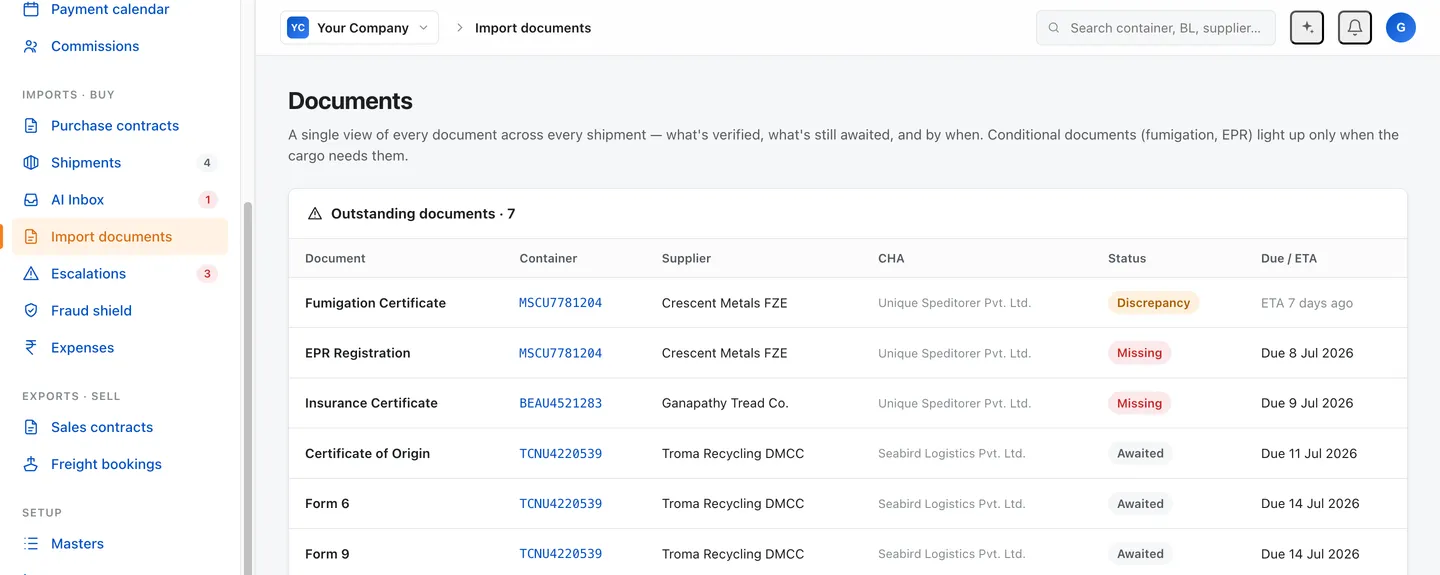
What Docket does is refuse to let the pack go out of sync. It reads the purchase contract, derives which documents the shipment needs and who owes each one, and then cross-checks the packing list against the invoice, the bill of lading and the certificate of origin: parties, descriptions, HS codes, package counts, net and gross weights, marks, container and seal numbers. Where two documents disagree, it says which two and on which field, before the entry is filed. That is what shipping document verification means on an import desk: not generating a clean document, but reading the ones that arrive.
Then it chases. Email first, WhatsApp at 24 hours, SMS at 48, an AI voice call at 72, on channels the supplier already uses and with no portal for anyone to sign up for.
The chase runs about 2.2 hours per container. Doc-pack preparation and checking alone took 45 to 90 minutes of it. Docket automates about 65% of the doc-pack drafting and about 85% of the chasing.
The packing list is the easiest document in the pack to get right and the one most often wrong. Getting it right is worth exactly one thing: the container clears on the first pass.
Sources
- World Customs Organization, Revised Kyoto Convention, General Annex Chapter 3 (Goods declaration and supporting documents)
- IMO SOLAS Chapter VI, Regulation 2, verified gross mass of packed containers
- ICC Uniform Customs and Practice for Documentary Credits, UCP 600, Article 14 on data consistency between documents
- Docket operational baseline, import–export desk