Phytosanitary certificate: what it certifies and who issues it
A phytosanitary certificate is the exporting country's official statement that a consignment of plants or plant products was inspected and meets the importing country's plant health requirements. For India it must be the original, in PQ Form 21 from the country of origin or Form 22 on re-export, and a consignment without it is not permitted import under the Plant Quarantine Order 2003.
- Phytosanitary Certificate
- An official certificate issued by the exporting country's national plant protection organisation stating that a consignment of plants or plant products was inspected and found to meet the importing country's phytosanitary requirements, including any treatment the importer's rules demand.
A phytosanitary certificate is the exporting country telling the importing country, on its own authority, that a consignment of plants or plant products has been inspected and meets the importer’s plant health rules. The model certificate is set internationally by the International Plant Protection Convention; each country prints its own version and names the officers who may sign it. India’s scheme calls the origin certificate PQ Form 21 and the re-export certificate PQ Form 22.
What it says
That the plants or plant products described were inspected or tested according to appropriate procedures, are considered free from the quarantine pests the importing country specifies, and conform to its current phytosanitary requirements. Where a treatment was required, the certificate records it: the treatment, the chemical or method, the duration and temperature, the concentration, and the date.
The certificate describes a specific consignment: the botanical name, the quantity, the number and description of packages, the distinguishing marks, the means of conveyance. Those fields are the ones the officer at the port reads against the packing list and the bill of lading, and they are where a genuine certificate most often fails.
Why it is the late document
The certificate is issued at the loading end, by an authority, after an inspection that the supplier has to book. It cannot be produced by the importer, cannot be reissued quickly from a distance, and cannot be corrected by anyone but the authority that signed it. The agri commodity import page sets out the whole document set it belongs to, including the import permit that only the importer can produce and the food-authority clearance that follows.
Where Docket sits
Docket does not inspect plants and does not sign certificates. The plant protection authority’s officer does that, at the other end.
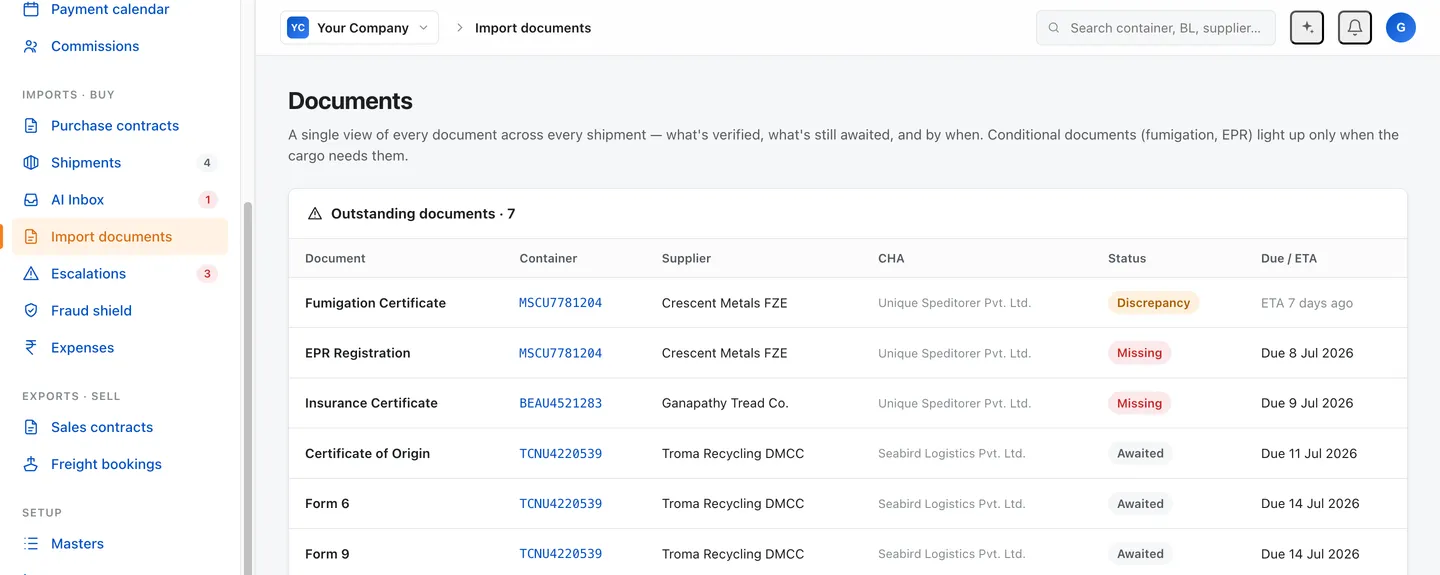
What Docket does is know, from the purchase contract and the commodity, that this shipment needs the certificate and any treatment the schedule demands; chase the supplier for it before loading, daily, on email and then WhatsApp, SMS and an AI voice call; and read the certificate that arrives against the invoice, the packing list and the bill of lading, naming the botanical name, quantity or container number that disagrees while the vessel is at sea. The certificate that is issued late is a chasing problem. The certificate that describes a different lot is a checking problem. Both are the desk’s, and the second is what import document checks is for: reading each arriving document against the others and against the contract, field by field, rather than filing it and discovering the mismatch at the port.
Questions traders ask
Who issues a phytosanitary certificate?
An authorised officer of the exporting country's national plant protection organisation, after inspecting the consignment at or before loading. The importer cannot obtain one, and neither can the supplier on their own; the supplier books the inspection and the authority signs. For goods re-exported from a country that is not their origin, the re-exporting country issues a re-export certificate, PQ Form 22 in India's scheme.
Is a phytosanitary certificate mandatory for import into India?
Yes, for plants and plant products. Clause 3(20) of the Plant Quarantine (Regulation of Import into India) Order 2003 requires the original certificate in PQ Form 21 from the country of origin, or Form 22 on re-export, and a consignment without it is not permitted import. Schedule V and VI commodities also need an import permit applied for at least ten days before shipment.
What does the certificate have to match?
The consignment in front of the officer. Botanical name and description against the invoice, quantity and packages against the packing list, marks and container numbers against the bill of lading, and where the import permit or the schedule requires a treatment, the treatment named on the certificate with its date and method. A certificate that is genuine but describes a different lot is treated as no certificate.
What is a PQ certificate?
PQ certificate is the everyday Indian name for the phytosanitary certificate, after Plant Quarantine — the division of the agriculture ministry that administers the scheme and issues the forms. The same shorthand covers two related documents, so it pays to say which one is meant: the certificate itself is PQ Form 21 for goods from their country of origin and PQ Form 22 on re-export, while the import permit a Schedule V or VI commodity needs before shipment is PQ Form 06. A supplier promising the PQ certificate is promising Form 21; the permit is the importer's own job.
Is a phytosanitary certificate the same as a fumigation certificate?
No. The fumigation or treatment certificate records that a treatment was carried out, by whom, with what and when. The phytosanitary certificate is the plant protection authority's statement that the consignment meets the importing country's requirements, and it may record the treatment as one of the facts it certifies. Indian plant quarantine can require both, and where treatment is ordered on arrival it is arranged at the importer's cost.
Sources
- Plant Quarantine (Regulation of Import into India) Order 2003, clauses 3(17), 3(20) and 4, PQ Forms 06, 21 and 22 · checked 2026-09-06
- International Plant Protection Convention, ISPM 12, Phytosanitary certificates
- Docket operational baseline, import–export desk