Food import documents: Singapore's approved-source rule
Singapore decides a food consignment's paperwork by who made it, not by what it is. SFA accredits the overseas establishment before its product may be imported, and the application comes through the exporting country's government, not from the supplier and not from you. Meat, live poultry, eggs and higher-risk fish need an accredited source; meat products at 5% or less meat content do not.
- HS chapters
- 02 — Meat and edible meat offal · 03 — Fish and crustaceans, molluscs and other aquatic invertebrates · 04 — Dairy produce, birds' eggs, natural honey · 16 — Preparations of meat, fish, crustaceans and molluscs
- Beyond the standard pack
- Licence for Import/Export/Transhipment of Meat and Fish Products, valid one year, held by the Singapore-registered importer before any consignment permit is applied for · Cargo Clearance Permit per consignment, applied for through TradeNet after the licence is in place · Health certificate per consignment, issued by the Competent Authority of the exporting country or region, not by the supplier and not by a private inspector · Proof that the producing establishment is accredited by SFA for the exact product being shipped, checked in the Accreditation Database for Overseas Sources before the order is placed · Meat labelling carrying the country of origin, the processing establishment's designation number, the slaughter date and the net weight, so the label and the health certificate can be read against each other · Registration to Import Processed Food Products and Food Appliances, in place of a licence, where the cargo is processed food rather than meat or fish
The other cargo pages on this site turn on something about the goods. Metal scrap turns on a certificate, plastic waste on a measurement, used clothing on which eight-digit line the commodity sits on. Food into Singapore turns on something else entirely: who made it, and whether two governments agreed about that before the cargo existed.
The approved source is decided before the cargo exists
SFA states the rule plainly. Meat and meat products must only be imported from SFA-approved sources, and all overseas sources of meat and meat products must be accredited before they can be imported. So far that reads like any other licensing requirement, and it is the next sentence that changes how a desk has to work:
Applications for accreditation are submitted to SFA through the Competent Authorities of exporting countries or regions.
Accreditation is done at a government-to-government level.
Read those together and the ordinary escalation ladder has nowhere to climb. The supplier cannot apply for itself. You cannot apply for the supplier. There is no fee, no expedited route and no document that fixes a non-accredited establishment once the box is on the water, because the missing thing is not a document at all. It is a decision taken between a foreign ministry and SFA, at whatever pace those two move.
Which is why, on this cargo, the check belongs in the purchase contract. SFA publishes the Accreditation Database for Overseas Sources and tells importers to use it to check approved sources and establishments before importing any consignment. Before, not during. The establishment’s designation number is the thing to write into the contract beside the supplier’s name, because that number is what the health certificate and the carton label will later have to agree with.
Accreditation also attaches to a product, not to a company. An establishment approved for frozen boneless beef is not thereby approved for cooked beef patties, so “we have imported from them for years” is not an answer to the question of whether this consignment is covered.
The 5% line, and what it does to a recipe
Not all of it needs accreditation, and where the line falls is a number rather than a description. SFA puts products containing 5% or less of meat content outside the accreditation requirement, while holding them to the exporting country’s own export rules.
That is a recipe threshold sitting inside a customs process. Two products off one production line can land on opposite sides of it, and the supplier is the only party who knows the formulation. So the question that has to go into the sourcing conversation is a percentage, asked before the first purchase order, not a category name. Slaughterhouses, cutting plants and meat processing establishments need accreditation; coldstores where nothing is processed, and the farms that supply animals to an overseas slaughterhouse, do not. Fresh fruit and vegetables, ordinary processed food and food appliances need none of it.
A licence for the year, a permit for the box
The instruments stack, and mixing them up is the commonest way a first consignment stalls. The standing permission is annual: a Licence for Import/Export/Transhipment of Meat and Fish Products, or for produce a Licence for Import/Transhipment of Fresh Fruits and Vegetables, or for shell eggs a Licence to Import Shell Eggs, each running a year. Processed food and food appliances take a Registration rather than a licence. Underneath all of them sits the plumbing every Singapore importer needs anyway: an ACRA-registered company, an activated Customs account, a GIRO form lodged with SFA.
Then each consignment needs its own Cargo Clearance Permit, filed through TradeNet, and for meat a health certificate issued by the Competent Authority of the exporting country or region. Not by the supplier, not by a surveyor the supplier retains. A government department abroad has to issue it, which makes it the single most chaseable item in the pack and the one least responsive to being chased. Whoever files your permits, you or your declaring agent, is working from documents that a foreign ministry controls the timing of.
The meat label is the place where the layers have to line up: country of origin, the processing establishment’s designation number, the slaughter date, the net weight. Those four fields are how a carton can be read back against the health certificate and against the HS code on the permit, and a mismatch in any of them is a discrepancy found at the terminal rather than at origin.
The regulated set moves, eight digits at a time
The list of what falls under the meat-and-fish licence is not static, and it changes at the tariff line rather than at the commodity. SFA’s trade circular of 10 January 2025 regulated three lines with effect from 10 February 2025: 02109920, dried pork skin; and under 03061110, smoked frozen rock or spiny lobster and other smoked frozen crawfish. From that date, the circular says, a trader with a registered company in Singapore has to hold the Licence for Import/Export/Transshipment of Meat and Fish Products before applying for a cargo clearance permit for them.
Thirty days is the whole notice period, and dried pork skin is a line a food importer can buy for years as ordinary processed food. The practical consequence is that the HS lines in a live contract are worth re-reading against the current circulars each season, rather than against whatever the file said when the supplier was first approved. This is the same shape the textiles page found in DGFT’s restricted list: the condition attaches to the eight-digit line, so the commodity name in the contract is not a safe summary of the rule.
What the delay costs on chilled and frozen cargo
Every gap on this cargo has the same geometry: the thing that is missing lives abroad, and the cost of it missing accrues here. Document packs routinely run about eight days late against port free time, and a week of demurrage on a single container has cost about US$12,000.
On food that understates it twice over. Free time is counted in units that are not always calendar days, which the Singapore port page sets out from a carrier tariff that counts working days and excludes Saturdays, Sundays and gazetted public holidays, so four free days can mean ten on the calendar and a desk that plans in calendar days will be wrong in the direction that costs money. Then a reefer overstay carries power and monitoring on top of storage. And underneath both, the cargo has a shelf life, so a consignment released late can be compliant and worth less than it cost.
Singapore does not gate every regulated cargo this way, and the contrast is worth holding. Food turns on who made it, and no accreditation means no import at any price. The cosmetic import documents for the same market turn on the opposite arrangement: nobody approves the product at all, you notify it yourself, and the liability that a government-to-government accreditation carries here sits entirely on the seller there.
Where Docket sits
Docket does not apply for a licence, file a permit or accredit anybody. Those are yours, your declaring agent’s, and two governments’.
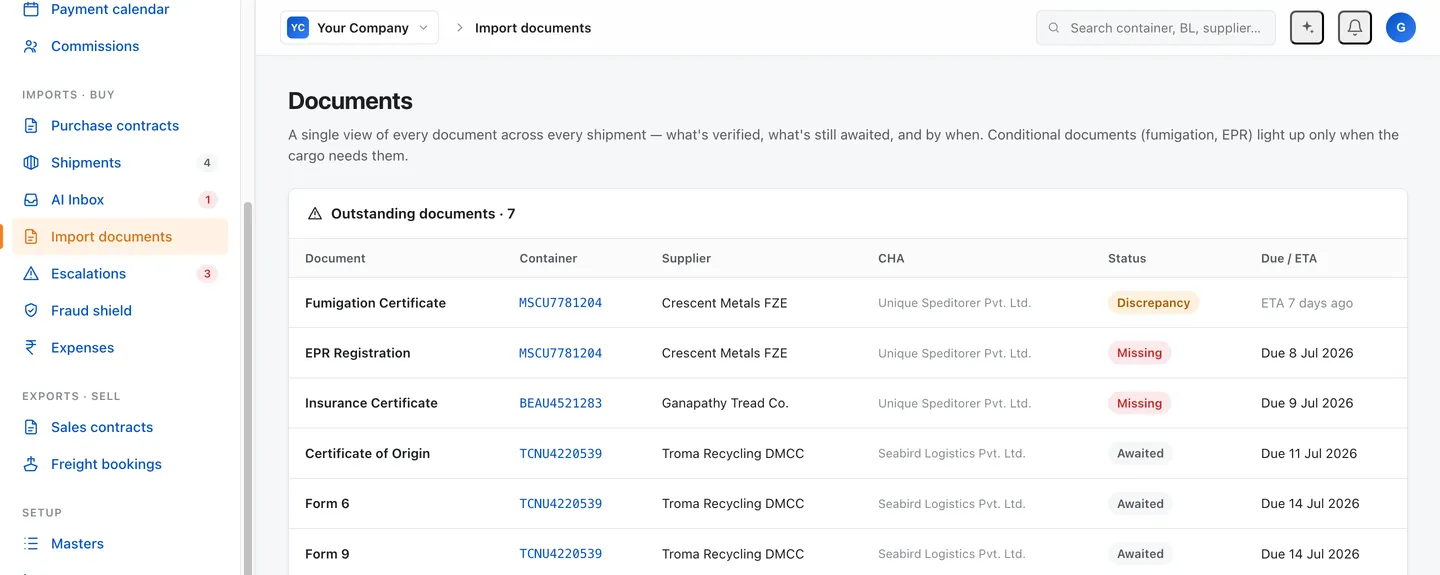
What it does is move the check upstream to where it still works. The purchase contract goes in first, so the system knows the cargo, the HS line and the establishment before the order is placed, and knows from them which of the accreditation, the government health certificate and the labelling fields this shipment has to have. Then it chases those items while the goods are still at origin: the supplier for the establishment’s designation number and the formulation percentage, the authority’s certificate through whoever is obtaining it, on email first and up the ladder after that. Each document that arrives is read against the others, so a designation number that does not match the label, or an HS line that has moved under a new circular since the contract was signed, surfaces as a question at origin instead of a discrepancy at the terminal. That is what import document checking software is for on a cargo whose hardest requirement cannot be bought at any price once the vessel has sailed.
The jobs Docket does on this cargo
- Checks every document is present & correct — BL, invoice, COO, packing list, insurance — verified against your checklist, per container.
- Chases suppliers daily — schedules, prices, docs — Loading schedules until confirmed, prices every morning, and whoever owes the missing document.
- Escalates on WhatsApp / call when it's urgent — Email first. Then WhatsApp, SMS and an AI voice call — automatically.
- Builds your payment calendar itself — Loading confirmed → payables scheduled from your terms; receivables follow the sales contract. Currencies kept separate.
- Tracks every expense — traced to its email — Duty, port charges, CHA fees, detention — pulled from invoice emails, so each container's landed cost is live. Every line links to the email it came from.
Questions importers of this cargo ask
What documents do I need to import food into Singapore?
Three layers, in this order. A company registered with ACRA, an activated Customs account and a GIRO form with SFA. Then the right instrument for the cargo: a Licence for Import/Export/Transhipment of Meat and Fish Products, a Licence for Import/Transhipment of Fresh Fruits and Vegetables, a Licence to Import Shell Eggs, or a Registration to Import Processed Food Products and Food Appliances, each valid a year. Then, per consignment, a Cargo Clearance Permit through TradeNet, plus the health certificate and source evidence the category demands. The licence is the standing permission; the permit is the shipment.
How do I export food to Singapore?
The same way it is imported into Singapore, because it is one transaction seen from two ends — and almost every requirement sits on the Singapore side. The importer holds the licence or registration for the category, holds the Customs account and the GIRO arrangement with SFA, and files the Cargo Clearance Permit through TradeNet per consignment. Two things only your end can supply, and neither can be arranged after the goods sail: accreditation of the overseas establishment, which SFA grants through the Competent Authority of the exporting country at a government-to-government level, and the health certificate that authority issues for the consignment. So an exporter's practical question is not what to file in Singapore but whether its own establishment is already on SFA's accredited list for the exact product, and whether its own authority will certify this shipment.
What is an SFA approved source, and why does it matter before I buy?
It is an overseas farm or establishment that SFA has accredited for a named product. SFA states that meat and meat products must only be imported from SFA-approved sources, and that all overseas sources of meat and meat products must be accredited before import. The reason it matters at contract stage rather than at document stage is how accreditation is obtained: SFA says applications are submitted through the Competent Authorities of exporting countries or regions, and that accreditation is done at a government-to-government level. Your supplier cannot apply for itself and you cannot apply on its behalf. A consignment already afloat from a non-accredited establishment has no paperwork route to compliant.
Which food needs an accredited overseas establishment?
Meat and meat products, live poultry, shell eggs, processed eggs, and the higher-risk fish and fish products. SFA requires slaughterhouses, cutting plants and meat processing establishments to be accredited. Coldstores where no processing happens, and farms that supply animals to an overseas slaughterhouse, do not need accreditation themselves. Fresh fruit and vegetables, ordinary processed food and food appliances need no accreditation, only compliance with the exporting country's own rules.
Does a sauce or a ready meal need an accredited meat source?
It depends on the recipe, which is why this line catches desks out. SFA puts the threshold at meat content: products containing 5% or less of meat content do not require SFA accreditation, though they must still meet the overseas Competent Authority's export requirements. So two products off one production line, a dumpling and a dipping sauce, can sit on opposite sides of the rule, and the question to put to the supplier is a percentage rather than a description.
Can the list of regulated food change after I have signed the contract?
Yes, and it does, at the eight-digit line. SFA's trade circular of 10 January 2025 brought three lines under the meat-and-fish licence with effect from 10 February 2025: 02109920 dried pork skin, and under 03061110 smoked frozen rock or spiny lobster and other smoked frozen crawfish. The circular states that traders with a registered company in Singapore are required to obtain the Licence for Import/Export/Transshipment of Meat and Fish Products before applying for a cargo clearance permit for those products. A line that needed a registration last season can need a licence and an accredited source this one, on a month's notice, so the HS code on the contract is worth re-reading against the current circulars rather than against last year's file.
How does a food import document problem turn into demurrage?
By being unfixable at this end and expensive at this end at the same time. The missing item is a health certificate from a foreign government department or an accreditation nobody in Singapore can grant, while the box is already discharged and on the terminal's clock. Document packs routinely run about eight days late against free time, and a week of demurrage on one container has cost about US$12,000. On chilled and frozen cargo the overstay also carries reefer power and monitoring on top of storage, and the cargo itself has a shelf life the clock does not care about.
Does Docket apply for my SFA licence or accredit my supplier?
No. The licence application is yours, the permit is filed by you or your declaring agent, and accreditation is a matter between two governments that no software touches. What Docket does is make the check happen at the right moment: it reads the purchase contract, knows that this cargo and this HS line need an accredited establishment and a government health certificate, and chases the supplier and its authority for both while the goods are still at origin, rather than discovering the gap when the arrival notice lands.
Sources
- Singapore Food Agency, General Requirements for Overseas Farms & Establishments Accreditation: the categories requiring accreditation (meat and meat products, live poultry, shell eggs, processed eggs, higher-risk fish and fish products); the 5%-or-less meat content carve-out; applications submitted to SFA through the Competent Authorities of exporting countries or regions; accreditation done at a government-to-government level; slaughterhouses, cutting plants and meat processing establishments accredited while coldstores without processing and animal-supplying farms are not · checked 2026-09-26
- Singapore Food Agency, Import Requirements for Food & Food Products: meat and meat products to be imported only from SFA-approved sources; each consignment accompanied by a health certificate issued by the Competent Authority of the exporting country or region; the instruction to use the Accreditation Database for Overseas Sources to check approved sources and establishments before importing any consignment; frozen oysters certified free of norovirus · checked 2026-09-26
- Singapore Food Agency, Businesses that Need Licence / Permit / Registration for Import / Export: Licence for Import/Export/Transhipment of Meat and Fish Products (one year) plus a Cargo Clearance Permit per consignment; Licence for Import/Transhipment of Fresh Fruits and Vegetables (one year); Licence to Import Shell Eggs (one year); Registration to Import Processed Food Products and Food Appliances · checked 2026-09-26
- Singapore Food Agency, What You Need to Know for Import of Food for Commercial Sale: registration with SFA and a licence to import food for commercial sale; an import permit before the food is brought in; meat labelling carrying country of origin, processing establishment designation number, slaughter date and net weight; documents submitted before applying for the import permit through TradeNet; ACRA registration, an activated Customs account and an original GIRO form to SFA · checked 2026-09-26
- Singapore Food Agency trade circular, Newly Regulated HS Codes for Meat and Fish, 10 January 2025, effective 10 February 2025: HS 02109920 dried pork skin; HS 03061110 smoked frozen rock or spiny lobster (Panulirus spp) and other smoked frozen crawfish; the requirement to hold the Licence for Import/Export/Transshipment of Meat and Fish Products before applying for a cargo clearance permit · checked 2026-09-26
- World Customs Organization, Harmonized System Nomenclature, Chapters 02, 03, 04 and 16
- Docket operational baseline, import–export desk · checked 2026-09-26