Importing used clothing and rags into India, line by line
In India, worn clothing and textile rags are the cargo where the eight-digit tariff line, not the commodity, decides whether a box clears. DGFT's ITC(HS) Schedule 1 marks worn clothing (6309 00 00) Restricted, and every rag line in 6310 too, but three of those rag lines may be imported without a licence if the material arrives completely mutilated. Same bales, different line, different answer.
- HS chapters
- 63 — Other made-up textile articles (heading 6309, worn clothing and other worn articles; heading 6310, used or new rags)
- Beyond the standard pack
- A DGFT import authorisation for worn clothing, or the policy condition that removes the need for one on the specific rag line · The mutilation standard in force at the port of clearance, taken from that port's Customs Public Notice or Trade Notice · Packing list and weight list reconciled to the bill of lading at bale level, because the tariff line is argued from what is in the bales
Most cargoes are classified and then the documents follow. Used textiles work the other way round. The bales are the same bales whichever line they are entered under, and the eight-digit line decides whether the container needs a licence the importer does not have.
Two headings, and the gap between them
India’s import policy for this cargo lives in two headings of chapter 63.
6309 00 00, worn clothing and other worn articles. Marked Restricted. The only condition printed against the line is about what happens afterwards: “Units in the Special Economic zone will be allowed to sell worn clothing in the Domestic Tariff Area to the extent of 15% of the cif value of imports made in the previous year.” That is a sales cap on a processor, not a route for an ordinary importer, and it is the clearest signal in the policy that this material is meant to arrive at a unit that will work on it.
6310, used or new rags. Every line marked Restricted as well. But three of them carry a condition that changes the answer completely:
Permitted for import in completely mutilated form without a licence subject to the condition that mutilation must conform to the requirement specified by Customs Public Notice or Trade Notice.
Read those two headings next to each other and the policy is coherent. Wearable garments are controlled. Material cut past the point of being wearable is, on the right line, ordinary trade. The border between them is physical, and it is inspected.
The line, not the commodity
Here is the part that catches desks, and it is visible in the published list itself. Under 6310 the condition is printed against 6310 10 20 (cotton rags), 6310 90 10 (woolen rags) and 6310 90 40 (synthetic rags). It is not printed against 6310 10 10, which is also woolen rags, nor against 6310 90 20, which is also cotton rags.
Woolen rags and cotton rags each appear twice, on different lines, with different conditions. A supplier’s invoice that says “cotton rags” has not told you which of the two lines the consignment is entered under, and the difference between them is a licence.
DGFT prints its own warning on the front of that list: it “may be cross checked with the actual Schedule 1 of ITC(HS) Classifications of Export & Import Items and Notifications thereof”. Treat the compiled list as the map and Schedule 1 as the ground. Settle the line with your customs broker before the contract is signed, not when the vessel is three days out, because everything else on this page follows from it.
The standard that is set at the port
The mutilation condition does not say what completely mutilated means. It defers to “the requirement specified by Customs Public Notice or Trade Notice”. Those are documents issued by the customs formation at the port of clearance.
For a desk that means the acceptance standard is local. Two ports taking the same grade of rags can publish different requirements, and the supplier eight thousand kilometres away is cutting to whatever the last buyer accepted. The word “mutilated” in a purchase contract is not a specification. The notice in force at your port of clearance is.
This is the same shape as the other cargoes where a physical state decides the document set. Metal scrap is gated by a certificate an agency issues against a rule, which is why the metal scrap import documents page is about chasing an inspection abroad. Plastic waste is gated by a measurement in the supplier’s yard, which is why the plastic waste import documents page is about contamination thresholds. Used textiles are gated by a cutting standard published by a customs house. In all three the paperwork is downstream of something a person has to do to the goods, and in all three the desk finds out at the port whether it was done well enough.
What it costs to find out late
If the mutilation is judged insufficient, the consignment does not fail gracefully. It reverts to what it was before the condition applied: a restricted import without an authorisation. The remedy, mutilating or re-mutilating at the port, is work on every bale in the box, and it happens while the clock that started at discharge keeps running.
That clock is the reason this cargo belongs on the same desk as the others. Document packs routinely run about eight days late against free time. A week of demurrage on one container has cost about US$12,000, and on a consolidated lot of low-value bales the charge can pass what the goods are worth. Working the paperwork backwards from the last free day is not an optimisation here, it is the difference between a margin and a write-off, which is what demurrage and detention software is for on this lane.
Where Docket sits
Docket does not classify goods, does not cut bales, does not issue or obtain an authorisation, and does not decide whether mutilation is complete. Those belong to the importer, the customs broker, the supplier and the customs officer.
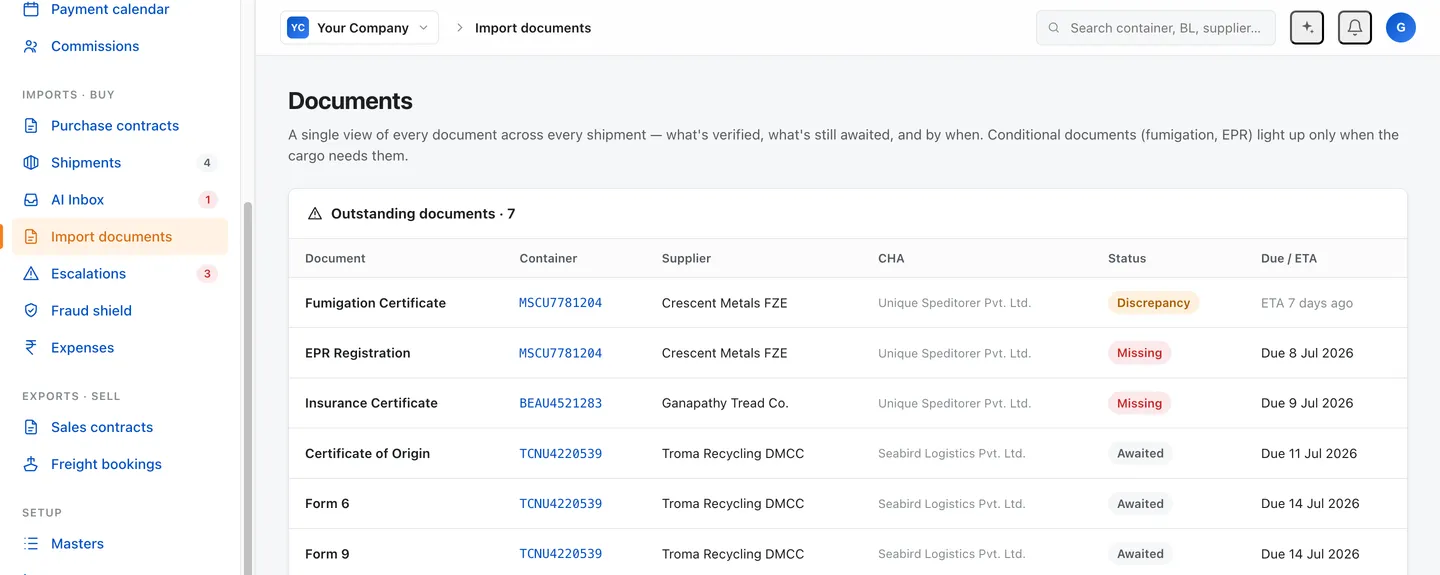
What Docket does is hold the tariff line and its policy condition on the purchase contract from the day the contract is recorded, so the requirement travels with the shipment instead of living in somebody’s memory. It chases the supplier for the bale-level packing list, the weight list and the mutilation evidence before loading, daily, on email first, then WhatsApp, SMS and an AI voice call when email is ignored. It reads what arrives against the bill of lading and names the bale count or the weight that disagrees while the vessel is still at sea. And it works every date backwards from the last free day, so a lot booked to a port whose notice the supplier has not seen shows up as a problem before loading rather than after discharge.
The jobs Docket does on this cargo
- Checks every document is present & correct — BL, invoice, COO, packing list, insurance — verified against your checklist, per container.
- Chases suppliers daily — schedules, prices, docs — Loading schedules until confirmed, prices every morning, and whoever owes the missing document.
- Escalates on WhatsApp / call when it's urgent — Email first. Then WhatsApp, SMS and an AI voice call — automatically.
- Tracks every expense — traced to its email — Duty, port charges, CHA fees, detention — pulled from invoice emails, so each container's landed cost is live. Every line links to the email it came from.
- Logs everything in a full audit trail — Every check, reminder, commitment and dollar on record — with the raw email behind it, one click away.
Questions importers of this cargo ask
Can you import used clothing into India?
Not freely. DGFT's ITC(HS) Schedule 1 lists exim code 6309 00 00, "Worn Clothing and other worn articles", as Restricted, which means it is not importable against the tariff alone. The one condition printed against that line concerns onward sale rather than entry: "Units in the Special Economic zone will be allowed to sell worn clothing in the Domestic Tariff Area to the extent of 15% of the cif value of imports made in the previous year." So the established route is an SEZ or export-oriented unit that processes the material, with a capped share released into the domestic market.
Are rags treated the same as worn clothing?
No, and this is the distinction the whole cargo turns on. Rags sit in heading 6310 and every line of it is marked Restricted, but three of those lines carry a condition the worn clothing line does not: "Permitted for import in completely mutilated form without a licence subject to the condition that mutilation must conform to the requirement specified by Customs Public Notice or Trade Notice." Completely mutilated material on the right line needs no licence. The same material, whole, does.
Which rag lines carry the mutilation condition?
In DGFT's published restricted-items list the condition is printed against 6310 10 20 (cotton rags), 6310 90 10 (woolen rags) and 6310 90 40 (synthetic rags). It is not printed against 6310 10 10 (woolen rags), 6310 10 30 (gunny cuttings), 6310 10 90 (other), 6310 90 20 (cotton rags) or 6310 90 90 (other). Note too that woolen rags and cotton rags each appear twice in that list, on different lines, with different conditions. The condition attaches to the eight-digit line, not to the commodity name. Confirm the line and its current condition against Schedule 1 itself before the contract is signed.
What counts as completely mutilated?
The DGFT condition does not define it. It defers: mutilation "must conform to the requirement specified by Customs Public Notice or Trade Notice". Those are issued by the customs formation at the port, so the operative standard is local and can differ between two ports taking the same cargo. Get the notice in force at your port of clearance in writing, before loading, and give the supplier the cutting standard it sets rather than the word "mutilated".
What happens if the mutilation is judged insufficient at the port?
The consignment stops being a no-licence import and becomes a restricted one without an authorisation, while free time runs. Mutilation ordered or redone at the port is a physical operation on every bale in the container, not a paperwork correction, and it is measured in days. Document packs routinely run about eight days late against free time even on ordinary cargo; a week of demurrage on one container has cost US$12,000.
Does Docket classify the goods or obtain the authorisation?
Neither. The tariff line is settled between the importer and the customs broker, and the authorisation is DGFT's to grant. What Docket does is carry the line and its policy condition on the contract from the day it is recorded, chase the supplier for the mutilation evidence and the bale-level packing list before loading, read what arrives against the bill of lading, and work every deadline backwards from the last free day at the destination port.
Sources
- DGFT, Restricted Items for Import (list compiled from Schedule 1 of the ITC(HS) Classification of Export & Import Items), entries 303–311 covering 6309 00 00 and heading 6310 · checked 2026-09-15
- DGFT, ITC(HS) based Import and Export Policy (Schedule 1, the authoritative text the restricted-items list is compiled from and asks to be cross-checked against) · checked 2026-09-15
- World Customs Organization, Harmonized System Nomenclature, Chapter 63 (headings 6309 and 6310) · checked 2026-09-15
- Docket operational baseline, import–export desk · checked 2026-08-08