Singapore container free time: in working days
Import free time at Singapore is counted in working days, not calendar days. Ocean Network Express's published tariff allows four working days of demurrage from discharge and six for detention, excluding Saturday, Sunday and the public holidays the Ministry of Manpower declares. Four working days therefore runs from four to ten calendar days depending on the sailing.
Carrier free time
| Carrier | Direction | Demurrage days | Detention days | Counted in | Source |
|---|---|---|---|---|---|
| Ocean Network Express (Singapore) Pte Ltd — published agency tariff, standard dry high-cube | import | 4 | 6 | Working days, excluding Saturday, Sunday and public holidays declared by the Ministry of Manpower | Ocean Network Express (Singapore) Pte Ltd Agency Office, Demurrage & Detention tariff, effective 15 July 2019 — inbound demurrage 4 workdays, inbound detention 6 workdays, all cargo natures, all trades |
| Ocean Network Express (Singapore) Pte Ltd — published agency tariff, standard dry high-cube | export | not verified | 8 | Working days, excluding Saturday, Sunday and public holidays declared by the Ministry of Manpower | Ocean Network Express (Singapore) Pte Ltd Agency Office, Demurrage & Detention tariff, effective 15 July 2019 — outbound detention 8 workdays, all cargo natures, all trades |
Singapore is the first of the two markets this site is written for, and it is the port where the free-time arithmetic is least like everywhere else. The number is small and the unit is unusual: not days, but working days.
What “four working days” costs you
The tariff’s own note is the whole page in one sentence:
Work days, where mentioned refers and excludes Saturday, Sunday and Public Holidays declared by the Ministry of Manpower, Singapore.
Four working days is therefore not four days, and it is not a fixed number of days either. It depends on which day of the week the vessel discharged and what the Ministry of Manpower has declared.
Take a box discharged on Friday 13 February 2026. Chinese New Year falls on the Tuesday and Wednesday of the following week. The four working days of free time land on Monday the 16th, Thursday the 19th, Friday the 20th and Monday the 23rd. Saturday, Sunday and the two holidays are not counted. The allowance expires on Monday 23 February, 10 calendar days after the box came off the ship.
The same allowance on a box discharged on a Monday in an ordinary week expires on the Friday: 4 calendar days. One allowance, one tariff, one port, and the deadline moves by 6 days depending on the sailing.
That is worth saying out loud because almost nothing an importer uses counts that way. A demurrage calculator that subtracts four from a discharge date is wrong here. So is a reminder set for “day 4”.
The two clocks, and which one this page can publish
At Jebel Ali the terminal publishes its storage tariff, so that page can state the port’s own charge and the carrier’s separately. Singapore is the other way round.
The carrier side is published, at least by some lines, and the table above carries the one row this site has verified: Ocean Network Express’s Singapore agency tariff, four working days inbound demurrage, six for detention, eight outbound. Note the date on it: effective 15 July 2019. It is the edition ONE’s Singapore agency publishes, and it is seven years old. Check it against what your line has given you in writing before you plan against it, because a published tariff is a default and your service contract is the thing that binds.
The terminal side is not published. PSA issues no public storage tariff of the kind DP World issues for Jebel Ali or JNPA issues for Nhava Sheva. So this page states no port storage charge, and an importer clearing late at Singapore should assume there may be one and ask the terminal or the declaring agent what it is.
The one deadline you can know in advance
There is one Singapore date a desk can plan against without asking anyone, and it is not a free-time date. Singapore Customs requires the permit before the goods are imported, and the declaring agent lodging it through TradeNet needs the invoice, the packing list, the bill of lading and the classification complete and correct to do so.
So the sequence at Singapore runs the other way from the way most desks work it. The permit deadline sits ahead of the vessel. The free-time clock starts at discharge and is counted in a unit that varies. Between them there is no slack to find later. There is only paper that was either ready before the ship arrived or was not.
Where the working days go
Not in the terminal, and not in TradeNet. They go in the fortnight before the vessel arrives, while somebody is emailing a supplier for the certificate that has not come. Document packs routinely run about 8 days late; against four working days that is the allowance spent several times over before the pack is even complete.
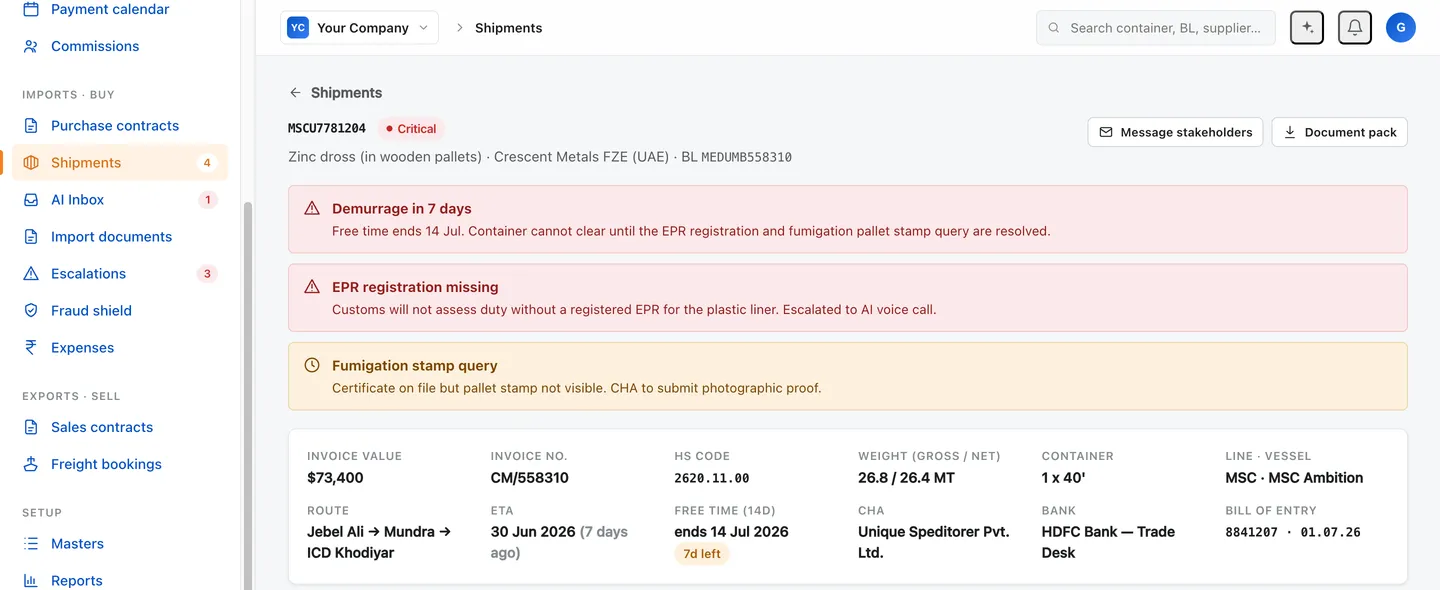
Counting backwards from the last free day, in the right unit and on the right holiday calendar, then chasing whoever owes the missing paper, is the job demurrage and detention software exists to do.
Questions importers clearing here ask
How many free days do you get at Singapore port?
It depends on your carrier, and the answer is in working days rather than days. Ocean Network Express's published Singapore agency tariff allows four working days of import demurrage and six working days of detention, for all cargo natures and all trades. Other lines publish different numbers, and a service contract can override the published tariff, so the only number that binds you is the one your own line has given you in writing.
Is Singapore free time counted in calendar days or working days?
Working days, on the tariff this page cites. ONE's note reads: "Work days, where mentioned refers and excludes Saturday, Sunday and Public Holidays declared by the Ministry of Manpower, Singapore." That is unlike Mundra, whose terminal tariff counts calendar days including Sundays and holidays, and unlike Jebel Ali, which counts ten days from discharge without excluding anything.
When does demurrage start at Singapore?
At discharge from the vessel, not at customs clearance and not at the delivery order. The tariff states that beyond the stipulated free time "demurrage shall be calculated retrospective from the date / time container is discharged from vessel by 24-hour block" — so once free time is exhausted the charge is computed back to the discharge timestamp, and the hour of discharge decides where each 24-hour block falls.
When does detention start and stop on a Singapore import?
The tariff puts it in gate terms: "For Import Container, it will be computed from the date/time container(s) exit PSA Gateway(s) to the date/time the empty container(s) return to Empty Depot by 24 hour block." The demurrage clock and the detention clock are therefore separated by one event, the gate-out, and both allowances are counted in working days.
What are PSA's storage charges at Singapore?
This page does not state them, because PSA publishes no terminal storage tariff the way DP World publishes one for Jebel Ali and JNPA publishes a Scale of Rates for Nhava Sheva. That is a genuine gap in the public record rather than an omission here: an importer clearing late at Singapore may owe a terminal charge as well as the carrier's demurrage, and the terminal half has to come from the terminal or the declaring agent.
Is there a PSA storage charges calculator?
Not one that can publish the rate, and be wary of anything that claims to. A calculator is only as good as the tariff behind it, and there is no public PSA terminal storage tariff to put behind one — so a tool that printed a Singapore terminal figure would be printing a guess. What does work is the other way round: get the rate and the free period from the terminal or your declaring agent once, then put your own numbers into the demurrage and detention calculator, which counts the days and applies the tiers you give it. The arithmetic is the easy half. The rate is the half somebody has to hand you.
Which public holidays stop the Singapore free-time clock in 2026?
The ones the Ministry of Manpower declares: New Year's Day (1 January), Chinese New Year (17 and 18 February), Hari Raya Puasa (21 March), Good Friday (3 April), Labour Day (1 May), Hari Raya Haji (27 May), Vesak Day (31 May), National Day (9 August), Deepavali (8 November) and Christmas Day (25 December). Three of them fall on a Sunday in 2026, which is why the Monday-in-lieu rule matters to a desk counting working days.
Sources
- Ocean Network Express (Singapore) Pte Ltd Agency Office, Demurrage & Detention tariff, effective 15 July 2019 — inbound demurrage 4 workdays, inbound detention 6 workdays, outbound detention 8 workdays, and the working-day, discharge-timestamp and PSA-gate definitions quoted on this page · checked 2026-09-24
- Ministry of Manpower, Singapore — public holidays declared for 2026 · checked 2026-09-24
- Singapore Customs — a customs permit must be obtained before the goods are imported · checked 2026-09-24
- Maritime and Port Authority of Singapore · checked 2026-08-08
- Docket operational baseline, import–export desk · checked 2026-09-24