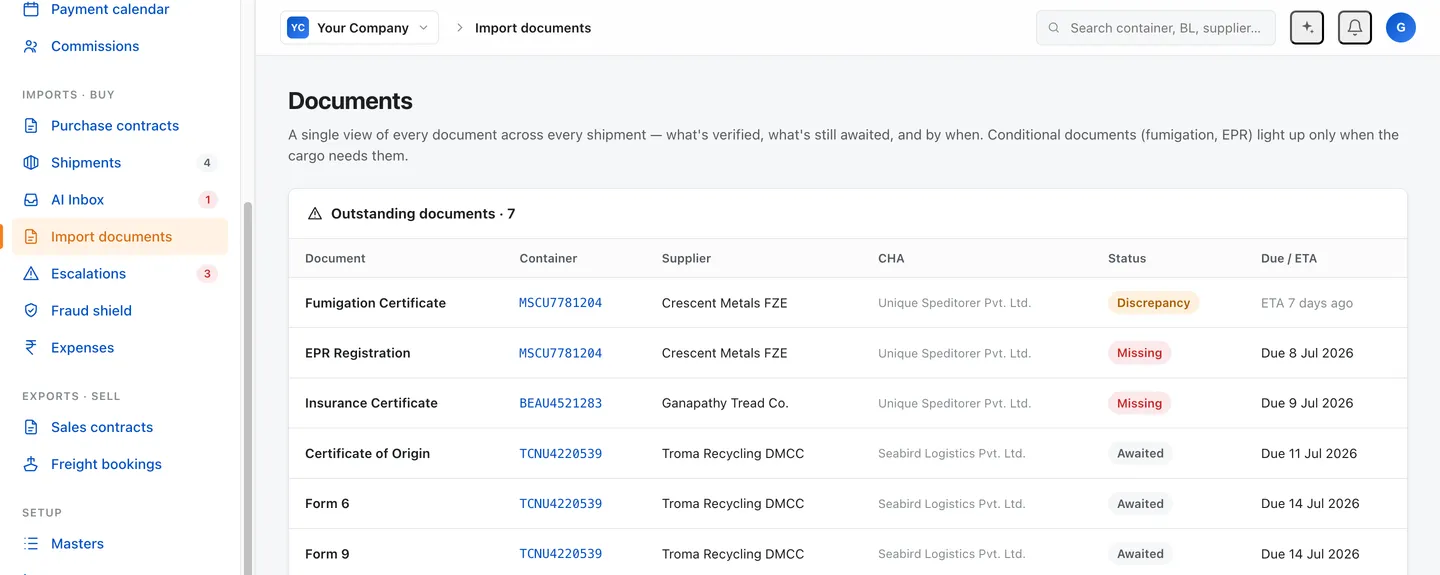
Shipping documentation software for whoever checks the pack
You are the last person to read the pack before the customs broker files it, and the first to be blamed when it is late. Docket reads every document against the contract and against the others in the pack, names the field that disagrees while the box is on the water, and chases whoever owes the missing item so the fourth reminder is not yours.
The pack is never in one place, in one format, at one time. The commercial invoice is a PDF from the supplier. The packing list is a photograph of a printed page, forwarded through two inboxes. The bill of lading arrives as a draft, then as a final, and the second one is not always the one that got filed. The certificate of origin comes from a chamber with its own numbering. The insurance certificate comes from a broker who copies four people.
You open all of it, type the values that matter into a spreadsheet, and compare. Then a correction comes in and you do it again. That is 45 to 90 minutes a container, the largest single line in the 2.2 hours of desk work each container consumes, and it is the line that costs the most when it slips, because a document nobody read is a document nobody can fix.
Two questions, and most desks only ask the first
Is everything there? Commercial invoice, packing list, bill of lading, certificate of origin, insurance certificate, a pre-shipment inspection certificate where the destination demands one, fumigation or phytosanitary where the cargo demands one (the agricultural import documents page lists that set in full), plus whatever the letter of credit lists. A checklist answers this and so does a printout.
Does everything agree? With each other, and with the contract that was signed. This is the harder question and the one that produces demurrage. A consignee spelled the way the exporter’s clerk remembers it. A gross weight on the packing list that is the net weight on the invoice. CIF where the contract says CFR, which is one letter and a different insurance obligation. A container number that matches the bill of lading and not the seal list.
Docket reads the documents that arrived and asks the second question on every one of them. The field that disagrees is named, with the two values side by side and the document each came from. While the box is on the water, not on the day the broker calls.
What happens after the field is named
You do not send the reminder. The chase goes to whoever owes the correction, with the shipment, the document and the field in the message. If email is ignored, WhatsApp at 24 hours, SMS at 48, an AI voice call at 72. The reissued document lands on the shipment when it comes back, is read again, and the item closes. You see every step. You are copied on nothing you did not ask for.
This is the part of the job that made it a full day. About 65% of the drafting and checking is built to run without a person, and about 85% of the chasing. What is left for you is the judgement: whether a description of goods is close enough to the contract line to file, whether to accept a certificate dated a day after the bill of lading, whether the credit’s tolerance covers a short shipment.
The clock this is all against
Free time starts at discharge, in calendar days, and does not pause because a document is pending. Packs routinely run about eight days late against it, and a week of demurrage on one container has cost about US$12,000. Docket derives the last free day from discharge and builds the checklist backwards from it, so every item has a date and the date is the one that matters. The import document checking page walks through the check in detail, and the bill of lading and packing list entries cover the two documents that break packs most often.
What the desk looks like afterwards
The container that took you 45 to 90 minutes of reading takes the minutes it needs to decide the exceptions. The fourth reminder is not yours to send. And when the broker asks where the certificate is, the answer is on the shipment’s timeline with the email it came in on, which is the audit trail nobody has to build by hand.
The jobs Docket takes off this desk
- Checks every document is present & correct — BL, invoice, COO, packing list, insurance — verified against your checklist, per container.
- Chases suppliers daily — schedules, prices, docs — Loading schedules until confirmed, prices every morning, and whoever owes the missing document.
- Escalates on WhatsApp / call when it's urgent — Email first. Then WhatsApp, SMS and an AI voice call — automatically.
- Logs everything in a full audit trail — Every check, reminder, commitment and dollar on record — with the raw email behind it, one click away.
Questions this role asks
Does Docket generate documents, or check them?
Checks them. Document generators produce a clean invoice from your masters; the problem on an import desk is the invoice the supplier sent, the packing list photographed at an angle, the draft bill of lading that was filed instead of the final. Docket reads what arrived, compares every field with the contract and with the other documents, and names the one that is wrong.
Which fields does it compare?
Consignee and notify party against the buyer's registration. Description of goods against the contract line and the declared HS code. Quantity, gross and net weight across invoice, packing list and bill of lading. Incoterm and named place. Ports of loading and discharge. Container and seal numbers across the bill of lading and the packing list. Invoice value, currency and whether the total is the sum of the lines. Dates, in the order the credit requires.
Do I still have to chase the supplier for the reissued invoice?
No. When a field fails, the chase goes to the party who owes the correction, with the document and the field named. Email first, WhatsApp at 24 hours, SMS at 48, an AI voice call at 72. You see every step and the reissued document lands on the shipment when it arrives.
What about the bank?
Under UCP 600 Article 14 a bank examines documents on their face and a discrepancy is refusal. Docket applies the same reading before the presentation, against the credit's own list of documents and dates, so the discrepancy is found on your desk a week earlier than the bank would find it.
Does it replace the customs broker?
No. Filing needs a licence and the licence carries liability, and that sits with a named person. What changes is that your broker gets a complete, checked pack days before the last free day, and Docket chases the filing status if it has not come back.
Sources
- Docket operational baseline, import–export desk
- Docket engineering model — projected automation rate by task
- ICC Uniform Customs and Practice for Documentary Credits (UCP 600), Article 14, standard for examination of documents