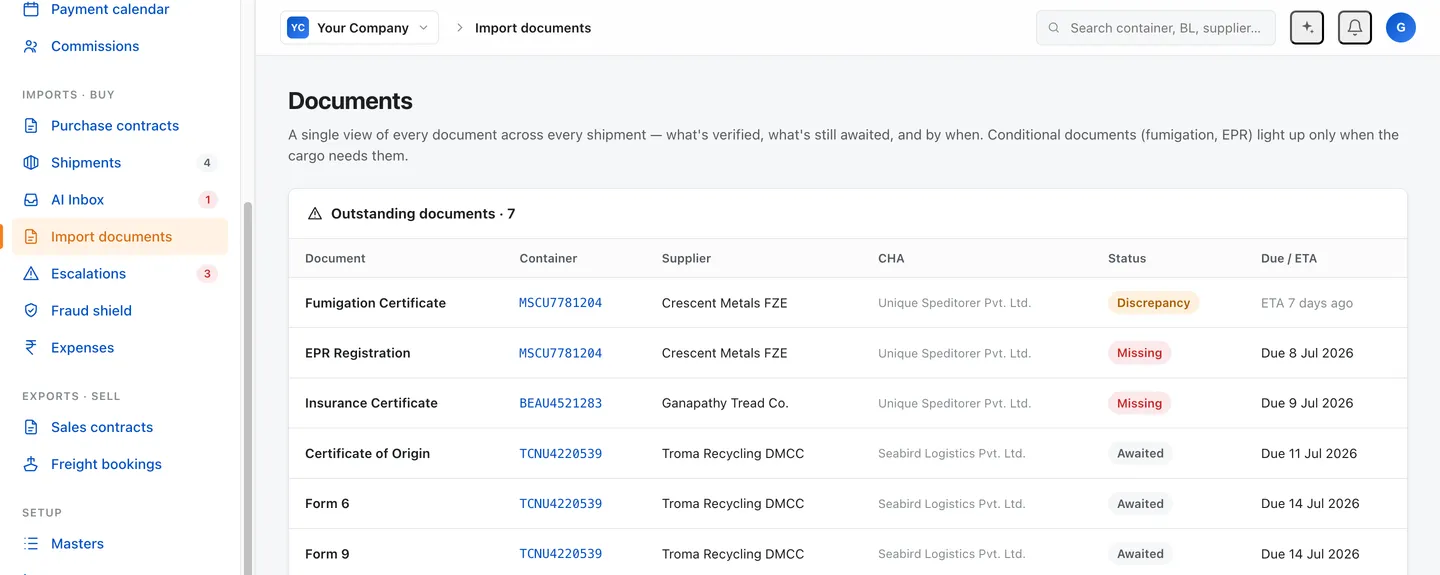
The import document checklist that actually holds
A document checklist that only names documents will not save you. Packs fail on fields that disagree across pages: weight, description, party name, quantity. Check eight fields across the whole pack instead of ticking eight documents. Doc-pack prep and checking runs 45–90 minutes per container, and one payment-diversion attempt on a single shipment was worth US$62,500.
A packing list showed 24,180 kg. The invoice for the same container showed 24,860 kg. Both documents were present, signed and on time. The pack was complete on every checklist you can download.
It still failed, three weeks later, at a bank counter, with the box on the ground and a clock running.
That is the problem with import document checklists. They check that documents exist. Documents existing is not what fails.
Why does a complete document pack still get rejected?
Because a document pack is not a list. It is one story told eight times, and it fails at the sentence that disagrees with itself.
The ICC’s standards for examining documents, ISBP 745, run to hundreds of paragraphs for exactly this reason. Almost none of it is about whether a document was sent. It is about whether the description on page four matches the description on page one. A bank examiner reads across the pack. A trader ticks down a list. Those are different actions and only one of them catches the error.
Four failure shapes cover most of what goes wrong.
The number that disagrees. Gross weight, net weight, quantity, unit price, total. One of them was corrected on one document and not on the other four.
The name that drifts. “Pte Ltd” on the contract, “Pte. Ltd.” on the invoice, the trading name on the certificate of origin. Three spellings of one company.
The description that got helpful. Someone rewrote the goods description to be clearer than the contract. Clearer is worse. The description has to match, not improve.
The date that moved. The shipment date changed, the transport document caught up, the insurance certificate did not.
None of these is a hard problem. Each of them is a five-second comparison that nobody owns.
What documents does an import shipment need?
Build the list from your contract, not from a template you found. That said, this is the shape of most packs.
| Document | Issued by | What it has to agree with |
|---|---|---|
| Commercial invoice | Seller | Contract: parties, description, quantity, price, incoterm |
| Packing list | Seller | Invoice: quantity, gross and net weight, marks, packages |
| Transport document (BL or AWB) | Carrier | Invoice and packing list: description, marks, weight, consignee |
| Certificate of origin | Chamber or authorised body | Invoice: description, consignee, country of origin |
| Insurance certificate | Insurer | Invoice value and incoterm, plus the transport document dates |
| Inspection or survey report | Independent surveyor | Contract specification and the packing list quantities |
| Analysis or mill certificate | Producer or lab | Contract specification, by grade and composition |
| Import declaration | You or your CHA | All of the above, plus the classification and the valuation |
The right-hand column is the checklist. The left-hand column is the filing system. Most desks treat the left as the work and the right as an afterthought, which is backwards.
The eight-field check
Do this once across the whole pack instead of eight times down a list.
1/ Party names. Buyer, seller, consignee, notify party. Character for character, against the contract. Not against last month’s shipment.
2/ Goods description. One wording, taken from the contract, repeated on every document. Repeat the words. Do not improve them.
3/ Quantity and packages. Number of units, number of packages, and the two agreeing with each other on both the invoice and the packing list.
4/ Gross and net weight. The single most common break we see on metals. Check that gross minus tare equals net on the same page before you check it across pages.
5/ Unit price, total value and currency. Multiply it yourself. A total that was typed instead of calculated is a real category of error.
6/ Incoterm and named place. “CIF” is half an incoterm. “CIF Singapore, Incoterms 2020” is an incoterm. The insurance certificate has to make sense against it.
7/ Dates. Shipment date, document issue dates, any expiry. Nothing dated after the document that depends on it.
8/ Shipping marks and container numbers. Marks on the packing list, container and seal numbers matching the transport document.
Eight fields. Fifteen minutes if the pack is clean. The whole point is that the fifteen minutes is fixed. Three days of correction is not.
What does this cost on a real desk?
Timed container by container, the work breaks down like this.
| Task | Time per container |
|---|---|
| Supplier follow-ups | 30–45 min |
| Export doc-pack prep and checking | 45–90 min |
| Status tracking and reporting | 20–30 min |
| Payment tracking | 10–15 min |
About 2.2 hours a container. The document line is the biggest single block and it carries the widest spread: 45 minutes to 90. That 45-minute swing is rework, and it is the block document-checking software exists to remove. A pack that arrives clean sits at the bottom. A pack with one wrong weight sits at the top, because the correction touches the invoice, the packing list, the certificate of origin and sometimes the transport document.
Multiply. Five hundred containers a month is roughly 1,100 hours, against a seven-person desk’s 1,232. Around ninety percent of the team is consumed before anyone buys or sells anything.
And when a pack misses its window, one missed document pack a month at US$1,000 to US$2,000 an event is US$12,000 to US$24,000 a year. No single event is large enough to trigger a meeting. The year-end total is a salary.
Which is why the checklist and the clock are one problem, not two. A demurrage management system that watches the free days and leaves the pack alone is watching the symptom: the item that ran the pack late is on the list above, and it was late because nobody chased the party holding it.
Where should the correct values live?
In your masters, and this is the part most desks skip.
A master is one stored record of a thing that repeats: a counterparty, a commodity grade, a port, a bank account, a standard clause. The legal entity name, spelled once, with the suffix punctuated the way it appears on the incorporation certificate. The goods description, worded once, taken from the contract. The consignee and notify blocks, formatted once.
Without masters, every document on every shipment is a fresh opportunity to type a name. With masters, the check stops being a comparison between eight documents and becomes a comparison between each document and one source. That is the difference between twenty-eight pairwise comparisons across a pack and eight straight ones.
Two rules that keep masters honest.
A master is changed on purpose, never in passing. If a counterparty’s registered name changes, that is a deliberate edit with a date on it, not something a person fixes inline while assembling a pack at 7pm.
The contract beats the master, once, for that shipment. If a specific deal negotiated a different description or a different named place, the shipment carries the exception and the master stays alone. Exceptions that quietly rewrite the master are how a one-off becomes your default two years later.
Build the masters from your last fifty shipments, not from a blank page. The variation you find while doing it is itself the audit.
The check that is not on any checklist
While you are examining the pack, someone is examining you.
A payment-diversion attempt arrives inside a legitimate-looking document thread. The email carries a corrected invoice, a plausible reason, and new bank details. It comes at the point in the deal where new bank details are least surprising, which is the point at which you are already frustrated about a correction.
One such attempt, on a single shipment, was worth US$62,500.
Four signals stopped it, and they are worth taping to a monitor.
A look-alike sender domain. One character different, or a swapped top-level domain.
Bank details changed mid-deal. There is almost never a good reason for this. If there is one, it survives a phone call.
A beneficiary name that does not match the contract party. The account name is the check, not the account number.
Urgency or secrecy language. “Before end of day.” “Do not discuss with the sales team.” Pressure is the tell.
The rule that goes with the four signals: confirm on a phone number you already had, from a previous document, before this thread started. Never the number in the email asking for the change.
The gap in this post
The 2.2 hours and the 45 to 90 minutes are an operational baseline, not a study. The US$62,500 is one payment-diversion attempt on one shipment — a single event, not a rate, and not something to annualise.
The document table above is the common shape of an import pack, not a legal requirement in your country. Commodity, jurisdiction and payment terms all move it. Your customs broker and your bank are the authorities on your specific set, not this page.
Where Docket fits
Docket drafts the pack from your contracts and masters, then runs the eight-field cross-check before the pack leaves your desk. It also screens every inbound email for the same four fraud signals that gave away the US$62,500 attempt. Document-pack drafting is built to run at about 65% without a person, which is the weakest of our three automation lines and the honest number to publish. The last stretch is judgement about a specific counterparty in a specific country, and a machine does not do that today.
Take the eight fields and run them across your next five packs by hand this week. Count how many break. The answer tends to surprise the person who has been assembling those packs for years.
Documents get filed. Fields get you paid.
And for one cargo the pack has a field that is not on any document at all: whether the port on the booking is one of the food import points of entry FSSAI will clear at.
Questions this raises
What documents does an import shipment need?
Commercial invoice, packing list, transport document, certificate of origin and an insurance certificate cover most shipments, with a survey or inspection report and a mill or analysis certificate added by commodity. The exact set depends on the commodity, the country and the payment terms, so build the list from your contract, not from a template.
Why do document packs get rejected when every document is present?
Because rejection happens at field level, not document level. A gross weight on the packing list that disagrees with the invoice, a party name spelled two ways, a goods description that does not match the contract. Every document is there and the pack still fails.
Which fields should I cross-check across the pack?
Party names, goods description, quantity, gross and net weight, unit price and total value, incoterm and named place, shipment and expiry dates, and the shipping marks. Check each field across every page it appears on, not once per document.
How long should checking a document pack take?
Forty-five to 90 minutes per container including preparation. The 45-minute spread is rework, not skill. Packs that come back for correction are what pushes a shipment to the top of the range.
How do I spot a payment-diversion attempt in a document email?
Four signals: a look-alike sender domain, bank details changed part-way through a live deal, a beneficiary name that does not match the contract party, and urgency or secrecy language. Any one of them stops the payment until it is confirmed on a phone number you already had.
Sources
- Docket operational baseline, import–export desk · checked 2026-08-08
- Reported incident, import–export desk: one payment-diversion attempt, US$62,500 · checked 2026-08-08
- ICC, UCP 600 and ISBP 745 (documentary credit practice and standards for examining documents) · checked 2026-08-08