Food imports clear at 171 points of entry. Book to the 172nd and wait.
Imported food is cleared in India only at points of entry where FSSAI has notified an authorised officer. After CBIC Instruction 04/2026 of 20 April 2026 there are 171 of them: 28 seaports, 19 airports, 89 ICDs and SEZs, 35 land customs stations. The list is set by notification and grows a few at a time, so the port on your booking is a document check, not a logistics preference.
There is a question that does not appear on any import checklist and decides whether a food consignment clears this week or next month: is the port on the booking one where FSSAI has an officer?
Imported food in India is released only after the Food Safety and Standards Authority has looked at it. That looking is done by an authorised officer, and authorised officers exist only at the points of entry FSSAI has notified. Book a container of pulses or edible oil to a port that is not on the notification and there is nobody there to draw the sample, scrutinise the documents or issue the no-objection certificate. The customs entry can be filed. The food cannot be cleared.
The list, as of April 2026
CBIC Instruction 04/2026-Customs of 20 April 2026 relayed FSSAI’s current list to every customs formation: 171 points of entry, made up of 28 seaports, 19 airports, 89 inland container depots and SEZs, and 35 land customs stations. The instruction pulls together two FSSAI notifications, of 6 January 2026 and 9 April 2026, which between them added five inland points: ICD Dhirpur in Haryana, the Electronic SEZ Park at Gandhinagar, ICD Naya Raipur, ICD Dahej and ICD Varnama.
Two things about that list matter to a desk.
It is set by notification, not by geography. A port with a customs house and a container terminal is not automatically a food point of entry; it becomes one when FSSAI names an officer there. The five points added this year were all inland depots that had customs formations for years.
And it grows a few at a time. 165 in 2024, 166 later, 168 in January, 171 in April. A desk that checked the list once, when it set up its lanes, is working from a list that is now wrong in both directions: points that have been added, and the occasional point whose officer has been withdrawn.
Why this is a document problem, not a logistics one
A desk thinks of the discharge port as a freight decision: the forwarder’s routing, the consignee’s location, the inland leg. For food it is a document decision, because the port determines whether the Bill of Entry can be followed by the one thing that releases the goods.
The consequence lands on the free-time clock. FSSAI clearance is itself a sequence: documents scrutinised, goods visually inspected, a sample drawn where the authority’s risk profile calls for it, a laboratory report due within five days of the laboratory receiving the sample. That is a rule the 2025 amendment to the Import Regulations restated with effect from 1 May 2026, and it is a laboratory’s five days, not the whole clearance. All of it runs after discharge, inside free time. At a point of entry with an officer, a sampled consignment can spend most of a short free-time allowance waiting for a result. At a point of entry without one, the wait has no end date until the goods move.
Document packs routinely run about eight days late against free time on ordinary cargo. A week of demurrage on one container has cost about US$12,000. Food is perishable and the demurrage is the smaller loss.
The check that prevents it
One line, at contract time, before the booking: is the intended port of discharge on the current FSSAI notification? If it is, the food pack is the usual set plus the agricultural documents the commodity carries: the importer’s own FSSAI licence, labels that meet the standards, the plant-quarantine permit and phytosanitary certificate where the commodity needs them. If it is not, the booking changes before the goods ship, which costs an email. After the goods ship, it costs a port.
The check is cheap because the list is public and short. It gets missed because it does not live on any document in the pack; it lives on a notification that changes three or four times a year and that nobody on the desk is asked to reread.
Where Docket sits
Docket does not clear food, does not draw samples and does not talk to FSSAI. The authorised officer’s decision is the officer’s.
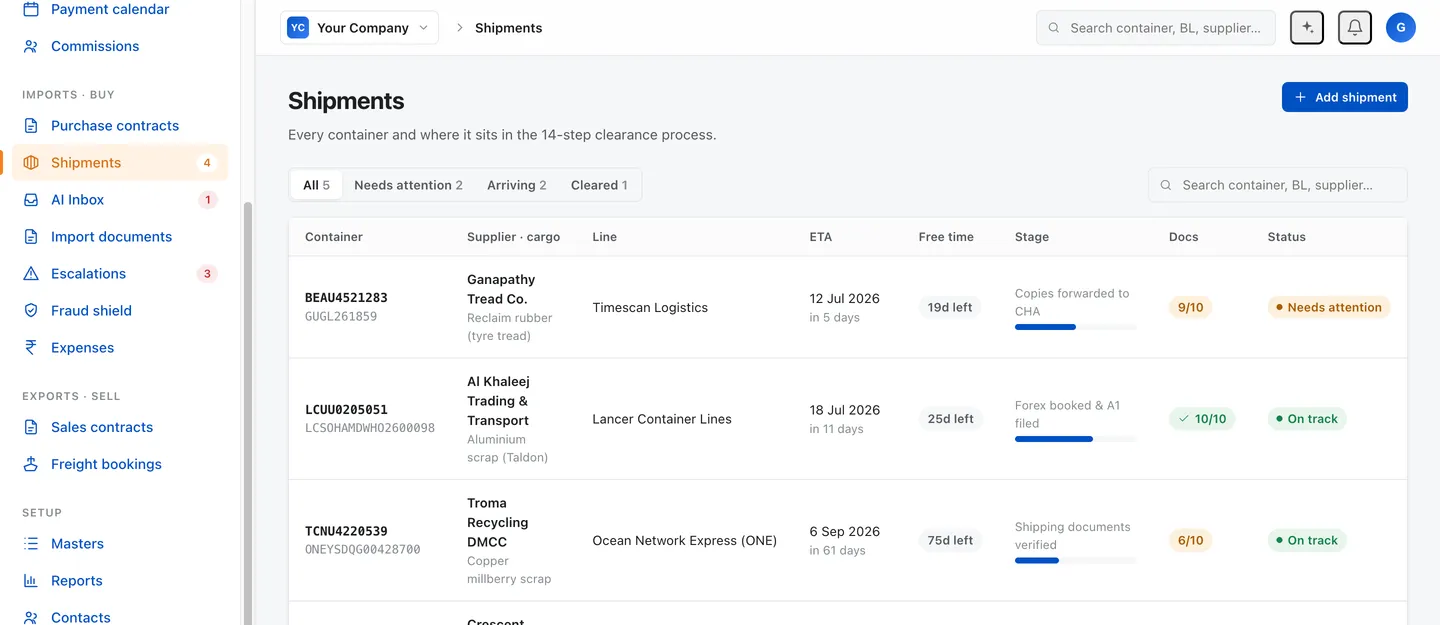
What Docket does is treat the port as part of the document set. When the purchase contract is recorded and the commodity is food, the port of discharge is checked against the notified points of entry as a document item, with a date: before booking. The rest of the food pack, the licence, the labels, the plant-quarantine permit, the phytosanitary certificate, is derived from the contract and the lane, with the party who owes each one, and chased daily on email, then WhatsApp, SMS and an AI voice call. Every date counts back from the last free day with the laboratory’s five days already taken out of it.
That is the import document checking job applied to the one document that is not a document, the port on the booking. About 65% of the checking and about 85% of the chasing is built to run without a person. The decision to ship to a port that is not on the list stays with you, which is the point: it should be a decision, not a discovery.
Questions this raises
Where can I import food into India?
Only at a point of entry where FSSAI has notified an authorised officer. As of CBIC Instruction 04/2026 of 20 April 2026 there are 171: 28 seaports, 19 airports, 89 inland container depots and SEZs, and 35 land customs stations. FSSAI publishes the list as a notification and updates it a few points at a time; the January and April 2026 notifications added five ICDs and SEZs between them.
What happens if my food consignment arrives at a port that is not on the list?
There is no authorised officer there to draw the sample, scrutinise the documents or issue the no-objection certificate, so the consignment cannot be cleared where it stands. It waits, or it moves, and either way the free time on the container runs. Check the port on the booking against the current notification before the goods ship, not after the arrival notice.
Which points of entry were added in 2026?
Five inland points: ICD Dhirpur in Haryana and the Electronic SEZ Park at Gandhinagar under the notification of 6 January 2026, and ICD Naya Raipur, ICD Dahej and ICD Varnama under the notification of 9 April 2026. Customs relayed the combined list of 171 to its formations in Instruction 04/2026.
How long does FSSAI take to clear a consignment?
Documents are scrutinised, the goods visually inspected, and a sample drawn where the authority's risk profile calls for it. Where the sample goes to a laboratory, the Import Regulations require the report within five days of the laboratory receiving it, a timeline the 2025 amendment restated with effect from 1 May 2026. The referral and the sampling visit sit in front of those five days, and all of it runs inside the container's free time.
Sources
- CBIC Instruction No. 04/2026-Customs dated 20 April 2026, authorised officers under section 25 read with section 47(5) of the Food Safety and Standards Act 2006 and regulation 13(1) of the FSS (Import) Regulations 2017 · checked 2026-09-07
- FSSAI notifications of authorised officers at points of entry dated 6 January 2026 (168 points) and 9 April 2026 (171 points) · checked 2026-09-07
- Food Safety and Standards (Import) Regulations 2017, and the First Amendment Regulations 2025 in force from 1 May 2026 · checked 2026-09-07
- Docket operational baseline, import–export desk · checked 2026-09-07