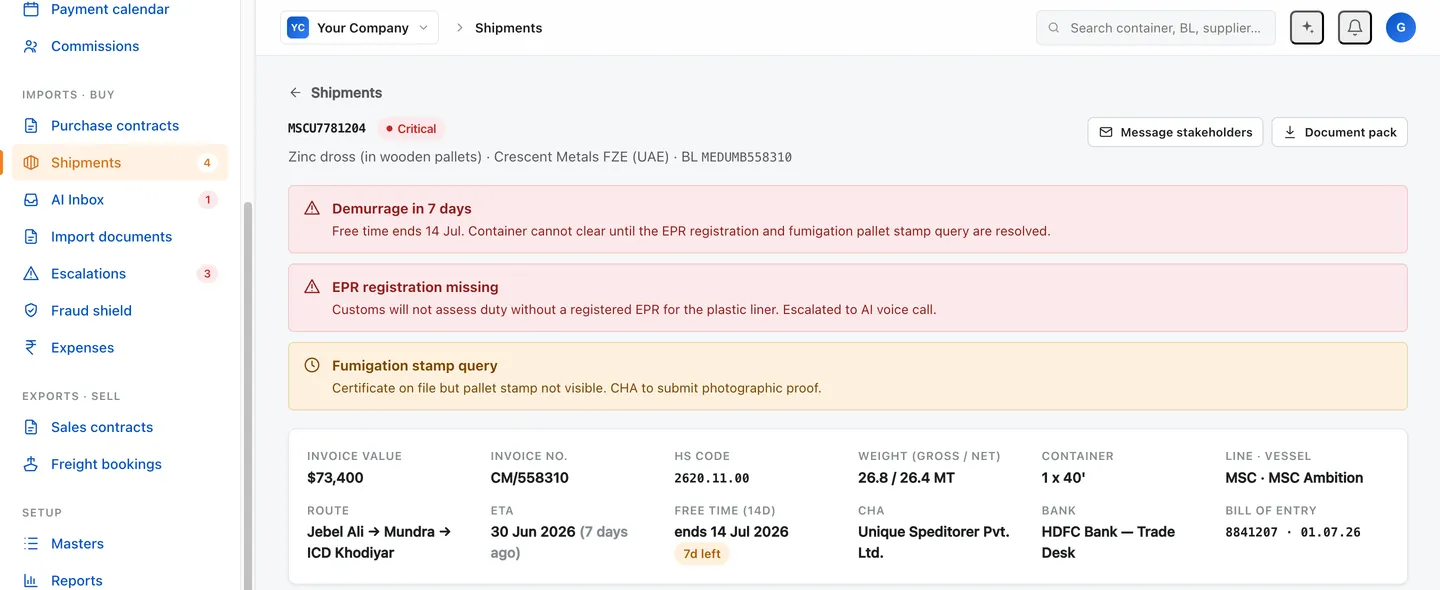
Why am I paying demurrage when the ship arrived on time?
You pay demurrage because two clocks run against every container and neither one is the ship. Port free time starts the hour the box is discharged. Your document pack starts when the supplier answers. Paperwork routinely runs about 8 days behind, and one week of demurrage on one container costs about US$12,000.
US$12,000, for one week of demurrage on one container. The vessel was on schedule. The berth was on schedule. The container was discharged on the day the carrier said it would be. Nobody at the port did anything wrong.
The Bill of Lading was late by five days because a supplier in a different time zone had not confirmed a weight.
That is the whole story of demurrage on an import desk, and it is why the question in the title has a frustrating answer. You are not paying for the ship. You are paying for the paperwork.
Why does demurrage happen when the vessel arrived on time?
Because two clocks start at different moments and only one of them is visible on a tracking portal.
Clock one is port free time. It starts when the container hits the ground, and it does not care what you know about your own shipment. It runs on the terminal’s calendar, through weekends and public holidays, in a country where you are not standing.
Clock two is your document pack. It starts when your supplier answers an email. Which is to say it starts whenever your supplier feels like it.
Everyone watches clock one. It has a website. It sends alerts. The carrier will happily tell you where your box is. Nobody watches clock two, because clock two lives in a mailbox, and a mailbox does not raise an alarm when a message goes unanswered.
| Free-time clock | Document clock | |
|---|---|---|
| Starts | Discharge from the vessel | When the supplier replies |
| Runs through | Weekends, holidays, your time zone | Nothing. It stops when people stop |
| Visible on | The carrier portal, a tracking page | An inbox, a WhatsApp group, someone’s memory |
| Who owns it | The terminal | Nobody |
| What it costs when it slips | Per diem, per container, compounding | Nothing, until clock one catches it |
Read that last row twice. The document clock has no cost of its own. It borrows its cost from the free-time clock. That is exactly why a desk under pressure lets it slip: slipping is free until the day it is very expensive.
How far behind does the paperwork run?
Container by container, here is where it goes.
Typical paperwork lateness against port free time: about 8 days.
Eight days is not a disaster story. It is the ordinary state of an ordinary desk that is doing its job. The team is not lazy. Look at where their hours go and the eight days stop being mysterious.
One container consumes about 2.2 hours of desk work, and it splits like this:
| Task | Time per container |
|---|---|
| Supplier follow-ups | 30–45 min |
| Export doc-pack prep and checking | 45–90 min |
| Status tracking and reporting | 20–30 min |
| Payment tracking | 10–15 min |
Two point two hours per box. Five hundred boxes a month is roughly 1,100 hours. A seven-person desk gives you 1,232 hours in a month at 176 hours a head. Ninety percent of the desk is consumed before anyone has bought or sold a tonne of anything.
A desk at ninety percent utilisation has no slack. And demurrage is a slack problem. The box that goes wrong is never the box you were watching.
What does a week of demurrage cost on one container?
US$12,000, for one container, for one week.
That number moves with port, carrier, contract and equipment type, and I am not going to publish a per-diem table I cannot stand behind. Per-diem tariffs change, they differ by carrier, and half the numbers circulating on the internet are three years old. What I can stand behind is this incident, on this desk, in this currency.
Then there is the quieter version, which costs more over a year because nobody escalates it. One missed document pack a month, at US$1,000 to US$2,000 an event, is US$12,000 to US$24,000 a year. No single incident is big enough to trigger a meeting. The annual total is a salary.
Here is the part traders feel in their teeth. If your trading margin is five percent, every dollar of avoidable fees needs twenty dollars of fresh sales to earn it back. Six hundred dollars of charges is twelve thousand dollars of new business you now have to go and win. Your ops mistake became your sales target.
Which document is the one that is late?
The chain breaks upstream almost every time. Not at the bank. Not at the CHA. At the supplier.
The pattern goes like this. The commercial invoice arrives with a figure that does not match the contract. Someone emails about it. The supplier replies two days later with a corrected invoice and a packing list whose gross weight now disagrees with the invoice. Someone emails about that. By the time the certificate of origin is issued against corrected numbers, the vessel has sailed and the Bill of Lading is being amended, which is its own week.
None of those steps is hard. Each is a two-minute decision waiting three days for a human to make it.
Under the ICC’s Incoterms 2020 rules, who pays for carriage and who bears risk is settled the moment you agree the term. Who chases the supplier for a corrected packing list on a Tuesday is settled by nobody, in any rulebook, anywhere. That job has no owner. It has a volunteer.
Is this demurrage or is it detention?
Worth separating, because they run on different clocks and a desk that conflates them fixes the wrong thing.
Demurrage is the box sitting inside the terminal past its free time. It is a storage charge and it is the terminal’s clock. Detention is the box outside the terminal, unloaded or waiting to be unloaded, not yet returned empty. It is an equipment charge and it is the carrier’s clock.
One late document produces both. The pack is late, so the box sits inside the gate and accrues demurrage. The pack clears, the box goes out to your yard on a Friday, the empty comes back on Tuesday, and detention covers the weekend. Two charges, two invoices, often two different teams arguing about them, from one packing list with a wrong weight on it.
The fix is the same in both cases and it happens weeks earlier, at the supplier.
Can I just ask the carrier for more free time?
You can, and the answer depends entirely on when you ask.
Ask before the clock runs out, with a commercial reason and a named date, and you are negotiating. Ask after the charge is raised and you are requesting a waiver, which is a favour. Favours are finite, and you will want to spend yours on the container that goes properly wrong, not the one that went slowly wrong while everyone watched.
The better move is to change what the deadline is anchored to. Most desks set the document deadline against vessel arrival. Set it against estimated discharge minus your free time minus two days and the whole team is suddenly working to a date that means something.
How do I stop paying it?
Five things, in the order that pays back fastest. None of them need software.
1/ Write the discharge-minus-free-time date on the shipment the day the contract is signed. Not the arrival date. The deadline date.
2/ Give every open document one named owner. Not a team, not a group chat. A person. “The supplier is chasing it” is not an owner.
3/ Escalate on a timer, not on a feeling. Email today. If there is no answer in 24 hours, WhatsApp. In 48, SMS. At 72, pick up the phone. The timer matters more than the channel, because the timer is what removes the judgement call from a person who has forty other boxes.
4/ Check the pack against the contract, not against last month’s pack. Copy-paste is how a wrong weight survives four documents.
5/ Count your misses for one month. Just count them. Most desks have never seen the number, and the number is what gets the meeting.
The gap in this post
The 2.2 hours, the 8 days and the US$12,000 are an operational baseline, not an industry survey. They describe a desk running physical commodity imports where documents sit on the critical path. Buy DDP with a forwarder absorbing the coordination and your numbers are smaller, because the problem is smaller.
The per-diem itself moves with port, carrier, contract and equipment type, which is why there is no tariff table on this page. I am not going to publish one I cannot stand behind.
Where Docket fits
Docket runs the second clock. It reads the purchase contract, derives the document deadline from the discharge date, chases the supplier daily on email and then WhatsApp and then SMS and then an AI voice call, and checks each document against the contract before it goes anywhere near a bank. The chase is where the 85% cut in operations cost per shipment comes from, taking 2.2 hours of desk work down to about 20 minutes.
Most demurrage software sold to importers counts the free days down and tells a person the last free day is close. That is the first clock again, in a nicer colour. The one worth paying for is the one that moves the second clock forward.
We deliberately leave demurrage out of the return case we publish. It is episodic, it is easy for a CFO to argue away, and the ops-cost number is the one a trader can check against their own payroll this afternoon.
If you have paid demurrage because a document was late, I want to talk to you. Send me the shipment. Not the invoice, not a summary. The actual email thread, with the dates on it. Two of them told us more than a quarter of reading did.
The ship was never the problem. The mailbox was.
Questions this raises
Is demurrage the same as detention?
No. Demurrage is charged for a container sitting inside the terminal past its free time. Detention is charged for a container that has left the terminal and has not come back empty. One shipment can incur both, on different clocks, from the same delay.
Whose fault is demurrage when the vessel was on schedule?
Almost always the document chain, not the carrier. Free time starts at discharge. If the Bill of Lading, invoice, packing list and certificate of origin are still being corrected over email, the box waits while the paperwork catches up.
Can I get free time extended after the fact?
Sometimes, and it is the wrong thing to spend your morning on. Extensions are negotiated before the clock runs out, not after. Once the charge is raised it is a waiver request, and a waiver request is a favour, not a right.
How early do documents need to be complete?
Before the vessel discharges, not before it arrives. Work backwards from the estimated discharge date and set the document deadline there. Paperwork routinely runs roughly 8 days behind that mark.
Does Docket promise zero demurrage?
No. Docket closes the gap between the two clocks by chasing the supplier and checking the pack daily. Demurrage and fraud savings are deliberately left out of the ROI case we publish, because they are episodic and a trader can argue them away.
Sources
- Docket operational baseline, import–export desk · checked 2026-08-08
- Reported incident, import–export desk: one week of demurrage on one container, US$12,000 · checked 2026-08-08
- ICC, Incoterms 2020 rules (allocation of carriage and risk between seller and buyer) · checked 2026-08-08