Your landed cost is not final until the entry liquidates
Landed cost software that closes a shipment when the box is delivered closes it too early. On a US import the duty line stays provisional until CBP liquidates the entry, and an entry not liquidated within a year is "deemed liquidated by operation of law" at the amounts the importer asserted. The notice is posted on cbp.gov, not sent to you.
Every landed cost tracking software demo ends the same way. The container is delivered, the charges are allocated, the shipment turns green, and the file closes. It is a satisfying moment and, on a US import, it is about eleven months early.
The duty you paid is not the duty you owe
When goods are entered, the importer of record declares a value, a classification and a rate, and pays on that declaration. Liquidation is the point at which the agency settles what the correct figure was. Until it happens, the duty line is the importer’s own assertion with money attached.
The outside limit is a year, and the way the rule states it is the part worth reading twice. Under 19 CFR § 159.11(a), an entry not liquidated within one year from the date of entry
will be deemed liquidated by operation of law at the rate of duty, value, quantity, and amount of duties asserted by the importer of record.
So silence is not nothing. Silence for a year is a decision, made in your favour, on the numbers you supplied. That is a good outcome and it is still an event your cost record never heard about.
And the year is a default, not a ceiling. A Center director may extend it “for an additional period not to exceed 1 year” where information CBP needs for proper appraisement or classification is not available, or where the importer asks in writing before the period expires and shows good cause. Separately, the period “may be suspended as required by statute or court order”. That is the mechanism that keeps entries open for as long as a tariff question is in litigation, the shape the IEEPA refund question took.
Nobody is going to tell you
This is the half that surprises desks, because it inverts the usual assumption that an agency which wants money will come and find you.
Notice of liquidation of formal entries, says § 159.9(a), “will be provided on CBP’s public Web site, www.cbp.gov”. It is posted “in a conspicuous place” so that it “can readily be located and consulted by all interested persons”, and it is dated with the day it was posted electronically. The message that reaches your broker’s software is, in the regulation’s own verb, something CBP will “endeavor” to transmit. Section 159.11(a) calls it a courtesy notice.
Extensions and suspensions work the same way: posted on cbp.gov, and kept there “for a minimum of 15 months from the date of posting”. Fifteen months is a retention policy, and it is also a hint about how long these things stay unresolved.
A desk that learns its final duty figure by being told is a desk that will sometimes not be told. And the posting it did not read starts a clock: a customs protest has to be filed within 180 days of the notice of liquidation, measured from the posting date rather than from the day anybody noticed it. Miss that and the figure on the cost record is the figure for good.
Why this lands on the cost record and not on the broker
The usual answer is that the customs broker watches liquidation, and brokers do. But the broker watches the entry. The desk needs the number against the shipment: the same shipment that carries the freight invoice, the terminal storage charge, the CFS charges and the demurrage, because that is the unit margin is measured on.
Those two views come apart almost immediately. One entry can cover several purchase orders. One shipment can span more than one entry. A refund posted eleven months later arrives in a month that has already been closed, reported and compared against a budget. Payment tracking is already 10 to 15 minutes a container out of the roughly 2.2 hours of desk work on it, and that is before anyone goes back a year to re-open a file.
So the choice is not between tracking liquidation and ignoring it. It is between a cost record that expects a late correction and one that has to be argued back open.
The vendor question
The cluster has a test for each of these. For the demurrage tools it is whose clock the number came from. For landed cost it is shorter.
After the container is delivered and the file is closed, where does the liquidated duty go?
Three answers, in descending order of usefulness. It posts against the original shipment, and the estimate stays visible beside it, which means the tool was built knowing the figure arrives late. It goes in as a journal entry in the current period: the accounting is right and the shipment’s true landed cost is now unknowable. It does not, because the shipment is closed, in which case the tool is a receiving workflow wearing a costing label.
A fourth answer exists and is worth listening for: we watch cbp.gov and tell you. That is the right instinct, and it is also the admission that the notice is published rather than delivered.
What Docket does with it
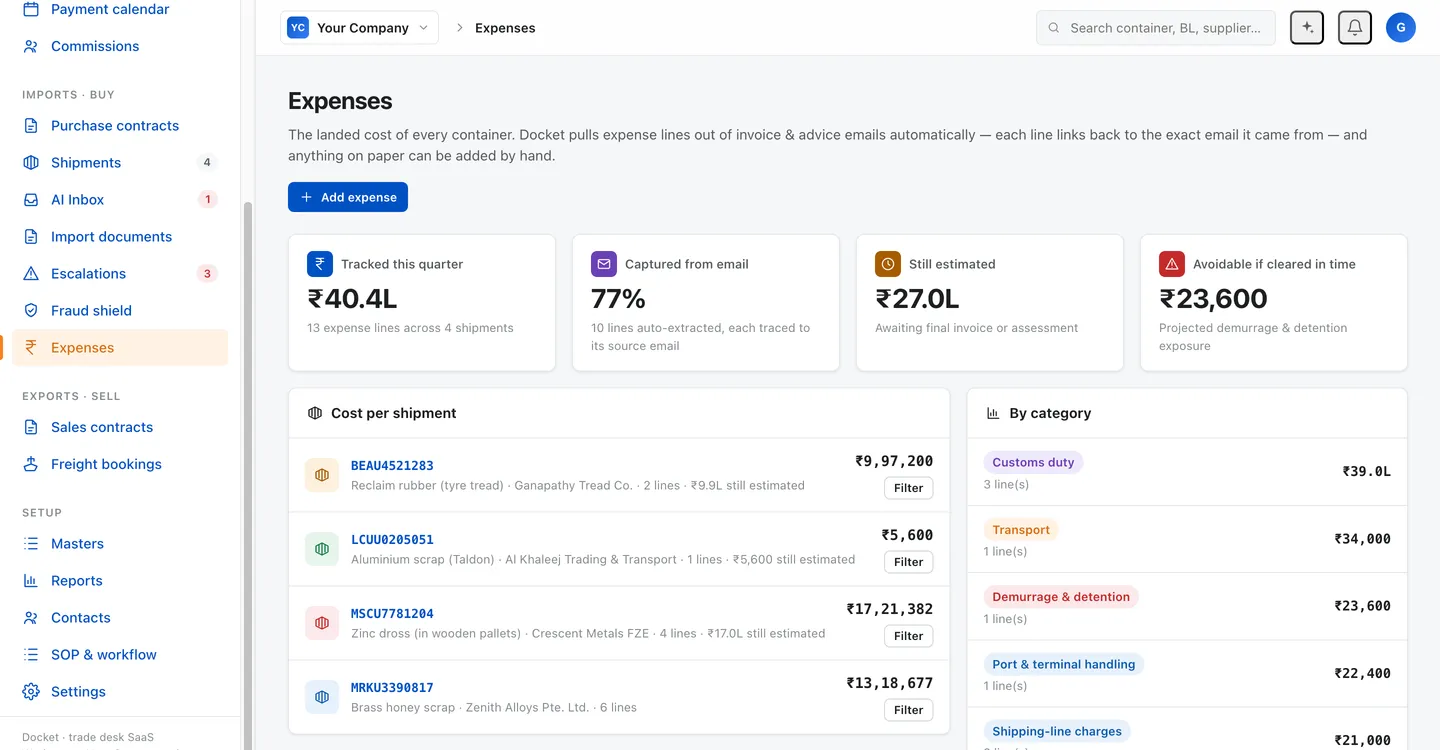
Docket keeps the shipment open after the cargo moves, because the expenses it traces to email arrive on their own schedule anyway: a terminal invoice, a correction, a refund. The estimated duty and the liquidated duty are two fields on one shipment rather than one field overwritten, so the difference is a number you can read rather than a discrepancy somebody has to notice. The payment calendar carries the liquidation window as a date like any other, which is the only reason a desk ever looks at it in time.
None of that is clever. It is the consequence of taking the regulation at its word: the figure is provisional, the notice is posted, and the file has to outlive the box.
Questions this raises
When is a landed cost final?
On a US import, when the entry liquidates. Until then the duty, taxes and fees on the entry summary are the figures the importer asserted, not the figures CBP has settled. The outside limit is one year from the date of entry, after which the entry is deemed liquidated by operation of law at the amounts the importer declared — unless a Center director has extended the period by up to a year, or it has been suspended by statute or court order.
How long after delivery can my duty figure change?
A year as the default, and longer when the clock is extended or suspended. A Center director may extend the one-year statutory period "for an additional period not to exceed 1 year" where information CBP needs for proper appraisement or classification is not available, or where the importer asks in writing before the period expires and shows good cause. Suspension happens "as required by statute or court order", which is how an entry caught in trade litigation stays open.
Will CBP tell me when my entry liquidates?
Officially, it posts. The regulation is explicit that notice of liquidation of formal entries "will be provided on CBP's public Web site, www.cbp.gov", posted "in a conspicuous place" so it can be located by all interested persons, and dated with the day it was posted. A courtesy notice to the filer is something CBP will "endeavor" to transmit. If your process waits for a message, your process waits for a favour.
What should landed cost software do about liquidation?
Keep the shipment open and keep the two numbers apart. The estimate is what you paid at entry; the final figure is what the entry liquidated at, and the difference is a real cost or a real refund that belongs against that shipment rather than in the month it landed. Ask a vendor one question: after the container is delivered and the file is closed, where does the liquidated duty go?
Does this apply outside the United States?
The pattern does, the sections do not. Most customs regimes assess on declared particulars and keep a period in which the authority can reopen, reassess or audit, and the names differ — reassessment, post-clearance audit, final assessment. The US rules are quoted here because they are published in full and precise about the clock. What carries everywhere is the shape: the number on the declaration is provisional, and your cost record has to outlive the cargo.
Sources
- 19 CFR § 159.11, Entries liquidated by operation of law — § 159.11(a): "Except as provided in § 159.12, an entry not liquidated within one year from the date of entry of the merchandise, or the date of final withdrawal of all merchandise covered by a warehouse entry, will be deemed liquidated by operation of law at the rate of duty, value, quantity, and amount of duties asserted by the importer of record", with notice given electronically and CBP to "endeavor to provide a courtesy notice of liquidation" · checked 2026-10-15
- 19 CFR § 159.12, Extension of time for liquidation — § 159.12(a)(1): the Center director "may extend the 1-year statutory period for liquidation for an additional period not to exceed 1 year" where "Information needed by CBP for the proper appraisement or classification of the merchandise is not available" or the importer requests it in writing before the period expires and shows good cause; § 159.12(a)(2): "The 1-year liquidation period may be suspended as required by statute or court order"; § 159.12(b) and (c): notices of extension and of suspension are posted on www.cbp.gov and maintained there "for a minimum of 15 months from the date of posting" · checked 2026-10-15
- 19 CFR § 159.9, Notice of liquidation and date of liquidation for formal entries — § 159.9(a): "Notice of liquidation of formal entries will be provided on CBP's public Web site, www.cbp.gov"; § 159.9(b): the notice "will be posted for the information of importers in a conspicuous place on www.cbp.gov in such a manner that it can readily be located and consulted by all interested persons"; § 159.9(c)(1): the notice "will be dated with the date it is posted electronically on www.cbp.gov" · checked 2026-10-15
- Docket operational baseline, import–export desk — payment tracking runs 10–15 minutes per container of the ~2.2 hours of desk work on it