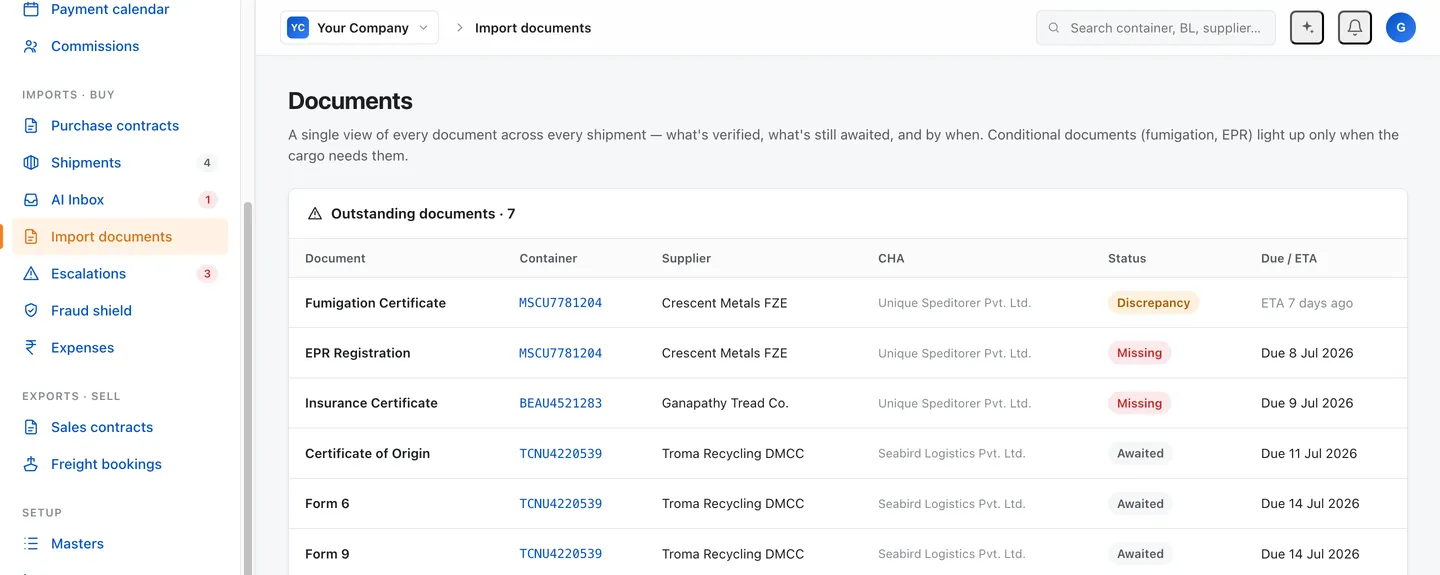
Import and export documentation in one system
Buyers asking for software that handles both import and export documentation are not asking for two modules. They want one record that survives a shipment going out as well as one coming in, and the two are not symmetric: an import deadline counts forward from arrival, an export deadline backwards from gate-in. Export doc-pack prep is the largest line on the desk.
One of the queries this site gets shown for is not a keyword at all. Someone typed “looking for solution that handles both import and export documentation” into Google, in those words, and landed on our document-checking page. One impression. It is worth more than its volume, because it is a buyer describing their own desk in a sentence, and the sentence contains the requirement most vendors in this category quietly fail.
Both directions is the normal case, not the edge case
Trading desks are rarely purely one thing. The house buys and the house sells, often on the same commodity, sometimes in the same week, and the same four people handle the paperwork in both directions. The desk the figures on this site are drawn from is an import–export desk, and that is not incidental to the numbers.
Of the roughly 2.2 hours of desk work a container consumes, the single largest line is export doc-pack preparation and checking at 45 to 90 minutes — ahead of supplier follow-ups at 30 to 45, status tracking and reporting at 20 to 30, and payment tracking at 10 to 15.
Read that against how this category is sold. Almost everything marketed to an importer reads the inbound pack: the invoice, the packing list, the certificate of origin that arrives from a supplier abroad. That is real work and it is the second-largest line. The largest one, on the same desk, with the same people, is the pack going the other way.
The two directions are not mirror images
It is tempting to assume export documentation is import documentation with the arrows reversed. It is not, and the difference is the deadline.
An import deadline counts forward from the ship arriving. The bill of entry is measured against entry inwards; the US entry summary from release; free time and demurrage from discharge. Time passing makes it worse, and almost until the end, a fix is still possible.
An export declaration counts backwards from the ship leaving, and the real cut-off is earlier than the sailing. Singapore Customs’ recommended practice for sea cargo is lodgement
Before cargo lodgement with sea port operators (gate-in)
The United States says the same thing in hours: for vessel cargo, the filing citation is due to the carrier “twenty-four hours prior to loading cargo on the vessel at the U.S. port where the cargo is laden”. Either way, by the time the vessel is working, the box has been in the terminal’s hands for days and the window is shut.
That asymmetry has a practical consequence for software. On the import side a tool can be useful by surfacing a problem late, because the container is sitting there and something can still be done. On the export side there is no equivalent: after gate-in the correction has nowhere to go, and Singapore Customs lists “Submitting declarations only after export” among its common offences rather than among its inconveniences.
One record, because it is one trade
The other half of the buyer’s question is quieter. The documents on both sides of a trade are largely the same documents.
Your commercial invoice, packing list, certificate of origin and bill of lading go out with the cargo and arrive at the other end as somebody’s import pack. The values on them have to agree with your sales contract, and, where you bought the goods to sell them, with your purchase contract too. Two systems means the same consignment is typed twice, checked against two different sources of truth, and reconciled never.
This is why the contracts are the entry point rather than the documents. The purchase contract says what you are owed and by whom; the sales contract says what you owe and by when. Every check in both directions is a comparison against one of those two, and every chase is a consequence of one of them being unmet.
What to ask a vendor
Three questions separate the tools that genuinely hold both directions from the ones with an export tab.
- Which date is the deadline hung off? If the export clock counts from vessel departure rather than from cargo lodgement at the terminal, it is late by days on every shipment and will never say so.
- What happens when a field disagrees with the contract? Recording that a document arrived is not checking it. Naming the field, showing both values and chasing the correction is.
- Is the record one record? If the outbound pack and the inbound pack live in separate modules with separate masters, the overlap between them is doing no work for you.
Import document checking software earns the name on the second question. The first and the third are what make it worth running on a desk that sells as well as buys.
Questions this raises
Is there software that handles both import and export documentation?
Handling both means one system that reads documents against a contract, in either direction, and chases whoever owes the missing one. Docket records the purchase contract on the buy side and the sales contract on the sell side, and runs the same completeness and correctness check over both packs. What it does not do is file for you: your customs broker or declaring agent files, in both directions, and that is their licence and their liability.
Why would one tool need to cover both directions?
Because most trading desks are not importers or exporters, they are both, and the same people do both jobs on the same day. The desk this site's figures come from is an import–export desk, and the single largest line in the roughly 2.2 hours of work a container takes is export doc-pack prep and checking, at 45 to 90 minutes. A tool that reads only the inbound pack leaves the biggest line of the day untouched.
What is actually different between import and export documentation?
The direction of the clock and who owes you the paper. An import entry is timed against the ship arriving and the documents are owed to you by a supplier in another country. An export declaration is timed against the ship leaving — in practice against gate-in at the terminal, which is earlier — and the documents are owed by you. Chasing someone else and being chased are different problems with the same deadline discipline behind them.
Do import and export documents overlap?
Heavily, and that is the argument for one record rather than two. The commercial invoice, packing list, certificate of origin and bill of lading appear on both sides of the same trade; your export pack becomes somebody's import pack at the other end. Keeping them in two systems means the same values are typed twice and reconciled never.
What should I ask a vendor about export documentation?
Two questions. First: does the deadline it tracks hang off the vessel's departure or off cargo lodgement at the terminal, because those are different dates and only one of them is the real cut-off. Second: when a field in the export pack contradicts the sales contract, does the system raise it and chase the correction, or does it record that the document arrived?
Sources
- Docket operational baseline, import–export desk — about 2.2 hours of desk work per container, of which export doc-pack prep and checking is 45–90 minutes, supplier follow-ups 30–45, status tracking and reporting 20–30, and payment tracking 10–15
- Singapore Customs, Export Procedures Overview — "Exporters must obtain a Customs export permit before exporting goods from Singapore"; recommended practice "Export by sea: Before cargo lodgement with sea port operators (gate-in)"; common offences include "Submitting declarations only after export" and "Failing to submit export documents within 14 days after vessel or aircraft departure" · checked 2026-10-16
- 15 CFR § 30.4, Electronic Export Information filing procedures, deadlines, and certification statements — for vessel cargo the filing citation or exemption legend is due to the carrier "twenty-four hours prior to loading cargo on the vessel at the U.S. port where the cargo is laden" · checked 2026-10-16