Bill of lading: the document that is the cargo
A bill of lading is the carrier's receipt for your cargo, the evidence of the carriage contract, and, when it is made out to order, the document of title. Whoever holds the endorsed original set can claim the box at destination. That is why an original stuck in a courier bag or a bank's document room costs demurrage while the container sits in the port doing nothing.
- Bill of Lading
- The transport document a carrier issues for goods received, which works at once as a receipt, as evidence of the contract of carriage, and, when made out to order, as the document of title to the cargo.
A bill of lading is three documents sharing one name. It is the carrier’s receipt for the goods. It is evidence of the contract of carriage. And when it is made out to order, it is the document of title: whoever holds the endorsed original set can claim the cargo at destination. Your purchase contract cannot do that. Your commercial invoice cannot do that.
What is a bill of lading?
The carrier, or an agent signing for the master, issues the bill of lading once the goods are received or loaded. The paper records what was received, in what condition, from whom, for whom, and where it is going. The Hague-Visby Rules set out what the carrier has to state on it: the leading marks, the number of packages or the quantity or weight as furnished by the shipper, and the apparent order and condition of the goods.
That last phrase is the one importers skim past and lawyers read first. “Apparent order and condition” is what makes a bill of lading clean. A clean bill says the carrier saw nothing wrong on the outside of the packages when it took them. A claused bill says the carrier saw something: torn bags, rust, wet cartons, short count. A claused bill is often unacceptable under a letter of credit, so a single line typed by a tallyman in a port you have never visited can stop your payment.
Three parties appear on the face of it. The shipper is who handed the goods over. The consignee is who receives them. The notify party is who the carrier tells when the vessel arrives, which is frequently your customs house agent and not you.
Why does the original matter so much?
Because the original is the goods.
A negotiable bill of lading is issued in a set, usually three originals and several non-negotiable copies. Any one of the originals is enough to take delivery, which is why the carrier will only release cargo against one of them and will take the whole set out of circulation once it does. Surrender one original and the other two are dead paper.
Trace what this means in practice. The exporter loads the container in Jebel Ali. The carrier issues three originals to the exporter. The exporter hands the set to their bank. The bank sends it to your bank. Your bank releases it to you against payment or against acceptance. You endorse it and hand it to your customs house agent, who surrenders it to the shipping line’s local office in exchange for the delivery order. Only then does the terminal let the box out.
Count the hops. Five parties, two banks, one courier, and a physical object that has to travel the same route your container just travelled, on a slower vehicle. On a short regional lane the vessel routinely beats the paper. The ship berths, the box discharges, and free time starts counting while your original bill of lading is in a pouch somewhere over the Arabian Sea.
Document packs routinely run about eight days late against free time, and a week of demurrage on one container runs about US$12,000. Nothing was wrong with the cargo. The cargo was in the port the whole time.
Original, seaway bill or telex release: which one do you want?
There are three ways to move a container’s release rights, and traders treat them as one thing until the day the choice costs them money.
| Original B/L (to order) | Sea waybill | Telex release / express B/L | |
|---|---|---|---|
| Document of title | Yes | No | No, the originals are surrendered at origin |
| Cargo released against | Surrender of one original | Consignee proving identity | Carrier’s release message to the destination office |
| Can be sold or pledged in transit | Yes, by endorsement | No | No |
| Works under a documentary credit | Yes, this is the normal instrument | Rarely, banks want title | Rarely |
| Physical courier needed | Yes | No | No |
| Typical use | Open trade, LC business, goods traded afloat | Same-group shipments, trusted repeat counterparties | Prepaid cargo where payment is already settled |
The trade-off is exactly the trade-off between security and speed. An original bill of lading protects the seller: the buyer does not get the goods until the bank has the money or the acceptance. A sea waybill protects the schedule: nothing has to be couriered, so nothing can be late. Traders who ship monthly to the same buyer on advance payment and still insist on original bills are paying demurrage to protect against a risk they already closed with the payment terms.
Decide this at contract time, in writing, per counterparty. It is a line in the purchase contract, not a decision for the day the vessel berths.
What is the difference between a master B/L and a house B/L?
A master bill of lading is issued by the ocean carrier to whoever booked the space, which is usually the freight forwarder or NVOCC. A house bill of lading is issued by that forwarder to you. On a consolidated LCL load, one master bill covers the container and several house bills cover the individual shipments inside it.
The practical consequence: your house bill is only as good as the forwarder who signed it. If the forwarder does not settle with the ocean carrier, the carrier holds the container and your house bill is a claim against a company, not a claim on a box. Ask which document you are actually holding before you assume you control the cargo.
What does the bank check on a bill of lading?
Under a documentary credit, the bank pays against documents and never against goods. UCP 600 Article 20 sets out what a bill of lading has to show for a bank to accept it, and the list is unforgiving: the name of the carrier, a signature identified as carrier or master or a named agent signing for one of them, an on-board notation with the loading date, the port of loading and the port of discharge named in the credit, and the full set of originals where the credit calls for them.
A discrepancy is any gap between the document and the credit. The buyer’s name spelled two ways. A port named “Nhava Sheva” in the credit and “JNPT” on the bill. A shipped-on-board date one day after the latest shipment date. Each one gives the issuing bank grounds to refuse, and then payment turns into a negotiation you did not plan for.
The fix is boring and it works: check the draft bill of lading against the letter of credit, field by field, before the carrier issues the original. After issue, a correction means a switch bill, an amendment fee, and days.
What goes wrong, and what it costs
Four failures show up again and again on an import desk.
The original arrives after the vessel. Free time runs, demurrage starts, and the desk pays for a container nobody moved.
The consignee field is wrong. Made out to a group entity instead of the importing entity, or to the bank when the credit said to order and blank endorsed. The line will not release against it, and amending a bill after issue is slower than issuing one.
The description does not match the invoice, the packing list or the certificate of origin. Customs reads all of them together. One document saying 25.00 MT and another saying 25.400 MT is a query, and a query is days.
The bill is claused. The tallyman noted wet bags or a short count. Under a credit, that can end the payment. Outside a credit, it is the start of a cargo claim.
None of these are shipping problems. They are all document problems, which means they are all upstream of the port, which means they are all fixable before the vessel sails.
How do you keep the bill of lading from running you?
Work backwards from discharge, not forwards from booking.
Fix the release mechanism in the purchase contract: original set, sea waybill or telex, per supplier, per payment term. Get the draft bill of lading from the shipper or the forwarder before issue and check it against the credit, the invoice and the packing list on the same screen. Name a courier deadline that sits ahead of the estimated arrival with real slack in it, and chase against that date rather than against the vessel schedule. Ask the carrier for the number of originals you actually need. Three originals moving through two banks is three chances to lose one.
And know your last free day. Every document deadline on the shipment hangs off that date.
Where Docket sits
Docket does not issue bills of lading and does not sign them. The carrier does that, and no software changes it.
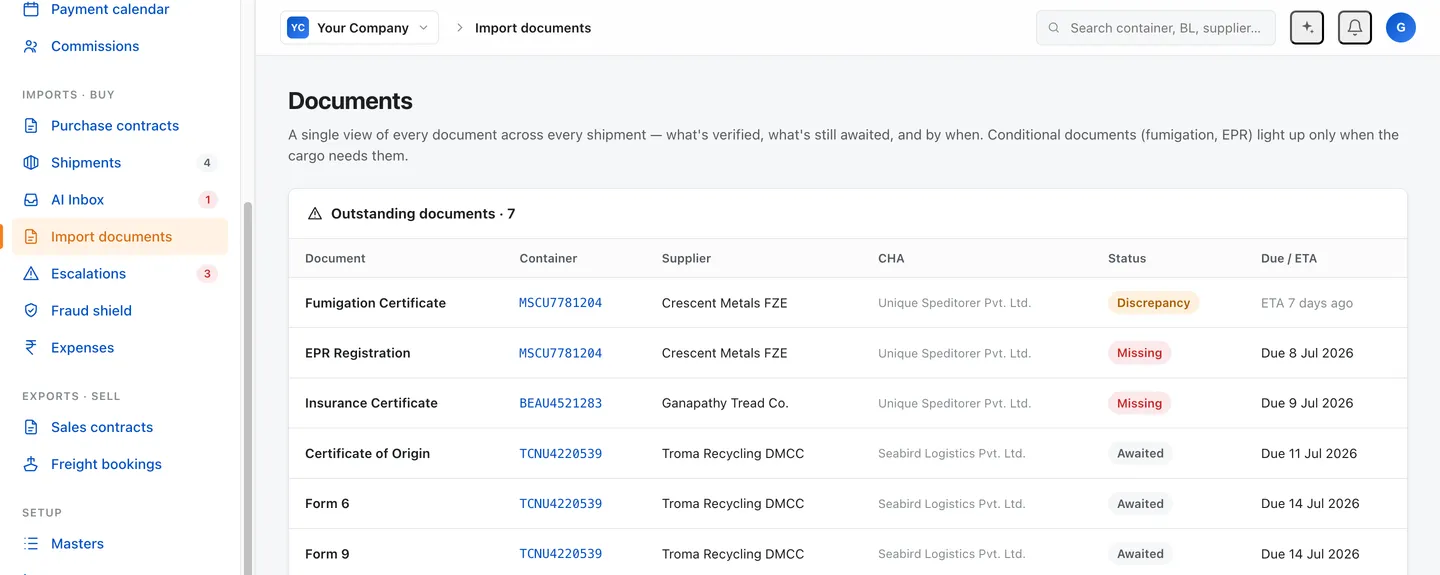
What Docket does is take the purchase contract, derive every document the shipment needs, and chase the people who owe them. This is what trade documentation software should mean in practice: it reads the draft bill of lading against the contract and the rest of the pack, flags the fields that disagree, and keeps asking the shipper, the forwarder and the customs broker until the paper exists. When someone goes quiet it escalates on the channels they already use: email, then WhatsApp at 24 hours, SMS at 48, an AI voice call at 72.
The per-container chase runs about 2.2 hours. Roughly 45 to 90 minutes of that was doc-pack preparation and checking. Docket automates about 85% of the chasing and about 65% of the doc-pack drafting.
The target is narrow. Have the original in the right hands, or the release message sent, before the last free day. Then there is nothing to pay.
Sources
- Hague-Visby Rules (International Convention for the Unification of Certain Rules of Law relating to Bills of Lading, 1924, as amended by the 1968 and 1979 Protocols)
- ICC Uniform Customs and Practice for Documentary Credits, UCP 600, Articles 20 and 27
- Docket operational baseline, import–export desk