Licensed warehouse: duty stops, storage does not
A licensed warehouse is premises licensed by a customs authority in which imported dutiable goods may be held with duty and GST suspended, payable only on removal into the customs territory for local use. In Singapore the scheme covers liquor, tobacco, motor vehicles and petroleum, and storage may be indefinite. What it suspends is tax. It does not pause free time or terminal storage.
- Licensed warehouse
- Premises licensed by a customs authority in which imported dutiable goods may be stored with duty and GST suspended until the goods are removed and enter the customs territory for local use or consumption.
A licensed warehouse is premises a customs authority has licensed to hold imported dutiable goods with the duty and GST suspended. The goods are in the country and not yet in its tax net; the bill falls due when they leave the warehouse for local use.
In Singapore the scheme is narrow by construction, because so little is dutiable there in the first place. Duty applies to four categories of goods: intoxicating liquors, tobacco products, motor vehicles, and petroleum products and biodiesel blends. Those five classes of goods are exactly what the Licensed Warehouse Scheme names. For everything else there is the Zero-GST Warehouse Scheme, which suspends GST and has no duty to suspend. Singapore Customs puts the distinction in one line: “The type of warehouse determines which taxes are deferred.”
The word that does the work is “approved”
The scheme “allows approved companies to store imported dutiable goods for an indefinite period in a designated area licensed by Singapore Customs, known as licensed premises.”
That is a licence held by a company over specific premises. It is not a document issued per shipment and not something a declaring agent can arrange while a box is sitting in the stack. The practical consequence for a desk is a sequencing rule rather than a paperwork rule: the duty-suspension option exists for a consignment only if the licence existed before the vessel arrived. A desk that budgeted for deferred duty and has no licence pays it at import instead, on cargo whose selling season may be a quarter away.
The indefinite period is the real benefit, and it is unusual
“For an indefinite period” is worth sitting with, because the other way goods end up stored under a customs authority’s eye is the opposite of indefinite. Cargo that is never entered goes into general order, and merchandise that stays in customs custody for six months from importation without all estimated duties and charges paid is considered unclaimed and abandoned.
Both are “goods held with duty unpaid.” One is a commercial decision with no deadline; the other is a default with a six-month fuse. Reading the first as though it were the second, or the reverse, is how a desk mis-sizes the risk on a slow-moving consignment.
What it does not touch
This is the part worth being blunt about, because the phrase “duty suspended” reads like a general pause and is nothing of the kind.
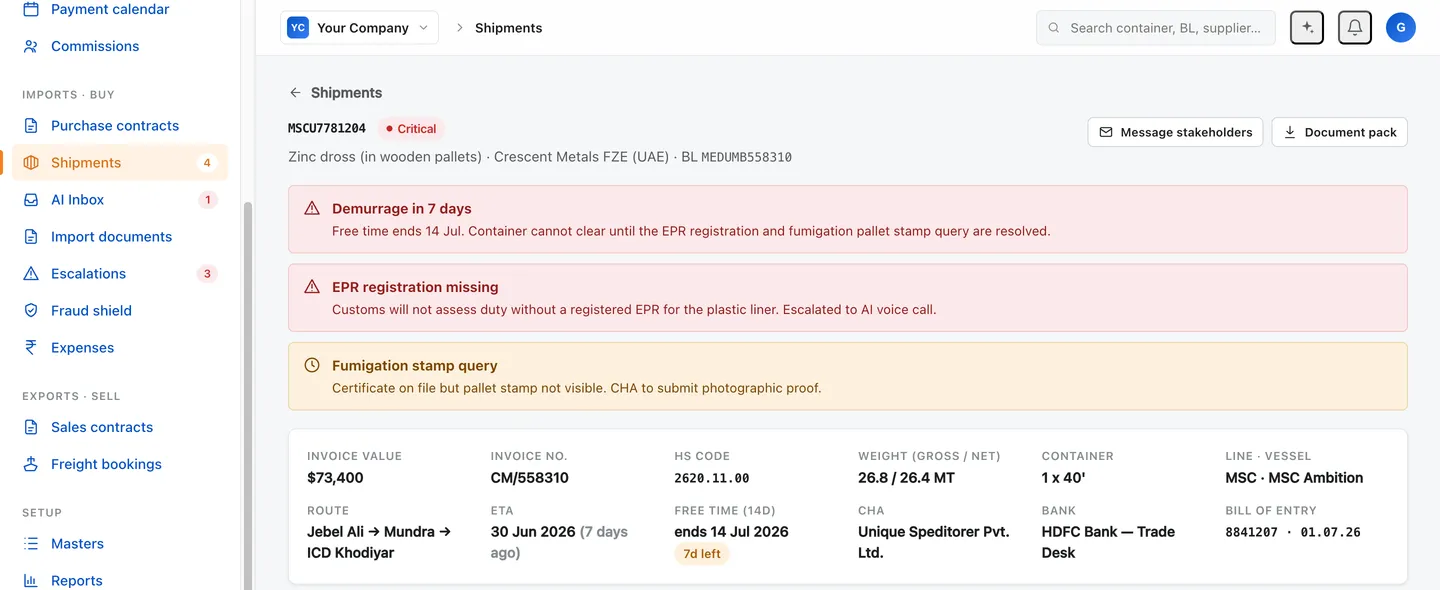
A licensed warehouse suspends taxes owed to a government. It has no effect on the terminal storage charge, which is owed to the terminal operator under its published tariff, or on the carrier’s free time and detention, which are owed to the shipping line under a service contract. Those charges are indifferent to the tax status of the cargo. A consignment can be duty-suspended and accruing storage on the same day, to two different creditors, on two clocks that started at different events.
So “we have a licensed warehouse” answers the question “when is the duty due?” and answers nothing about demurrage. The box still has to be moved out of the terminal before free time expires, and getting it there still depends on a permit being right and a document pack being complete. That is a chasing problem, and demurrage and detention software that counts what the warehouse does not stop is the only part of it a tool can hold — the duty side belongs on a payment calendar, dated from the removal, because the removal is what makes it payable.
Questions traders ask
What is a licensed warehouse?
Premises licensed by a customs authority to hold imported dutiable goods with the duty and GST suspended. In Singapore the Licensed Warehouse Scheme "allows approved companies to store imported dutiable goods for an indefinite period in a designated area licensed by Singapore Customs, known as licensed premises", and the dutiable goods it names are liquor, tobacco, motor vehicles, petroleum and biodiesel blends. Duty and GST are suspended while the goods are inside and become payable when they are removed for local use.
Does a licensed warehouse stop demurrage?
No, and this is the expensive misreading. What a licensed warehouse suspends is tax, not storage. The carrier's free time on its container and the terminal's storage on its yard space are contractual and tariff charges owed to different parties, and neither is affected by the tax status of the cargo. A consignment can sit duty-suspended and still accrue terminal storage every day, because the two clocks are measuring different things and are owed to different people.
What is the difference between a licensed warehouse and a Zero-GST warehouse?
Which tax is suspended, which follows from whether the cargo is dutiable. A licensed warehouse holds dutiable goods and suspends both duty and GST. A Zero-GST warehouse holds non-dutiable goods and suspends GST only. Singapore Customs' own framing is that "The type of warehouse determines which taxes are deferred", and goods in a Zero-GST warehouse may additionally sit under the Major Exporter Scheme or the Import GST Deferment Scheme.
How long can goods stay in a licensed warehouse?
Indefinitely, in Singapore's case. The scheme's own words are "for an indefinite period". That is a real commercial difference from customs custody regimes with a clock on them: unentered cargo in the United States becomes general order merchandise and is considered unclaimed and abandoned six months from importation. A licensed warehouse is a place you chose to put goods, not a place they ended up.
Can I arrange a licensed warehouse once the container has arrived?
Generally not, because the licence attaches to the company and the premises rather than to the shipment. The scheme licenses approved companies over designated licensed premises, so the arrangement either exists before the vessel arrives or the option is not available for that consignment. A desk that assumed duty suspension and finds it has no licence pays the duty at import instead, on cargo that may not sell for months.
When does the duty actually become payable?
On removal, not on arrival. Singapore Customs states that you "will only pay duty and GST when the goods are removed from the licensed warehouse and enter Singapore's customs territory for local use or consumption". That makes the removal date a cash-flow event a desk has to plan for and date, which is why the payment side of a duty-suspended consignment belongs on a calendar rather than in somebody's memory.
Sources
- Singapore Customs, Depositing Goods in Licensed or Zero-GST Warehouses — "When you store goods in a licensed or zero-GST warehouse, duty and GST are suspended until the goods are removed for local use. The type of warehouse determines which taxes are deferred." The Licensed Warehouse (LW) Scheme "allows approved companies to store imported dutiable goods for an indefinite period in a designated area licensed by Singapore Customs, known as licensed premises"; the dutiable goods named are liquor, tobacco, motor vehicles, petroleum and biodiesel blends; "Duty and Goods and Services Tax (GST) are suspended while the goods are in the licensed warehouse"; "You will only pay duty and GST when the goods are removed from the licensed warehouse and enter Singapore's customs territory for local use or consumption"; "This allows businesses to defer tax payments until the goods are needed or sold locally." The Zero-GST Warehouse (ZGS) Scheme "allows approved companies to store imported non-dutiable goods for an indefinite period" with GST suspended, and such goods "may also be placed under IRAS' GST suspension schemes, Major Exporter Scheme or Import GST Deferment Scheme". Last updated on 25 March 2026 · checked 2026-10-07
- Singapore Customs, Duties and Dutiable Goods Overview — "There are four categories" of dutiable goods: intoxicating liquors, tobacco products, motor vehicles, and petroleum products and biodiesel blends; "Goods not subject to customs or excise duty are non-dutiable, although GST may still apply unless exempted". Last updated on 9 March 2026 · checked 2026-10-07
- 19 CFR § 127.11, Unclaimed merchandise — any entered or unentered merchandise "which remains in Customs custody for 6 months from the date of importation ... and without all estimated duties and storage or other charges having been paid, shall be considered unclaimed and abandoned" · checked 2026-10-07