ICD: the customs port that is nowhere near the sea
An inland container depot is an inland facility with customs jurisdiction, where a bill of entry can be filed and a container cleared without the cargo ever being cleared at the seaport. It shortens the road leg and moves clearance closer to the factory. It also lengthens the chain, and the carrier's detention clock does not pause for the rail leg.
- Inland Container Depot
- An inland facility with customs jurisdiction where import and export containers are received, stuffed, destuffed and customs-cleared, functioning as a port of clearance without being on the coast.
An inland container depot is a customs station with no coastline. A container discharged at a seaport moves inland under customs bond to the ICD, and the bill of entry is filed and assessed there. The importer never clears at the port. For a factory 900 kilometres from the water, that is the difference between a two-day road haul on every box and a rail move that ends in the next district.
Most jurisdictions call it an ICD. UN ESCAP, in the Intergovernmental Agreement on Dry Ports, calls the same thing a dry port. Carriers and forwarders use both words, plus “inland port”, and mean roughly the same facility. Each notified ICD has its own UN/LOCODE, which is how it appears on a bill of lading.
What makes a facility an ICD rather than a yard?
Customs jurisdiction. That is the whole distinction.
An ICD is appointed by the national customs authority as a place where imported goods may be unloaded and export goods loaded, which means a customs officer sits there, assessment happens there, and a bill of entry filed against that location is a valid entry. In India that appointment is made under section 7 of the Customs Act 1962 and administered by the Central Board of Indirect Taxes and Customs. Other jurisdictions use different statutes and the same principle.
A container yard without that appointment is storage. You can park boxes in it. You cannot clear them.
ICD, CFS, port terminal, bonded warehouse
Four facilities that traders mix up, because a single container can pass through all four.
| Facility | Customs jurisdiction | What happens there | Whose clock runs |
|---|---|---|---|
| Port terminal | Yes, it is the port of entry | Discharge, stacking, gate-out | Terminal demurrage, then carrier detention on gate-out |
| Inland container depot | Yes, appointed as a customs station | Bond transfer in, assessment, clearance, stuffing and destuffing, empty return | ICD ground rent, plus carrier detention if the box is on merchant haulage |
| Container freight station | Yes, but as an extension of a port or ICD | Consolidation and deconsolidation of LCL cargo, examination | CFS storage charges |
| Bonded warehouse | Yes, duty deferred while goods remain warehoused | Storage of cleared-but-unduty-paid goods | Warehouse rent and interest, per the bond terms |
The one that matters for the entry is the ICD. The one that generates surprise invoices is the CFS, because LCL cargo is destuffed there by a party the importer did not appoint and did not negotiate with.
Why does an importer choose an ICD?
Four reasons, in the order they usually decide it.
Distance. Rail from the port to a depot near the plant beats road on cost per tonne kilometre on any long haul, and it beats it decisively on bulk and heavy cargo like scrap, metals and grain.
Congestion. A seaport under pressure has slow gate turns, restricted appointment slots and terminal storage priced to force cargo out. Moving under bond to an ICD takes the box off the terminal without needing your clearance to be ready.
Clearance where your people are. Your broker, your examination, your samples and your own team are inland. Arguing a classification at a counter four hours away is cheaper than arguing it at a counter four hours by plane.
Empty return. The same depot usually accepts the empty, so the box goes back where it came off the train rather than making a second long road trip.
What does an ICD do to the free-time clock?
This is where importers lose money, and the answer depends on one line in the transport document.
Under a port-to-port bill of lading, the carrier’s responsibility ends at the discharge port. Everything after that, the rail move and the ICD, is arranged by the importer or the importer’s forwarder. This is merchant haulage. The carrier’s detention clock started when the box gated out of the port terminal and it keeps running through the rail transit, the ICD dwell, the destuffing and the empty return. The train is not a pause.
Under a combined transport or through bill of lading naming the ICD as the place of delivery, the carrier is contractually responsible to the ICD. Free time is usually measured against arrival at the ICD rather than discharge at the port. This is carrier haulage. It costs more per box and it removes an entire category of dispute.
The ICD itself runs a third clock: ground rent or storage on the container and on the cargo, per its own published tariff, independent of anything the carrier charges. So an importer clearing at an ICD on merchant haulage can be paying carrier detention and ICD ground rent on the same day, for the same box, to two different parties, under two different tariffs, with two different free periods.
We do not publish per-diem rates or free-time allowances for ICDs here. They are carrier-specific, depot-specific and lane-specific, they are revised, and a number that is right for one depot is wrong two states away. Pull them from the tariff of the carrier on your bill of lading and from the notified tariff of the depot.
What the paperwork has to say
Three things have to be consistent before a container can move inland under bond, and any one of them being wrong stops the box at the port while the clock runs.
The bill of lading has to name the ICD as the place of delivery if you are on carrier haulage, and it has to carry the correct UN/LOCODE. Amending a bill of lading after issue costs a fee and time you do not have.
The bill of entry has to be filed at the ICD as the port of clearance, not at the seaport. A prior entry filed against the wrong customs station is not a small correction.
The bond and the transit document covering the inland move have to be in place before the box gates out. The bond is the reason customs allows an uncleared container to travel.
None of that is difficult. All of it is a chase, across a shipping line, a forwarder, a broker and a depot, none of whom report to you.
Where the time actually goes
The Docket baseline puts about 2.2 hours of desk work on a single container, split across supplier follow-ups at 30 to 45 minutes, document-pack preparation and checking at 45 to 90, status tracking and reporting at 20 to 30, and payment tracking at 10 to 15. An ICD adds parties to every one of those lines. A second haulier, a depot operator, a different customs counter.
Document packs routinely run about eight days late against free time, and that is on shipments clearing at the gateway. Add an inland leg and the same lateness has a longer runway to compound in, because the box is now moving through more custodians while the paper is still incomplete.
A week of demurrage on one container has cost about US$12,000. The rail saving on the same box is real, and it is smaller than that.
Should you clear at the port or at the ICD?
The test is not cost per tonne kilometre. It is whether your document pack is reliably complete before discharge.
If it is, the ICD wins on almost any long haul. The box moves under bond while your broker works, the terminal is not charging you to store it, and clearance happens next to your plant.
If it is not, the ICD adds a second place for a late document to strand a container, and strands it with two meters running instead of one. Fix the pack first, then move the clearance inland.
Ask a depot four questions before you commit volume to it. Which carriers accept empties there. What the notified ground-rent tariff and free period are, in writing. Which examination facilities are on site, because a mandated examination at a depot without the equipment means another move. And what the actual rail transit time has been over the last quarter, not the scheduled one.
Where Docket sits
Docket does not run trains and does not own depots. It works on the part that decides whether the inland move is a saving or a trap, which is whether the paper is ready.
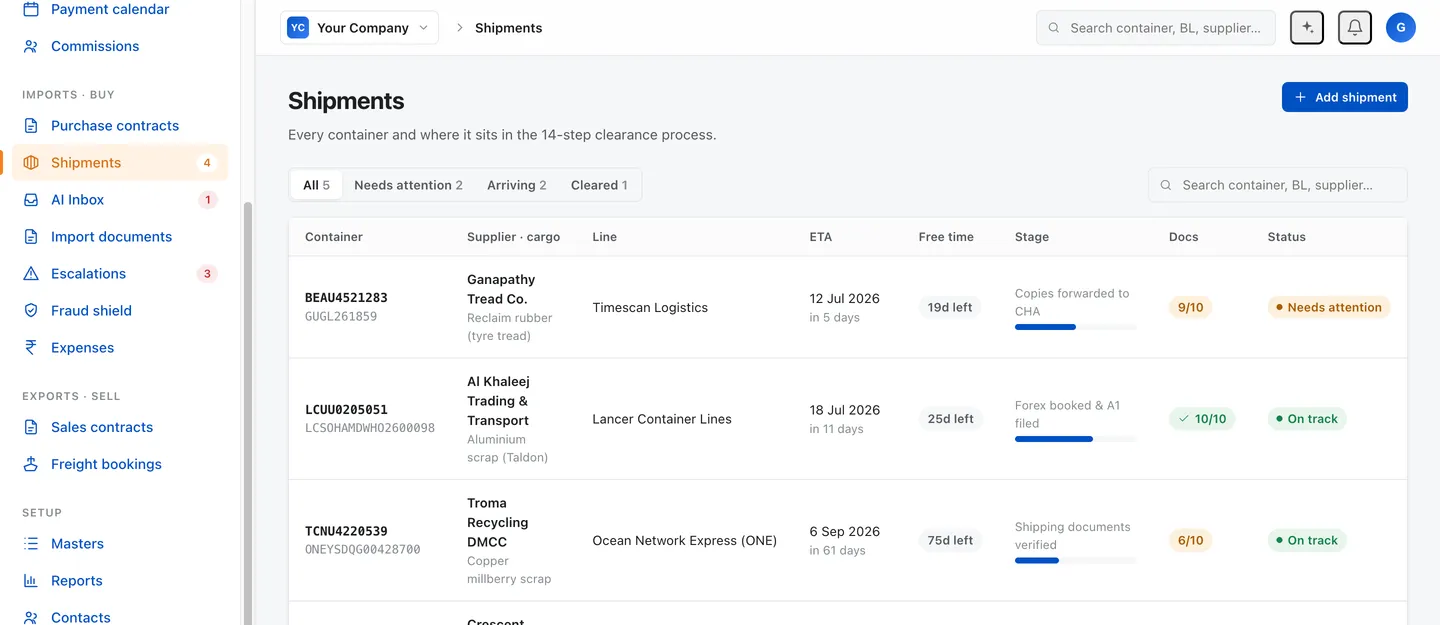
It reads the purchase contract and the transport document, works out which clock applies (the demurrage prevention page walks through both), derives the last free day from discharge or from ICD arrival depending on how the bill of lading is drawn, and builds the document checklist backwards from that date. Then it chases the parties who owe documents. Email first, WhatsApp at 24 hours, SMS at 48, an AI voice call at 72, on the channels the exporter, the forwarder and the CHA already use. No portal for anyone to sign up for.
Every charge that arrives, from the carrier, the depot or the haulier, is matched to the consignment and traced back to the email it came in on, so the landed cost includes the inland leg instead of discovering it at month end.
The honest limit: Docket cannot get a container out of a congested terminal, cannot make a depot accept an empty it has no space for, and does not file your entry. It removes the reason those things become expensive, which is a document that nobody chased.
Sources
- UN ESCAP Intergovernmental Agreement on Dry Ports (concluded 2013)
- UN/LOCODE, United Nations Code for Trade and Transport Locations (UNECE)
- Customs Act 1962, section 7, on the appointment of inland container depots as customs stations (India, administered by the Central Board of Indirect Taxes and Customs)
- Docket operational baseline, import–export desk