Detention: the charge that starts when the box leaves port
Detention is the daily charge a carrier levies for holding its container outside the terminal past the free period, from gate-out until the empty is returned to the nominated depot. Demurrage is the opposite side of the gate: the box still inside the port. Importers routinely pay both on one container and call the whole thing demurrage, which sends the post-mortem to the wrong desk.
- Detention
- The daily charge a carrier levies for keeping its container outside the terminal beyond the agreed free period, running from gate-out until the empty is returned to the depot the carrier nominates.
Detention is rent on the carrier’s equipment. Once the container passes the terminal gate the clock runs, and it runs until you hand the empty back at the depot the carrier nominates. It has nothing to do with whether the port is congested and everything to do with how long the box sits at your yard, your warehouse, or your customer’s plant.
Detention is not demurrage
The two get merged in conversation and on invoices, which is how importers end up unable to say which one they are actually paying.
- Demurrage. The container is still inside the terminal, past free time.
- Detention. The container is outside the terminal, past the free period, and you are holding the carrier’s equipment.
The US Federal Maritime Commission draws precisely this line in its interpretive rule, and most carrier tariffs follow the same split. One container can incur both on a single journey: demurrage while the paperwork is stuck, then detention while the box waits to be unstuffed and returned.
| Demurrage | Detention | |
|---|---|---|
| The asset being charged for | Terminal ground space | The carrier’s container |
| Clock starts | Discharge from the vessel | Gate-out from the terminal |
| Clock stops | Gate-out | Empty returned to the nominated depot |
| Root cause, nine times in ten | Documents, customs, bank release | Transport, yard, plant, depot |
| Who inside your business fixes it | The documentation desk | The logistics desk |
| Where the fix has to happen | Before the vessel arrives | After the box is released |
| Lever you hold | Document deadlines in the contract | Turnaround time and haulage choice |
When does the detention clock start, and when does it stop?
Gate-out to empty-in. Both ends are less obvious than they look.
The start. The interchange record at the terminal gate is the timestamp that counts, not your transporter’s job sheet and not the delivery order date. Ask for the equipment interchange receipt. It is the document that decides the first day.
The stop. The empty has to reach the depot the carrier nominates, and be accepted. A depot that is full and turns your truck away does not stop your clock, because from the carrier’s system the box is still out. This is the single most common cause of detention that importers think is unfair, and it is also the one worth documenting, because the refusal is provable.
Between those two timestamps sit the unloading slot, the plant’s shift pattern, public holidays, and whether your transporter got a return appointment. None of that is visible to the carrier, and all of it is billed at a daily rate.
Why is it worth separating the two charges?
Because the fixes are different, and so is the person you argue with.
Demurrage is almost always a document problem. The ship arrived, the box was discharged, and the Bill of Entry or the certificate of origin was not ready. You fix it upstream, by having the pack complete before discharge.
Detention is a scheduling problem. Transport not booked, yard full, plant closed for a holiday, empty return depot refusing the box. You fix it downstream, with slots and turnaround.
Treating both as “demurrage” means the review meeting goes looking for the cause in the wrong half of the journey. The document team gets blamed for a plant shutdown, the logistics team gets blamed for a bank release, and the same charge recurs next month because neither of them owned the real failure.
What drives the per-diem rate?
First, a word on the word. “Per diem” is carrier and forwarder vocabulary for this charge, and it is not a separate thing from detention. The US regulation folds the two together in its own definitions: under 46 CFR § 541.3, demurrage or detention means any charges, “including ‘per diem’ charges”, assessed by carriers, marine terminal operators or NVOCCs for the use of marine terminal space or shipping containers, freight charges excluded. So an invoice line that says per diem is a detention line, and every rule about how a detention charge must be billed applies to it.
Four variables set the rate, and none of them is a global constant.
- Carrier. Two lines calling the same berth publish different tariffs.
- Equipment. A 40-foot dry box, a reefer with a genset on it, a flat rack and an open top do not carry the same daily rate, and reefers are the expensive end because plug points are scarce.
- Trade lane and port. Rates track equipment scarcity. A lane where the carrier is short of boxes prices detention to get them back.
- Days held. Almost every tariff steps up. A rate that starts modestly can multiply once you pass a threshold, which is why day nine costs several times what day two cost.
We deliberately do not quote a single global number here, because there is not one. Pull the rate from the tariff of the carrier on your bill of lading, for your equipment type, on your trade lane, and read the escalation steps, not only the headline figure.
Carrier haulage or merchant haulage?
The choice decides who carries the turnaround risk, and it is made at booking, not at arrival.
| Carrier haulage | Merchant haulage | |
|---|---|---|
| Who arranges inland transport | The shipping line | You, or your forwarder |
| Who chooses the empty return depot | The line | The line, still |
| Detention exposure | Bundled into the line’s combined free period | Yours, from gate-out |
| Visibility of the real cost | Low. It sits inside one rate | High. Every leg is invoiced |
| Flexibility on delivery timing | Low | High |
| Who you chase when the truck is late | The line’s customer service | Your own transporter |
Neither is right in general. Carrier haulage suits a desk with no transport relationships and irregular volumes. Merchant haulage suits a desk that ships a lane repeatedly, because the combined free time under carrier haulage rarely reflects how fast you can actually unload. What loses is choosing one by accident and discovering the free-time structure after the first invoice.
Where detention comes from on a real import desk
Walk one container through it.
1/ Box gates out on a Thursday afternoon. Detention clock starts.
2/ It reaches the plant Friday morning. The plant unloads on a first-in queue and there are four boxes ahead of it.
3/ Saturday and Sunday count. Almost every tariff counts calendar days.
4/ Monday the box is unstuffed. The transporter asks for a return slot.
5/ Tuesday the nominated depot is full and turns the truck away. The box goes back to the transporter’s yard, still on your account.
6/ Thursday the depot accepts it. Seven days of detention on a box that was physically handled for one.
Nothing in that sequence is a documentation failure. Nothing in it is visible to the person who signed the purchase contract. And every step of it is fixable with a booked slot and a phone call made two days earlier than it was.
What can you negotiate, and what can you dispute?
Negotiate, before the cargo moves. Combined free time on carrier haulage. Extra detention days in the service contract on a lane where the carrier wants your volume. A named alternative return depot, in writing, so a full yard is not an automatic charge. A street turn, where your empty goes straight to another shipper’s export booking instead of back to the depot, which the line has to authorise in advance.
Dispute, after the charge. The Ocean Shipping Reform Act of 2022 amended the Shipping Act of 1984 and led the Federal Maritime Commission to write the Demurrage and Detention Billing Requirements rule. That rule sets out what an invoice has to contain, the window in which it must be issued, and the window in which the billed party may dispute it. An invoice that does not meet those requirements is challengeable on its face, before anyone argues the merits. The section that also limited who could be billed, 46 CFR 541.4, was set aside by the D.C. Circuit in September 2025 and removed from the regulation in January 2026; the rest of the rule is unaffected. Which arguments survive that change, and what applies outside US trades, is set out in the walkthrough on contesting a demurrage or detention charge.
Underneath sits the incentive principle in 46 CFR § 545.5. Detention exists to get equipment back. Where the equipment could not have been returned, the charge is not doing the job it was created to do, and the Commission weighs that.
The fact patterns that win are the ones you can prove with somebody else’s paper: the depot’s refusal notice, the terminal’s gate closure notice, the carrier’s own failure to release an appointment. The pattern that never wins is “our plant was busy.”
Common misconceptions
“Detention is just demurrage after the gate.” It is a different charge on a different asset, billed under different tariff lines, caused by a different team.
“The clock stops when we finish unloading.” It stops when the depot accepts the empty. Those two dates can be a week apart.
“Free days are free days.” Some tariffs give a combined demurrage-and-detention allowance, some give two separate allowances. Under a combined allowance, slow paperwork eats the days you were counting on for turnaround.
“The forwarder is handling it.” The forwarder books. The tariff, the depot nomination and the escalation steps are the carrier’s, and the invoice is yours.
Where Docket sits
Detention is a scheduling failure, and Docket does not move containers, does not book trucks, and does not negotiate with the depot. That work stays on your logistics desk.
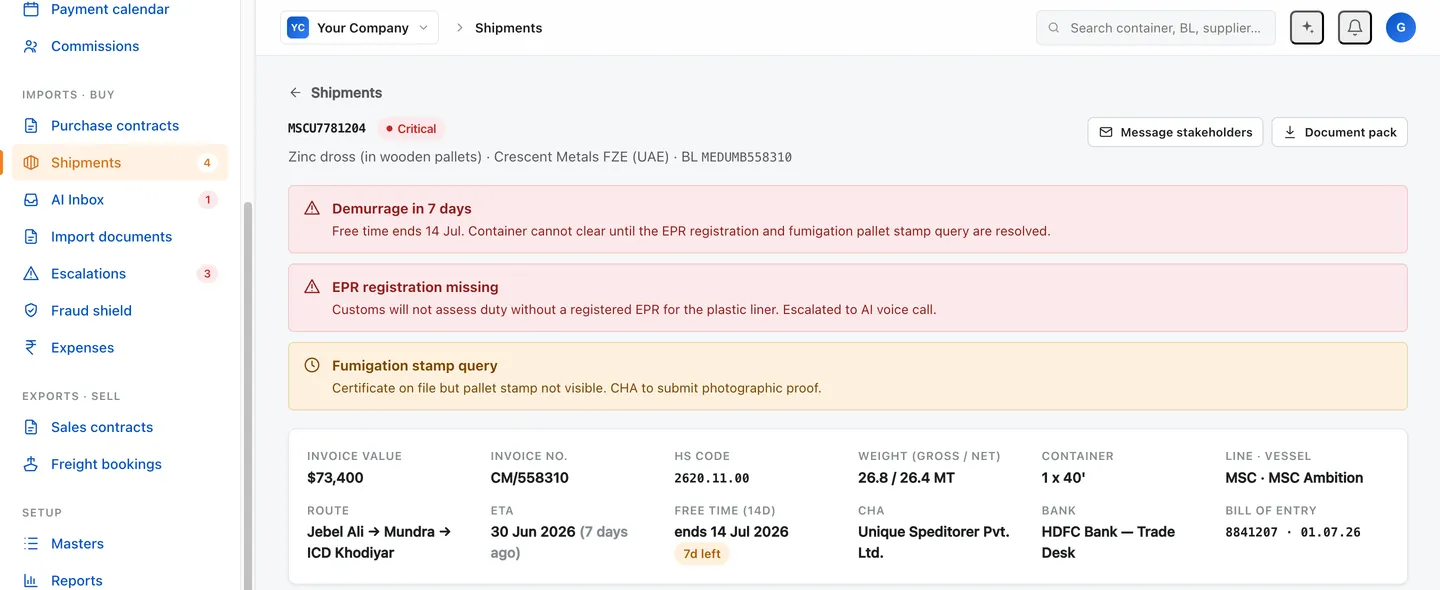
What Docket removes is the upstream cause that turns a clean delivery into a late one; that is what its demurrage and detention software is built around. It reads the purchase contract, derives the last free day from discharge, checks the document pack against the contract and against itself, names the party who owes each missing item, and chases them daily. Email first, WhatsApp at 24 hours, SMS at 48, an AI voice call at 72, on channels the exporter and the CHA already use. Nobody signs up for a portal.
On the baseline desk, a container carries about 2.2 hours of desk work, of which 30 to 45 minutes is supplier follow-ups and 45 to 90 minutes is document-pack preparation and checking. Docket automates about 85% of the chase and about 65% of the doc-pack drafting. The rest is judgement, and judgement stays with your team.
A box that is cleared and released on day two of free time is a box your transporter can schedule properly. That is the only detention lever a documents system holds, and it holds it well.
Sources
- 46 CFR § 541.3, Definitions: 'Demurrage or detention' means any charges, including 'per diem' charges, assessed by ocean common carriers, marine terminal operators or non-vessel-operating common carriers related to the use of marine terminal space or shipping containers, but not including freight charges · checked 2026-09-12
- US Federal Maritime Commission, Interpretive Rule on Demurrage and Detention (46 CFR § 545.5)
- US Federal Maritime Commission, Demurrage and Detention Billing Requirements final rule (46 CFR part 541)
- Ocean Shipping Reform Act of 2022, amending the Shipping Act of 1984
- Docket operational baseline, import–export desk