Laytime: the agreed time to load or discharge a chartered ship
Laytime is the period agreed between the parties during which the owner will make and keep the vessel available for loading or discharging without payment additional to the freight. It belongs to voyage charters of bulk and tanker cargo, not to containers. It starts after a notice of readiness is tendered and the charter's notice period runs; when it expires the charterer goes on demurrage.
- Laytime
- The period of time agreed between the parties to a voyage charter during which the shipowner will make and keep the vessel available for loading or discharging without payment additional to the freight.
Laytime is the clock on a chartered ship. A voyage charterer has bought the carriage of a cargo, and with it a fixed allowance of time to get that cargo on or off. Use less and the owner may owe you money. Use more and you owe the owner money.
The Laytime Definitions for Charter Parties 2013, agreed between BIMCO, the CMI, FONASBA and the Baltic Exchange, define it at number 5 as “the period of time agreed between the parties during which the owner will make and keep the Vessel available for loading or discharging without payment additional to the freight.”
Read the last clause. Laytime is not free time in the sense of a gift. It is time you have already paid for inside the freight rate.
This is the bulk and tanker world, not the container world
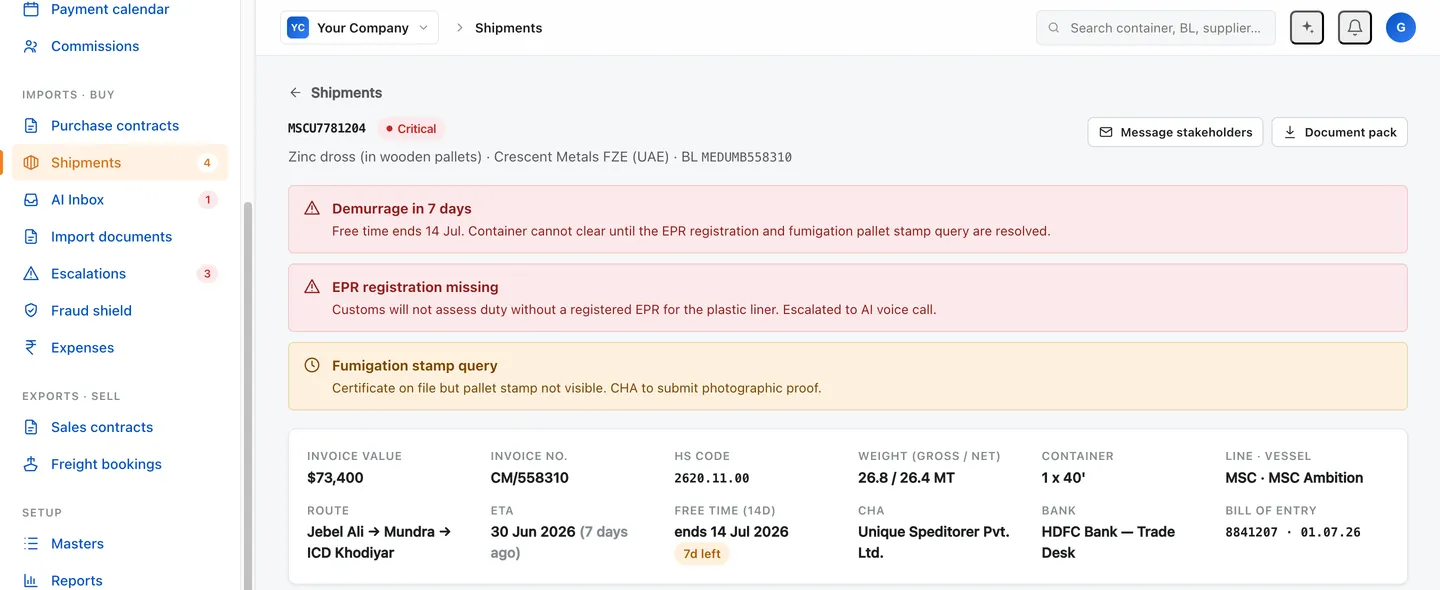
If you import in containers, this page is almost certainly not the one you want. Your equivalent clock is free time, and the charge when it expires is container demurrage. Nobody tenders you a notice of readiness and nobody is going to pay you despatch money.
The two vocabularies overlap badly, which is why “demurrage” means two different things depending on who is saying it. The demurrage a charterer pays a shipowner is a separate entry.
How laytime is counted
Three things have to be settled before anyone can calculate anything, and all three are in the charter rather than in any general rule.
How much. A number of days or hours, or a rate of tonnes per day against the cargo quantity. A rate means the allowance is not known until the cargo figure is.
Which days count. This is where the 2013 Definitions do most of their work, by giving separate meanings to formulations that people had been using interchangeably. A weather working day is not a working day. Whether the charter says SHEX (Sundays and holidays excepted) or SHINC (included) changes the answer, and so does whether excepted periods are excluded from the count or merely suspend it.
When it starts. Definition 25 puts a notice of readiness as “the notice to the charterer, shipper, receiver or other person as required by the Charter Party that the Vessel has arrived at the Port or Berth, as the case may be, and is ready to load or discharge.” The notice is tendered, the charter’s notice or turn time runs, and laytime commences. Each of those steps has been litigated: whether the vessel had arrived in the charter’s sense, whether she was actually ready, whether the notice was tendered in the manner and hours the charter required.
The arithmetic itself is then done from the statement of facts, the signed record of what happened at the port hour by hour. Both sides work from that document, and both sides read it differently.
Running out, and finishing early
When laytime expires the vessel goes on demurrage: the agreed daily amount the charterer owes the owner for the delay. Definition 30 frames it as an amount payable “in respect of delay to the Vessel once the Laytime has expired, for which the owner is not responsible.”
The reverse also exists. Definition 31 defines despatch money as “an agreed amount payable by the owner if the Vessel completes loading or discharging before the Laytime has expired.” Whether you get it at all depends on the charter, and the conventional rate is half the demurrage rate.
| Laytime used | Consequence | |
|---|---|---|
| Less than allowed | Charter may provide despatch money, owner to charterer | Commonly half the demurrage rate |
| Exactly the allowance | Nothing owed either way | — |
| More than allowed | Demurrage, charterer to owner | The daily rate written into the charter |
Where Docket sits, and does not
Not here. Docket works the document pack on container imports: the purchase contract, the chase, the checks, the deadline derived from discharge. Laytime calculation on a voyage charter is a different discipline with its own specialist software, and we are not in that market and will not pretend to be.
The entry exists because the word “demurrage” is shared and the two meanings get mixed up in the same conversation, usually to somebody’s cost. If your charge is a carrier line item on a box that sat at a terminal past its free days, go to what demurrage costs an importer instead.
The box version of the problem is also the one that can be scheduled. A voyage charter’s laytime is settled after the fact, in a statement of facts; a container’s free time is known at discharge, which is why the box side of the word is served by a container free time countdown working document deadlines backwards, and the charter side is served by laytime calculation software working forwards from a notice of readiness.
Questions traders ask
What is laytime in shipping?
The time a voyage charterer is allowed for loading or discharging, paid for inside the freight rate. The Laytime Definitions for Charter Parties 2013 put it as the period of time agreed between the parties during which the owner will make and keep the vessel available for loading or discharging without payment additional to the freight. It is a charter-party term and it does not apply to a container shipment.
When does laytime start?
When the charter says it does. The usual sequence is that the vessel arrives and tenders a notice of readiness, the charter's notice or turn time runs, and laytime commences after it. The detail is where the disputes are: whether the vessel had arrived for the purposes of the charter, whether she was in fact ready, and whether the notice was validly tendered.
What is the difference between laytime and free time?
They are the same idea in two different markets. Laytime is the allowance in a voyage charter for a bulk or tanker cargo, agreed between charterer and shipowner. Free time is the allowance a container line or terminal gives an importer before demurrage and detention start, set by tariff or service contract rather than negotiated per voyage.
What happens when laytime runs out?
The charterer goes on demurrage and owes the owner the agreed daily amount for the delay. If loading or discharging finishes before laytime expires, the charter may instead entitle the charterer to despatch money from the owner. The charter fixes both rates; a despatch rate of half the demurrage rate is the common convention.
Sources
- Laytime Definitions for Charter Parties 2013 (BIMCO, CMI, FONASBA and the Baltic Exchange), definitions 5 (Laytime), 25 (Notice of Readiness), 30 (Demurrage) and 31 (Despatch Money) · checked 2026-09-07
- Docket operational baseline, import–export desk · checked 2026-09-07