Vessel demurrage: the charter-party charge, not the container one
Vessel demurrage is an agreed amount payable to the shipowner for delay to the vessel once laytime has expired, for which the owner is not responsible. It runs between charterer and owner under a voyage charter of bulk or tanker cargo. Container demurrage, which an importer pays a terminal or carrier for a box left inside the port, is a different charge that happens to share the word.
- Vessel Demurrage
- An agreed amount payable to the shipowner in respect of delay to the vessel once the laytime has expired, for which the owner is not responsible; a voyage-charter charge running from charterer to owner, distinct from container demurrage.
Two charges share the word “demurrage” and they have almost nothing in common except that somebody is being billed for time.
Vessel demurrage is the charter-party one. Definition 30 of the Laytime Definitions for Charter Parties 2013 states it as “an agreed amount payable to the owner in respect of delay to the Vessel once the Laytime has expired, for which the owner is not responsible.” A voyage charterer has bought a ship’s carriage and an allowance of time to load or discharge; run past the allowance and the owner is compensated at a daily rate written into the charter.
Which one is on your invoice
Check who sent it before you do anything else.
| Vessel demurrage | Container demurrage | |
|---|---|---|
| Who bills | The shipowner | The terminal, the carrier, or both |
| Who pays | The voyage charterer | The importer, normally the consignee on the bill of lading |
| Governed by | The charter party | The carrier’s tariff or your service contract |
| The clock | Laytime, agreed per voyage | Free time, set by tariff |
| Calculated from | The statement of facts | The discharge date and the gate-out date |
| Typical cargo | Bulk, tanker, breakbulk | Containers |
| The rate | Written into the charter | The tariff’s daily tiers |
If your cargo moved in boxes, the charge on your desk is the second column and the entry you want is demurrage on a container import. Everything below is the first column.
Why it is more than a late fee
Vessel demurrage is compensation for the owner’s ship being held up, agreed in advance so that neither side has to prove loss when it happens. That character has consequences.
The rate is not negotiable after the fact. It was agreed when the charter was fixed. Arguing about it once the vessel has sailed is arguing about the wrong thing.
Once on demurrage, always on demurrage. The general rule is that when laytime expires, the exceptions that would have stopped the laytime clock no longer stop the demurrage clock. Weather, holidays and stoppages that were excluded from laytime keep running once you are on demurrage. A charter can displace that, but only by saying so clearly, and the absence of clear words is the reason many charterers discover the rule the expensive way.
The argument is almost always about the statement of facts. Both sides calculate from the same signed record of what happened at the port. The dispute is which hours in it were laytime, which were excepted, and when the notice of readiness validly started the clock.
Charters commonly time-bar the claim. Tanker charters in particular require a demurrage claim to be presented within a stated period with specified supporting documents, and a claim that misses it can fail regardless of merit. The period and the document list are in the charter.
What this shares with the container problem
One thing, and it is the thing this site is about: the money is decided by whether a set of documents and timestamps was assembled correctly and on time, not by anything that happened at sea.
On a charter that means the statement of facts, the notices, the pumping logs and the letters of protest. On a container import it means the invoice, the packing list, the certificate of origin and the bill of lading reaching the customs broker before the last free day. Different documents, same failure: nobody owned the chase, so the paper arrived after the clock had already run.
Where Docket sits, and does not
Docket does not calculate laytime and does not draft or defend a charter-party demurrage claim. That is a specialist discipline with specialist software, and a product built for container document packs has no business pretending otherwise.
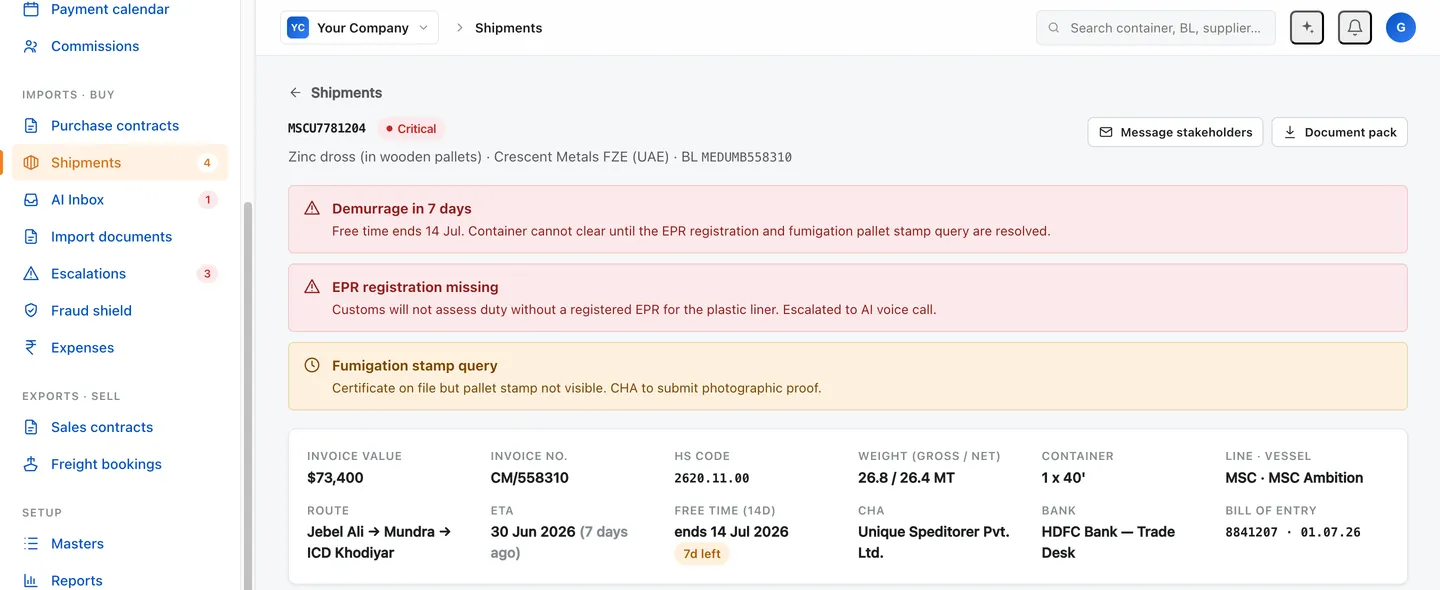
What Docket does is the container side: read the purchase contract, derive the deadline from the discharge date, chase every party who owes a document, and check each one before it goes anywhere near a bank. If that is the problem you actually have, the demurrage and detention page is the right one.
Questions traders ask
What is vessel demurrage?
The money a voyage charterer owes a shipowner when loading or discharging takes longer than the laytime the charter allowed. The Laytime Definitions for Charter Parties 2013 define it as an agreed amount payable to the owner in respect of delay to the vessel once the laytime has expired, for which the owner is not responsible. It is a bulk and tanker term.
Is vessel demurrage the same as container demurrage?
No, and confusing them is expensive. Vessel demurrage runs from charterer to shipowner under a charter party, at a daily rate the charter fixes, calculated from the statement of facts. Container demurrage runs from importer to terminal or carrier, at a tariff rate, for a box left inside the port past its free time. Different parties, different documents, different arithmetic.
How is vessel demurrage calculated?
Laytime allowed, less laytime used, gives the time on demurrage; that figure multiplied by the daily rate in the charter gives the amount. Both inputs come out of the statement of facts and the charter's counting rules, which is why nearly every dispute is about how a period in the statement of facts should have been counted rather than about the rate.
What does once on demurrage, always on demurrage mean?
The general rule that once laytime has expired and the vessel is on demurrage, the exceptions that would have interrupted laytime stop applying, so time keeps running through periods that would otherwise have been excluded. It can be displaced, but only by clear words in the charter saying the exception applies to demurrage as well.
Who pays vessel demurrage?
The charterer pays the shipowner. In a chain of contracts the charterer will often be looking to pass it down to a shipper or receiver under the sale contract, and whether that works depends on the sale contract's own laytime and demurrage terms, not on the charter.
Sources
- Laytime Definitions for Charter Parties 2013 (BIMCO, CMI, FONASBA and the Baltic Exchange), definitions 5 (Laytime), 25 (Notice of Readiness) and 30 (Demurrage) · checked 2026-09-07
- Docket operational baseline, import–export desk · checked 2026-09-07