Metal scrap import: the documents, the ports and the clock
Scrap is the cargo where paperwork, not value, decides whether the box clears. Indian law attaches a pre-shipment inspection certificate to metal scrap unless it comes from six named regions through eleven named ports; without one the consignment is examined in full. The certificate is issued abroad, before loading, by an agency the importer does not control, so chase it first.
- HS chapters
- 72 — Iron and steel (heading 7204, ferrous waste and scrap) · 74–81 — Copper, nickel, aluminium, lead, zinc, tin and other base-metal waste and scrap
- Beyond the standard pack
- Pre-shipment inspection certificate (PSIC) from a DGFT-recognised agency, or a supplier's radioactivity and explosives certificate where the PSIC is waived · Weight list reconciled with the packing list and the bill of lading · The hazardous-waste rules' import information filed with the Bill of Entry
Scrap is cheap per tonne and expensive per day. A container of HMS or shredded steel is worth less than most finished-goods boxes on the same vessel, and it travels with more paper than any of them, because every importing country treats scrap as a waste stream first and a commodity second. The document that decides whether the box clears is issued abroad, before loading, by an inspection agency the importer has never met.
What a scrap shipment has to carry
The standard pack applies: commercial invoice, packing list, bill of lading, certificate of origin, insurance. Scrap adds three things.
The pre-shipment inspection certificate. Paragraph 2.51 of the Handbook of Procedures 2023 makes metallic waste and scrap, shredded or unshredded, subject to a pre-shipment inspection certificate from an agency the DGFT recognises. The certificate says the consignment carries no arms, ammunition or explosive material, and that its radiation does not exceed natural background. It names the container numbers and the weights.
Or, for six origins at eleven ports, a supplier’s certificate instead. Public Notice 43/2023 waived the PSIC for scrap from the USA, the UK, Canada, New Zealand, Australia and the EU, when it clears through Chennai, Tuticorin, Kandla, JNPT, Mumbai, Krishnapatnam, Mundra, Kattupalli, Hazira, Kamarajar or Adani Gangavaram. Those ports have radiation portal monitors and container scanners, which is why they are on the list. A waived consignment still travels with a certificate from the supplier or the scrap yard confirming the absence of radioactive material and explosives.
The hazardous-waste filing. Metal scrap sits in Schedule III Part D of the Hazardous and Other Wastes Rules 2016. Importing it does not need the environment ministry’s permission, which is the good news. It does need the Rules’ own import information filed with the customs entry, and it does need the importer to be a party the Rules allow to receive it.
Nineteen ports, and why the choice matters
Scrap can be imported through nineteen designated ports. Only eleven of them carry the PSIC waiver, and only for the six regions. Book a European lot to Cochin or Paradip and the waiver is gone; the consignment needs the PSIC it would not have needed at Mundra.
The trap is in the timing. The port is chosen at booking. The PSIC is issued at loading. If nobody on the desk connects the two, the box sails without the certificate the destination port will demand, and the first anyone hears of it is the customs query.
What customs does when the certificate is missing
CBIC Circular 48/2016 lays out the procedure. Unshredded, compressed or loose scrap that arrives without the prescribed certificate is examined in full: every container opened, alongside action under the Foreign Trade Policy for the missing document. Shredded scrap with its paperwork in order is examined at 10%, a minimum of one container.
Full examination of a scrap consignment is not an afternoon. It is days, sometimes a week, and the free-time clock started at discharge. Document packs routinely run about eight days late against free time on ordinary cargo; on scrap the missing document is the one that also triggers the examination, so the two delays stack. A week of demurrage on one container has cost about US$12,000. On a multi-container scrap lot the arithmetic is worse than on anything else in the yard.
Which is why scrap is the cargo where demurrage management software has to work the document pack rather than the clock. Counting the free days down tells you the examination is going to hurt; getting the inspection certificate in hand before the vessel sails is what stops it.
The charge itself arrives later still, as a carrier invoice weeks after the lot has moved, which is why scrap is also the cargo where the landed cost per container is most often closed too early. Metal is bought on a thin margin against an exchange price; an examination-driven demurrage line that lands after the stock is sold does not adjust the sale, it only reveals what the tonne actually cost.
Who owes each document, and when
This is the part that makes scrap a chasing problem rather than a filing problem.
| Document | Who issues it | When it can exist |
|---|---|---|
| Commercial invoice, packing and weight list | Supplier | At stuffing |
| Bill of lading | Carrier | After loading |
| Certificate of origin | Chamber or authority at origin | After invoice |
| Pre-shipment inspection certificate | Recognised inspection agency at origin | At or before loading, on inspection |
| Supplier’s radioactivity and explosives certificate (waiver lanes) | Supplier or scrap yard | At loading |
The PSIC is the odd one out. It is issued by a third party, at the loading end, against an inspection that has to be booked, and it has to carry the same container numbers and weights as documents produced by two other parties. It is late more often than any other document in the pack, and when it is wrong it is wrong in a field, a container number that does not match the bill of lading, a gross weight that is the packing list’s net.
The classification question
Ferrous scrap sits under heading 7204, with HS 7204.49 as the residual subheading for material that is not turnings, shavings, chips or stampings. Non-ferrous scrap sits in chapters 74 to 81 by metal. The six-digit code is harmonised; the eight-digit Indian tariff line and the policy condition attached to it are national, and the policy condition is where the PSIC requirement lives. Confirm the line with your customs broker before the contract is signed, because the document set follows the code.
A scrap desk that also buys plastic regrind should read the two document sets side by side, because they fail differently. Metal scrap is gated by a certificate an authorised agency issues against a rule. Plastic waste is gated by a measurement: the plastic waste import documents Singapore asks for turn on contamination thresholds somebody has to verify in the supplier’s yard, and no certificate substitutes for the surveyor’s report on the state of the bales.
A third variant is worth knowing if the same desk handles waste textiles, because it moves the gate again: the used clothing import documents India requires turn on a cutting standard published by the customs house at the port, so the acceptance test is neither a certificate nor a laboratory figure but the physical state of the bales as one formation defines it.
Where Docket sits
Docket does not issue certificates, does not inspect scrap, does not file the entry, and does not choose your port. Those are the inspection agency’s, the customs broker’s and the trader’s.
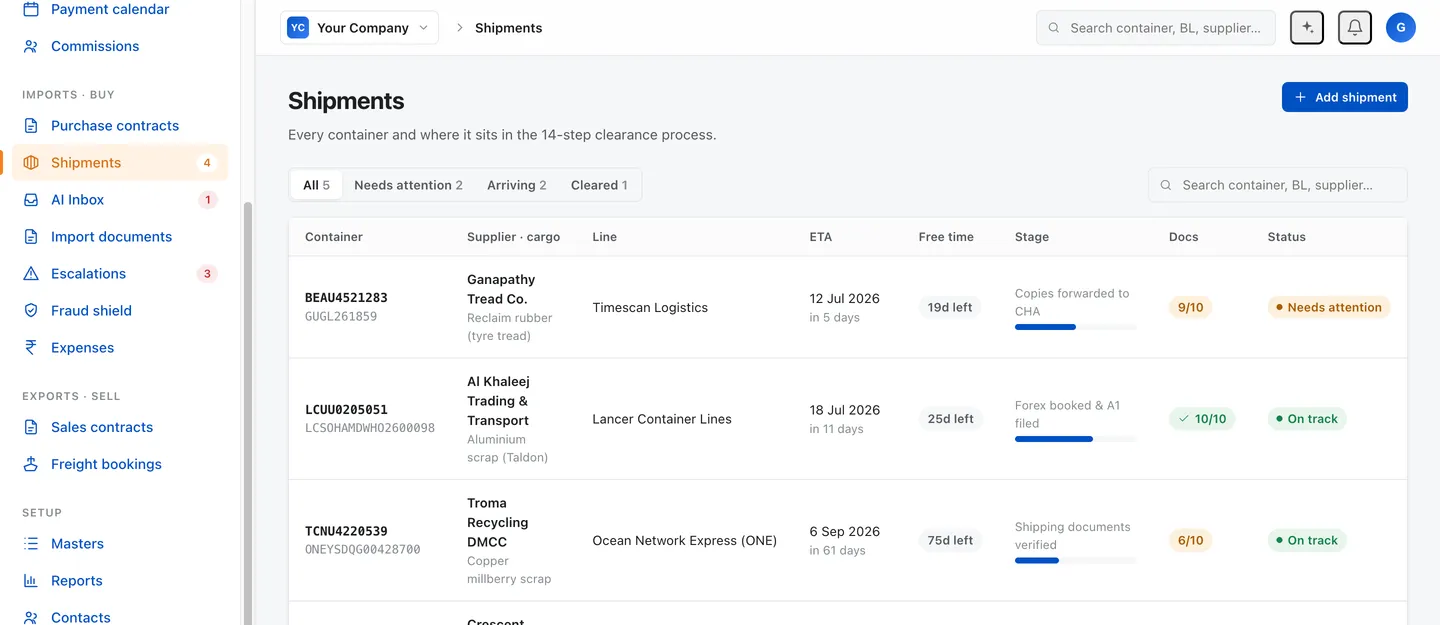
What Docket does is read the purchase contract, take the cargo and the lane, and derive the document set that shipment needs, PSIC included, with the party who owes each item. Then it chases: the supplier for the packing and weight list, the agency for the certificate, the forwarder for the bill of lading, daily, on email first and then WhatsApp, SMS and an AI voice call when email is ignored. When the PSIC arrives it is read against the packing list and the bill of lading, and the container number that does not match is named while the vessel is still at sea. The whole checklist is worked backwards from the last free day at the destination port, so a lot booked to a port without the waiver shows the PSIC as due before loading, not after arrival.
On the desk that is the import document checking and supplier follow-up jobs applied to the cargo where they matter most. About 85% of the chasing and about 65% of the checking is built to run without a person. The judgement, whether a lot with a one-container mismatch should sail, stays with you.
The jobs Docket does on this cargo
- Checks every document is present & correct — BL, invoice, COO, packing list, insurance — verified against your checklist, per container.
- Chases suppliers daily — schedules, prices, docs — Loading schedules until confirmed, prices every morning, and whoever owes the missing document.
- Escalates on WhatsApp / call when it's urgent — Email first. Then WhatsApp, SMS and an AI voice call — automatically.
- Tracks every expense — traced to its email — Duty, port charges, CHA fees, detention — pulled from invoice emails, so each container's landed cost is live. Every line links to the email it came from.
- Logs everything in a full audit trail — Every check, reminder, commitment and dollar on record — with the raw email behind it, one click away.
Questions importers of this cargo ask
Do I need a PSIC to import metal scrap into India?
Usually, yes. Under paragraph 2.51 of the Handbook of Procedures 2023, metallic waste and scrap needs a pre-shipment inspection certificate from an agency recognised by the DGFT. The exception, added by Public Notice 43/2023 of 14 February 2024, is scrap from the USA, the UK, Canada, New Zealand, Australia and the EU cleared through eleven named ports, which needs a supplier's certificate that the consignment is free of radioactive material and explosives instead. Every other origin, and every other port, needs the PSIC.
Which Indian ports allow scrap import without a PSIC?
Eleven, for scrap from the six exempt regions: Chennai, Tuticorin, Kandla, JNPT, Mumbai, Krishnapatnam, Mundra, Kattupalli, Hazira, Kamarajar and Adani Gangavaram. Scrap import in general is allowed through nineteen designated ports; at the other eight the PSIC applies regardless of origin. Check the current list against the DGFT public notice before booking, because the list has grown twice since 2023 and a booking to the wrong port turns a waived certificate back into a required one.
What must a PSIC for scrap certify?
Two things, in the format the customs circular prescribes: that the consignment contains no arms, ammunition, mines, shells, cartridges or other explosive material in any form, and that it was checked for radiation and does not exceed natural background for gamma and neutron radiation. The certificate names the container numbers and the weights, so it has to agree with the packing list and the bill of lading, which is where most of them fail.
What happens at customs if the PSIC is missing?
The consignment is examined in full. CBIC Circular 48/2016 sets 100% examination for unshredded, compressed or loose scrap that arrives without the prescribed certificate, alongside action under the Foreign Trade Policy. Shredded scrap with its paperwork in order is examined at 10%, minimum one container. Full examination of a scrap consignment takes days, and free time does not pause for it.
Does Docket issue or verify the PSIC?
Neither. The certificate is issued by a recognised inspection agency at the loading end, and its legal weight is the agency's. What Docket does is know the shipment needs one from the contract and the lane, chase the supplier and the agency for it before the vessel sails, read the container numbers and weights on it against the packing list and the bill of lading, and flag the mismatch while the box is on the water.
Sources
- DGFT, Handbook of Procedures 2023, paragraph 2.51 (import of metallic waste and scrap), as amended by Public Notice No. 43/2023 dated 14 February 2024 · checked 2026-09-05
- CBIC Circular No. 48/2016-Customs dated 26 October 2016 and Circular No. 53/2016-Customs dated 18 November 2016, procedure for clearance of imported metal scrap
- Hazardous and Other Wastes (Management and Transboundary Movement) Rules 2016, Schedule III Part D and rule 13, import of metal scrap · checked 2026-09-05
- World Customs Organization, Harmonized System Nomenclature 2022 Edition, Chapters 72 and 74–81
- Docket operational baseline, import–export desk