Plastic waste import documents: Singapore thresholds
Plastic waste is the one cargo whose paperwork is decided by a measurement, not a description. NEA publishes Singapore's thresholds: 0.5% other plastic types per bale, 2.5% total non-plastic contaminants, zero household or hazardous waste. Under them the consignment is Basel Annex IX and needs no permit. Over them it is hazardous waste and needs a Basel permit before the shipment moves.
- HS chapters
- 39 — Plastics and articles thereof · 3915 — plastic waste, parings and scrap: the heading NEA's technical guidelines are scoped to
- Beyond the standard pack
- Basel import permit from NEA's Chemical Control and Management Department, obtained before the shipment moves, where the waste falls in Basel Annex II or Annex VIII — its number goes in the TradeNet CA Licence Number field · Surveyor's inspection evidence from the loading end: cargo quality against the specification, general appearance, photographs of the state of the bales · Analytical reports and certifications where Basel Annex I constituents are known to be present, establishing whether they make the waste hazardous · Bale labelling that matches the shipping documents: consignment or batch numbers, weight and dimensions per bale, the plastic types present with their HS and Product codes, and the point of origin and destination · TradeNet permit declaring the purpose of import, the item description and quantity, the CA Product Code against the HS Code, and the container and shipper seal numbers
Every other cargo page on this site is about documents that describe a shipment. This one is about documents that measure it.
Plastic waste is bought and sold as a description (PP regrind, washed PET flake, mixed bales) and regulated as a measurement. The description is in your purchase contract. The measurement decides whether the consignment needs a permit, and it is taken in a yard on the other side of the world before anything is loaded.
The threshold is the regulation
Singapore’s National Environment Agency publishes the numbers, per bale or bag, by weight. They are short enough to put on one screen and they are the whole gate.
| What is in the bale | Allowed |
|---|---|
| Other plastic waste types (single-stream waste, and PP/PE/PET mixtures alike) | 0.5% |
| Household waste, including food waste and beverages | 0% |
| Hazardous, biohazardous, e-waste, radioactive waste | 0% |
| Other recyclables: waste paper, wood-chips, scrap metal, glass, rubber and tyres | 0.5% |
| Water | 2% |
| Others, for example stones and dirt | 0.5% |
| Total non-plastic contaminants, all of the above together | 2.5% |
Two more conditions sit alongside them. The waste has to be sorted and packed one stream per bale, with the single exception of mixtures of only polyethylene, polypropylene and polyethylene terephthalate, which may travel together. And it has to have come from post-industrial or post-consumer use, not from a landfill or a waste disposal site.
Get under those numbers and the consignment is Basel Annex IX material. Go over them and it is something else entirely.
What crosses at 2.5%
The Basel Convention’s plastic waste amendments, adopted at COP-14 in 2019 and effective from 1 January 2021, put plastic waste into three boxes:
- Annex IX, entry B3011. Presumed not hazardous, and so not subject to the Prior Informed Consent procedure. It replaced the old B3010. It covers waste almost exclusively of one non-halogenated polymer, or one cured resin or condensation product, or one fluorinated polymer, destined for recycling in an environmentally sound manner and almost free from contamination; and mixtures of only PE, PP and PET destined for separate recycling of each material.
- Annex VIII, entry A3210. Plastic waste presumed hazardous, and therefore subject to PIC.
- Annex II, entry Y48. Plastic waste, including mixtures, that is neither of the above.
NEA’s guidelines state the consequence plainly for the exempt case: wastes listed in Annex IX are exempt from transboundary movement control, and are not regulated under the Hazardous Waste (Control of Export, Import and Transit) Act or its Regulations. Singapore acceded to the Convention on 2 January 1996 and this is how it applies it.
For everything else, Singapore Customs is equally plain: under that Act, anyone importing hazardous waste must obtain a Basel permit from NEA’s Chemical Control and Management Department, and CCMD applies the Prior Informed Consent procedure in granting one. The permit has to be obtained before the shipment and before the TradeNet permit application, and its number goes into the CA Licence Number field. Approval of the TradeNet application itself has to be obtained before the goods are imported.
So the same commercial cargo, from the same supplier, on the same lane, sits on either side of a regulatory line depending on how well somebody sorted it. That is not a paperwork question you can settle from a desk in Singapore.
The evidence is physical, and it lives at origin
This is the part that makes plastics a different job from metals and scrap or agri commodities, where a certificate is issued by an authority against a rule.
NEA requires companies to provide, or obtain from their overseas counterparts, evidence that inspection, testing or certification has been carried out to show the waste meets the specification. In practice that means two things:
A surveyor at the loading end. Physical checks on the waste by a surveyor able to inspect the intended shipment: verifying cargo quality against the required specification, checking the general appearance of the cargo and the packaging, photographic evidence of the state and quality of the waste. NEA is explicit that it appoints no official third-party surveyors and recommends none, so the credibility of the inspection is the importer’s own judgement to make and to defend.
An analytical report, where the constituents demand one. Where Basel Annex I constituents (heavy metals, waste oils, asbestos, organohalogen compounds) are known to be present, independent analytical reports and certifications are needed to establish that presence and to assess whether it renders the waste hazardous. Waste that contains Annex I constituents to an extent that it exhibits an Annex III characteristic is classified as hazardous, and its movement needs the Basel permits.
Neither document can be produced after the fact. A photograph of a bale in a yard in Malaysia is not available to anyone in Singapore three weeks later. This is the deadline that catches desks out: on most cargoes a missing document can be chased to the destination, and on this one the chase has to finish before the container is sealed.
The labels have to match the packing list, bale by bale
NEA sets out what goes on each bale or bag, and says why: for ease of traceability, accountability and comparison with the details declared in the shipping documents.
Each bale carries the consignment or batch number, the weight and dimensions, the plastic waste types present with their HS and Product codes, and the point of origin and intended destination. A single container may hold multiple well-segregated bales of different single-stream waste, so long as they are separable, and subject to the importing country accepting it.
Line that up against what the TradeNet application declares: the purpose of import, the item description and quantity, the CA Product Code against the HS Code, and the container number and shipper seal number. Then line both up against the packing list and the bill of lading.
Four documents, produced by four parties, describing the same bales. On a mixed container of segregated bales that is not one comparison, it is one per bale. A person does that badly at eleven at night. A machine does it the same way every time.
What the delay costs on this cargo
The arithmetic is the site’s usual arithmetic, with the remedy in the wrong country.
Desk work runs about 2.2 hours a container, of which 30 to 45 minutes is supplier follow-ups and 45 to 90 minutes is document-pack preparation and checking. Document packs routinely run about eight days late against free time, and a week of demurrage on one container has cost about US$12,000.
On plastic waste, those eight days are harder to claw back. A missing certificate of origin can be emailed. A missing surveyor’s report on the condition of bales that are now inside a sealed container at a terminal cannot be produced at all. The last free day is fixed at discharge either way, and the free time does not extend because the problem is 3,000 kilometres away.
Where Docket sits
Docket does not classify waste, does not inspect bales and does not decide whether a consignment is hazardous. Classification is yours and your customs broker’s; an Annex III characteristic is a laboratory’s finding.
What it does is treat the origin-side evidence as a set of dated obligations from the day the purchase contract is recorded. It knows which documents this lane needs, chases the supplier and the surveyor for each of them before loading, on email first and then WhatsApp at 24 hours, SMS at 48 and an AI voice call at 72. Then it reads what arrives against everything else: the bale labels against the packing list, the declared plastic type against the HS and Product code, the analytical report against the specification in the contract. A weight that disagrees or a bale label that names a polymer the invoice does not surfaces while the goods are still in the yard, which is the only place it can be fixed.
Then it counts the rest backwards from the last free day, which is what demurrage and detention software is for. On this cargo the deadline that matters is not the one at the port. It is the one before the container is sealed.
The jobs Docket does on this cargo
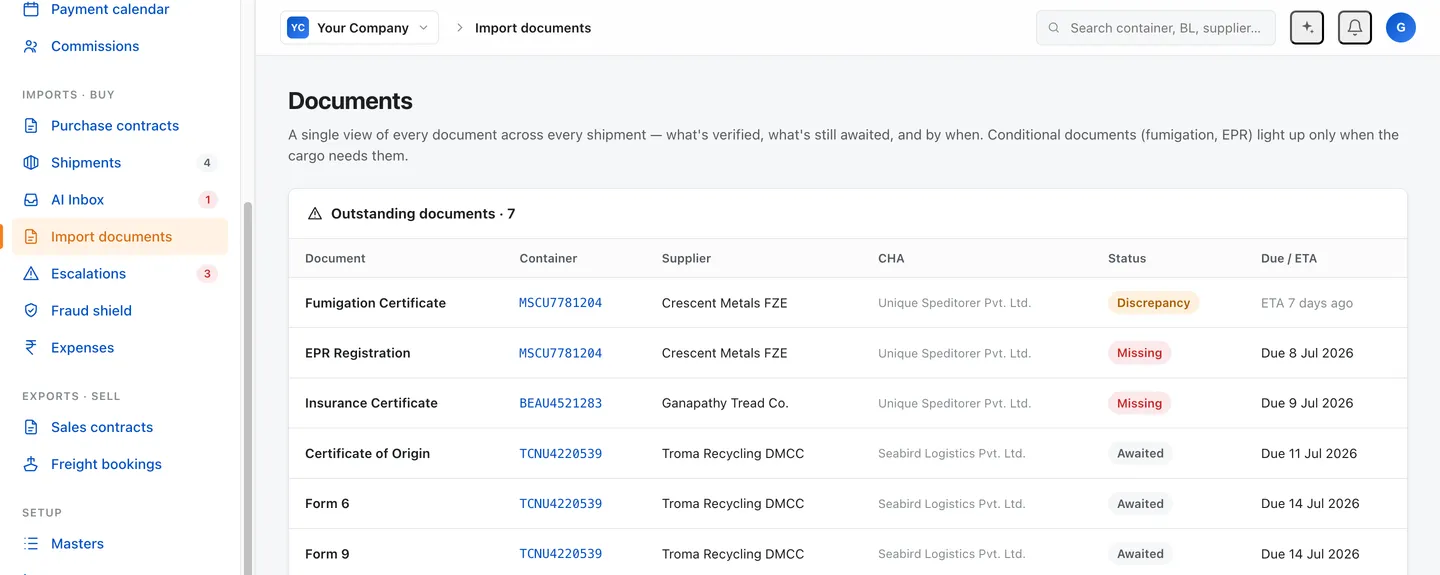
- Checks every document is present & correct — BL, invoice, COO, packing list, insurance — verified against your checklist, per container.
- Chases suppliers daily — schedules, prices, docs — Loading schedules until confirmed, prices every morning, and whoever owes the missing document.
- Escalates on WhatsApp / call when it's urgent — Email first. Then WhatsApp, SMS and an AI voice call — automatically.
- Tracks every expense — traced to its email — Duty, port charges, CHA fees, detention — pulled from invoice emails, so each container's landed cost is live. Every line links to the email it came from.
- Builds your payment calendar itself — Loading confirmed → payables scheduled from your terms; receivables follow the sales contract. Currencies kept separate.
Questions importers of this cargo ask
Do I need a Basel permit to import plastic waste into Singapore?
It depends on what is in the bale, not on what the contract calls it. Singapore Customs states that under the Hazardous Waste (Control of Export, Import and Transit) Act and its Regulations, anyone importing hazardous waste must obtain a Basel permit from NEA's Chemical Control and Management Department, and that CCMD applies the Basel Prior Informed Consent procedure when granting one. NEA's own technical guidelines say that plastic waste listed in Annex IX of the Convention is exempt from transboundary movement control and is not regulated under that Act. So a clean, single-stream consignment inside the published thresholds needs no Basel permit; a contaminated or mixed one is a different regulatory animal and needs one before the shipment moves.
What are the contamination limits for plastic waste into Singapore?
NEA publishes them per bale or bag, by weight. Other plastic waste types: 0.5%, for single-stream waste and for PP/PE/PET mixtures alike. Household waste including food waste and beverages: 0%. Hazardous, biohazardous, e-waste and radioactive waste: 0%. Other recyclables such as waste paper, wood-chips, scrap metal, glass and rubber: 0.5%. Water: 2%. Stones, dirt and the like: 0.5%. Total non-plastic contaminants across all of those: 2.5%. The waste also has to come from post-industrial or post-consumer use and not from a landfill or waste disposal site.
Which plastic waste is exempt from the PIC procedure?
The types in Basel Annex IX entry B3011, which replaced B3010 when the plastic waste amendments took effect on 1 January 2021. Broadly: waste almost exclusively of one non-halogenated polymer, or one cured resin, or one fluorinated polymer, destined for environmentally sound recycling and almost free from contamination; plus mixtures of only polyethylene, polypropylene and polyethylene terephthalate destined for separate recycling of each material. Annex VIII entry A3210 is the mirror image, plastic waste presumed hazardous, and Annex II entry Y48 catches plastic waste that is neither.
What documents does a plastic waste shipment need beyond the normal pack?
Evidence about the physical goods, gathered where the goods are. NEA requires companies to provide, or obtain from their overseas counterparts, evidence that inspection, testing or certification has been carried out: physical checks by a surveyor against the specification, checks on appearance and packaging, photographic evidence of the state of the waste. Where Basel Annex I constituents are known to be present, independent analytical reports are needed to establish whether they make the consignment hazardous. NEA appoints no official surveyors and recommends none, so choosing a credible one is the importer's problem. Bale labelling and the shipping documents then have to agree, bale by bale.
Why does the paperwork have to be finished before loading?
Because none of it can be produced at the destination. A surveyor's report on the state of a bale, a photograph of the packaging, an analytical breakdown of the constituents: every one of those describes the goods as they were in the yard at origin, and nobody in Singapore can generate them retroactively. The Basel permit has to be obtained before the shipment and before the TradeNet application, and approval of the TradeNet application has to be obtained before the goods are imported. A consignment that sails with the evidence outstanding has no route back to compliant.
How does a missing plastic waste document turn into demurrage?
By being unfixable at the wrong end. The clock starts at discharge and the missing document is in another country, held by a supplier and a surveyor who are not looking at your free time. Document packs routinely run about eight days late against free time, and a week of demurrage on one container has cost about US$12,000. On this cargo the delay is worse than average because the remedy is at origin, and by the time the gap is visible the vessel has sailed.
Does Docket classify my plastic waste or decide if it is hazardous?
No. Classification against the Basel annexes and the HS code is yours and your customs broker's, and whether a consignment exhibits an Annex III characteristic is a laboratory's finding, not software's. What Docket does is know from the purchase contract which evidence this lane needs, chase the supplier and the surveyor for it before loading rather than after arrival, and read each document that arrives against the others: the bale labels against the packing list, the declared plastic type against the HS and Product code, the analytical report against the specification in the contract.
Sources
- National Environment Agency (Singapore), Technical Guidelines for the Import and Export of Plastic Waste: scope limited to HS code 3915; Part A (Annex IX types exempt from transboundary movement control and not regulated under the Hazardous Waste (Control of Export, Import and Transit) Act); Part B (0.5% threshold for other plastic waste types per bale); Part C (0% household and hazardous waste, 0.5% other recyclables, 2% water, 0.5% others, 2.5% total non-plastic contaminants); Part D (labelling and packaging); Part E (surveyor inspections and analytical reports; Annex I constituents and Annex III characteristics); Part G (TradeNet declaration). Singapore acceded to the Basel Convention on 2 January 1996 · checked 2026-09-10
- Singapore Customs, Competent Authorities Requirements for Controlled Items, National Environment Agency, Chemical Control and Management Department (Basel Convention): the Basel permit requirement under the Hazardous Waste (Control of Export, Import and Transit) Act, the PIC procedure, the permit obtained before the shipment and the TradeNet application, the CA Licence Number and container and seal number fields, and the documents uploaded with the application. CCMD (Basel Convention) is NEA(MTV) in TradeNet · checked 2026-09-10
- Secretariat of the Basel Convention, Plastic Waste Amendments: COP-14 (29 April–10 May 2019) adopted amendments to Annexes II, VIII and IX — Annex VIII entry A3210 (plastic waste presumed hazardous, subject to PIC), Annex IX entry B3011 replacing B3010 (presumed not hazardous, not subject to PIC), Annex II entry Y48 (plastic waste that is neither). Effective 1 January 2021 · checked 2026-09-10
- World Customs Organization, Harmonized System Nomenclature, Chapter 39
- Docket operational baseline, import–export desk · checked 2026-09-10