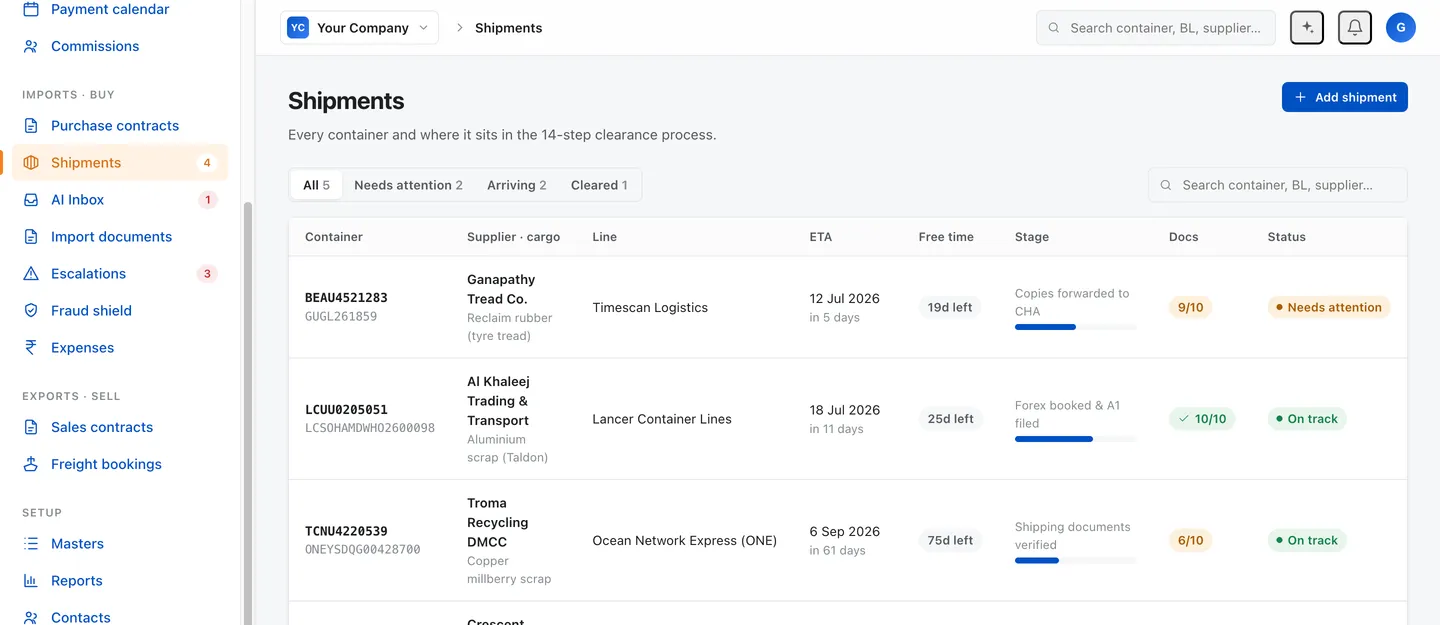
Last free day: the date an import deadline counts back from
The last free day is the final day of free time. After it, demurrage or detention starts. It is set at discharge, not when your paperwork is ready, and one container usually has more than one: the terminal's storage clock and the carrier's free time expire on different dates. In US trade the end date of free time is a required field on a demurrage invoice, and one missing it cannot be enforced.
- Last Free Day
- The last day of an allowed free time period, after which demurrage or detention begins to accrue on a container. It is derived from an event such as discharge from the vessel or gate-out, plus the number of free days allowed by the applicable tariff or service contract.
Every deadline on an import shipment is derived from one date, and the last free day is it.
It is the last day the container can stay where it is without a charge starting. Take the event the tariff counts from, add the free days allowed, and the last of those days is the last free day. From the next day the meter runs.
Two things about that date decide whether a desk is calm or expensive. It is knowable early, because for import demurrage it is fixed at discharge, usually days before anything can go wrong. And it is not one date.
One container, more than one last free day
The single most common error on an import desk is treating the last free day as a property of the container. It is a property of a clock, and there is more than one clock.
| Demurrage | Detention | Terminal storage | |
|---|---|---|---|
| What is being charged for | The box occupying the terminal | The carrier’s equipment, out in your yard | The ground the box stands on |
| Who charges | The carrier | The carrier | The terminal or port |
| Clock starts | Discharge from the vessel | Gate-out from the terminal | Discharge from the vessel |
| Where the allowance is set | Service contract or carrier tariff | Service contract or carrier tariff | The terminal’s published tariff |
| Same for every importer? | No | No | Yes |
Read the last row twice. Free time from a carrier is a commercial term: two importers with boxes on the same vessel, in the same terminal, can hold different allowances because they signed different contracts. Terminal storage is the opposite: a published document that applies to whoever is standing there. At Jebel Ali an ordinary import full container gets ten free days of terminal storage counted from discharge before the port’s own bands start, and that allowance is the same for everybody. The Jebel Ali page has the bands.
An importer who clears late pays both. The carrier bills demurrage for the same days the terminal bills storage, because the two charges are for different things and neither is a discount on the other.
The last free day is a required field, in one jurisdiction
In US trade the date is not something you have to reconstruct. It has to be on the invoice.
Title 46 of the Code of Federal Regulations, section 541.6, lists what a demurrage or detention invoice must contain as a minimum. Among the timing elements are the allowed free time in days, the start date of free time and the end date of free time, and for imports the container availability date. The rate rule, the container numbers and the bill of lading numbers are required alongside them.
Section 541.5 then says what happens if any of it is left off:
Failure to include any of the required minimum information in this part in a demurrage or detention invoice eliminates any obligation of the billed party to pay the applicable charge.
That is a stronger position than most importers realise they hold, and it comes with its own calendar. Under section 541.7 an invoice has to be issued within thirty calendar days from the date the charge was last incurred. Under section 541.8 the billed party gets at least thirty calendar days from the invoice date to request mitigation, refund or waiver, and the billing party has thirty days to resolve the request. A charge billed late, or billed without its free time dates, is a charge worth disputing rather than paying.
Section 541.4 is now marked reserved, so an explainer written against it in 2024 is describing a rule that is no longer there. Check the current text before relying on any summary of this part, including this one.
Outside US trade there is no equivalent. In India, the UAE, Singapore and most other markets the last free day comes from the carrier’s tariff or your service contract, nobody is obliged to print it for you, and reconstructing it after an invoice arrives is guesswork against somebody else’s records.
Why knowing the date early is the whole game
The last free day is not a warning. It is a deadline you can schedule against, and it is available at discharge.
Work backwards from it and every document in the pack acquires a date: the bill of lading has to be released by, the certificate of origin has to arrive by, the customs declaration has to be filed by, the duty has to be paid by. None of those dates is a surprise. All of them are arithmetic on a date you already have.
What goes wrong is not the arithmetic. Document packs routinely run about eight days late against free time, and a week of demurrage on one container has cost about US$12,000. Almost none of that is caused by not knowing where the container is. It is caused by a document sitting in somebody’s outbox and nobody chasing it.
A countdown does not fix that. Most software sold into this problem shows the box, counts the days down and turns a tile amber when the last free day is close. The tile is not the fix — by the time it changes colour, the missing document still has to be produced by a person who has not answered three emails.
Where Docket sits
Docket holds the free-time terms per lane, per carrier and per equipment type next to the purchase contract, derives the last free day from discharge, and works every document deadline backwards from it. Then it does the chasing itself: email first, WhatsApp at 24 hours, SMS at 48, an AI voice call at 72, on channels the counterparty already uses, with no portal for anyone to sign up for.
That is what demurrage and detention software is supposed to mean, and it is a different job from showing you a date. You can put your own free days and per-diem tiers into the demurrage calculator to see what a given last free day is worth missing.
Questions traders ask
What does last free day mean?
It is the last day a container can stay where it is without a charge starting. Count the free days allowed from the event the tariff counts from (usually discharge from the vessel for import demurrage, gate-out for detention), and the last of those days is the last free day. From the following day the charge accrues, normally per container per day, usually at a rate that rises in bands the longer the box sits.
Is the last free day the same for demurrage and detention?
No, and assuming it is one date is the common and expensive mistake. Demurrage runs on the box sitting inside the terminal and its clock starts at discharge. Detention runs on the carrier's equipment once you have taken it out, and its clock starts at gate-out. They are separate allowances, they start on different events, and they expire on different days. A container can be inside its detention free time and days past its demurrage last free day at the same time.
Who decides the last free day?
Whoever owns the clock. Carrier free time is a service-contract or tariff term and differs between two importers on the same vessel, so your last free day for demurrage may not be your neighbour's. Terminal storage is different: it is a published tariff that applies to everyone, which is why an importer who clears late can pay the terminal and the carrier for the same days. Neither party asks you before the clock starts.
Does the carrier have to tell me the last free day?
In US trade, yes, on the invoice. Section 541.6 of title 46 of the Code of Federal Regulations makes the allowed free time in days, the start date of free time and the end date of free time required minimum information on every demurrage and detention invoice, along with the container availability date for imports. Section 541.5 is blunt about the consequence: failure to include any of the required minimum information eliminates any obligation of the billed party to pay the charge. Outside US trade there is no equivalent rule, and the date comes from your own contract.
How far ahead can I know the last free day?
For demurrage, from discharge, which means you know it days before the charge can start, not after. That is what makes it the useful date to work backwards from: every document in the pack has a deadline derived from it, and the deadlines are all knowable in advance. Document packs routinely run about eight days late against free time, which is a scheduling failure rather than a shipping one.
Sources
- 46 CFR § 541.6, Contents of invoice: required minimum information includes the allowed free time in days, the start date of free time, the end date of free time, and for imports the container availability date · checked 2026-09-09
- 46 CFR § 541.5, Failure to include required information: 'Failure to include any of the required minimum information in this part in a demurrage or detention invoice eliminates any obligation of the billed party to pay the applicable charge.' · checked 2026-09-09
- 46 CFR §§ 541.7 and 541.8: invoices issued within 30 calendar days from the date the charge was last incurred; at least 30 calendar days for the billed party to request mitigation, refund or waiver, and 30 days for the billing party to resolve it · checked 2026-09-09
- DP World UAE Region Tariff Book, November 2023 edition, § 119 (Free Time) and § 511 (Container Storage Rates), for the published terminal storage allowance at Jebel Ali · checked 2026-09-08
- Docket operational baseline, import–export desk