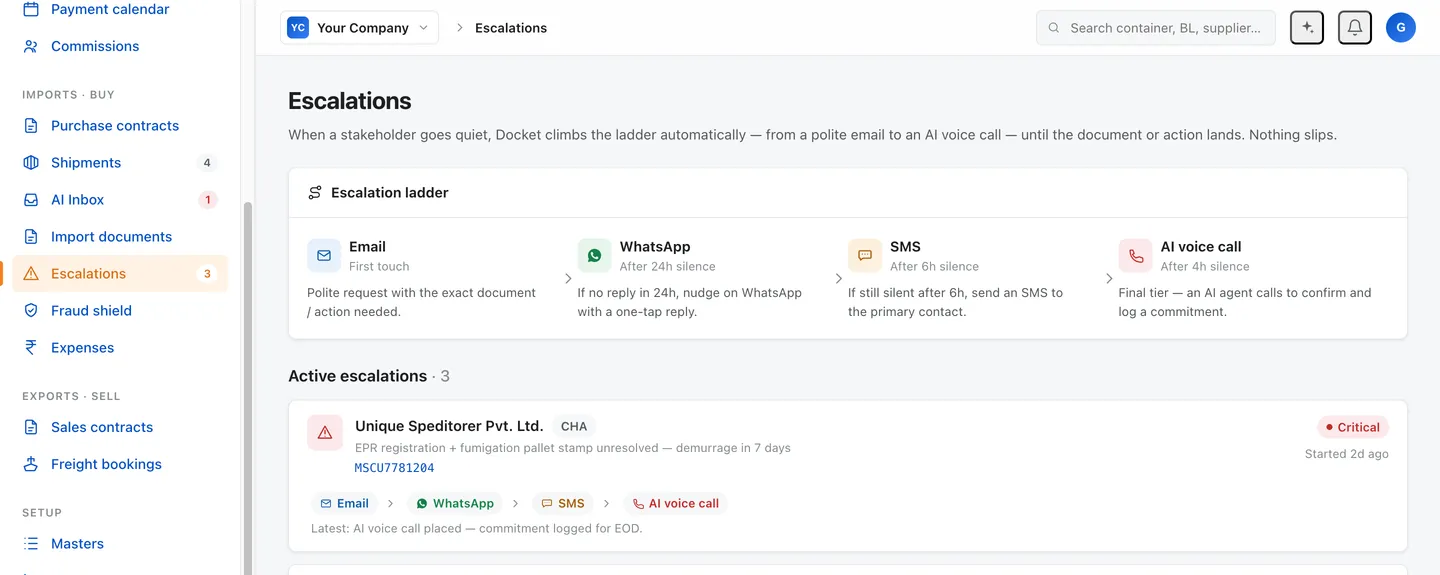
My exporter is not sending the shipping documents
A supplier goes quiet because your follow-up has no schedule and no consequence. Fix it with a timer, not a tone: email today, WhatsApp at 24 hours, SMS at 48, a phone call at 72. Chasing suppliers costs 30–45 minutes per container, and it is the single largest recoverable block of desk time.
Ravi runs documentation on an import desk. On a Tuesday morning he has forty-one open shipments and one supplier in a different country who has not answered three emails about a corrected packing list. He sends a fourth. It is politer than the third. It works about as well.
That supplier is not ignoring Ravi. That supplier has an inbox too, and in it Ravi’s request is one line among eighty, with no deadline attached to it and no consequence behind it.
The exporter who will not send documents is not a relationship problem. It is a follow-up problem with no owner and no schedule.
Why does an exporter go quiet on documents?
Four reasons, in rough order of frequency.
The document does not exist yet. The certificate of origin is with a chamber of commerce, the survey report is with a surveyor, the mill test certificate is with a mill. The supplier has nothing to send and no incentive to say so, because saying so invites another email.
The document exists and it is wrong. The supplier knows the weight on the packing list disagrees with the invoice. Sending it starts an argument. Not sending it postpones one.
The request is unclear. “Please send the documents” is not a request. It is a mood. The supplier does not know which document, in which format, by when, or what happens if it is late.
The request has no cost attached. Nothing happens on day one. Nothing happens on day three. On day nine something happens, at the port, to you.
Notice that only one of those four is about the supplier being difficult. Three of them are about how the ask was made.
Which is also why demurrage and detention alert software does not fix this. An alert tells you the last free day is close. You knew. The document is still sitting with a chamber of commerce, or sitting on a desk because sending it starts an argument, and no countdown on a screen has ever asked anybody for it.
What is the escalation ladder, and why does it work?
The ladder is four steps on a clock. Not four tones of voice.
| Step | Channel | When | The ask |
|---|---|---|---|
| 1 | Day 0 | Named document, named field, named date | |
| 2 | +24 hours | Same ask, one line, on the phone in their hand | |
| 3 | SMS | +48 hours | Same ask, shorter, gets past a full WhatsApp |
| 4 | Voice call | +72 hours | Same ask, spoken, to a person who must answer or decline |
Three things make this work and none of them are the technology.
The ask never changes. Same document, same field, same date, four times. A supplier who gets four different phrasings thinks four different people are confused. A supplier who gets the same sentence four times understands that this one is not going away.
The channel changes. Email is where requests go to queue. WhatsApp is where this trade lives. A voice call is the only channel where a human has to say yes or no in real time. Moving up the ladder is not aggression, it is arriving somewhere the message will be read.
The timer replaces the judgement. This is the part that matters on a busy desk. Ravi with forty-one shipments has to decide, every hour, which supplier deserves a nudge. That decision is expensive and he gets it wrong under load, in a predictable direction: the loud shipment gets chased and the quiet one goes to demurrage. A fixed timer takes the decision off him entirely.
What should the chasing message say?
Bad, and the most common message in this trade:
Hi, please send the documents at the earliest. Thanks.
Good:
Packing list for BL SLBK-4471, container MSKU 731. Gross weight shows 24,180 kg. Contract and invoice both say 24,860 kg. Please send an amended packing list with 24,860 kg by Thursday 5pm your time. We file the Bill of Entry Friday.
Six things are in the second message. The shipment reference. The document. The exact field. The exact value. A deadline with a time zone. The reason the deadline exists.
The second message gets answered because it is answerable. The supplier can act on it in ninety seconds without opening a thread or asking a colleague. The first message requires the supplier to reconstruct your problem before they can help with it, and nobody does unpaid work to make someone else’s email make sense.
The ICC’s document-examination standards, ISBP 745, exist because banks refuse documents over exactly this class of mismatch: a weight, a description, a spelling that disagrees across two pages of the same pack. The bank will catch it. The bank will catch it three weeks later, after the box has been sitting at a terminal. Catch it at the supplier and it costs one message.
How much is the chase costing you?
Timed container by container, the work breaks down like this.
| Task | Time per container |
|---|---|
| Supplier follow-ups | 30–45 min |
| Export doc-pack prep and checking | 45–90 min |
| Status tracking and reporting | 20–30 min |
| Payment tracking | 10–15 min |
About 2.2 hours a container, with a real range of 2 to 2.5 depending on how cooperative the supplier is that week. Sitting on top of that, and belonging to the desk instead of the container, is one to two hours a day of price collection: asking every supplier what they are quoting this morning.
Five hundred containers a month works out at roughly 1,100 hours. Seven people at 176 hours each gives you 1,232. The desk is at about ninety percent capacity on grunt work before anyone buys or sells anything.
The follow-up line is 30 to 45 minutes of that, and it is the most recoverable block on the sheet, because almost none of it is judgement. It is the same message, to a different supplier, on a different day, sent by a person whose actual skill is knowing what a wrong weight means.
What if the exporter is not the problem?
Run this check before you escalate, because on a busy desk a meaningful share of “the supplier has not sent it” turns out to be something else.
The document arrived and nobody logged it. It is in a shared mailbox, in a thread with a subject line about something else, sent to a colleague who was covering last Thursday. The supplier has been answered and the desk does not know.
The document went to the wrong party. Suppliers send packs to whoever they dealt with last. If your CHA received it directly, your file is empty and the shipment is fine.
The request never left your building. Somebody decided to raise it after the price discussion concluded, then the price discussion took four days.
You are waiting on your own instruction. The supplier is holding the certificate of origin because they asked which consignee name to put on it, three emails ago, and that question is sitting with your commercial team.
Check those four before you send a fourth email, and check them in that order. The last one is the most common and the most embarrassing, because the escalation ladder works beautifully at chasing a supplier for an answer only you can give.
What do I do when the supplier still will not answer?
Three moves, and take them in this order.
1/ Change who you are asking. The person on the email thread is often a sales contact with no access to a mill certificate. Ask them, once, who issues the document. Then ask that person.
2/ Attach the consequence to the date, in writing, before the date. “If the amended packing list is not with us by Thursday, we file with the original weight and the discrepancy sits on your invoice.” Not a threat. A schedule.
3/ Bring the buying decision into the room. The single fastest unblock in this trade is the person who signs the next purchase order asking the question. It works because it changes what the supplier is protecting.
If none of those work, you have learned something about that supplier that belongs in the file, and the next contract should carry a document deadline with a stated remedy in it.
The gap in this post
The timings here are an operational baseline, not an industry survey. Follow-up load moves with commodity, lane, supplier mix and how much your CHA absorbs, so treat 30 to 45 minutes as the shape of the problem rather than a number to quote back at your own team. Count yours for a week and you will have something better than this page.
The escalation ladder runs in a live demo against a real import SOP end to end. What it does on day three with your slowest supplier is the test that matters, and that one is worth running before you believe any of this.
Where Docket fits
Docket does the chase. It reads your purchase contract, works out which documents are due and when, and sends the specific ask on email, then WhatsApp at 24 hours, then SMS at 48, then an AI voice call. Same ask each time, on channels your counterparties already use, with no portal for anyone to sign up for. Docket is built to handle about 85% of supplier chasing without a person — an 85% cut in the operations cost per shipment on the chase, taking 2.2 hours down to roughly 20 minutes of human time.
The judgement stays with Ravi. What leaves him is the part where he decides, forty-one times a morning, who to nudge.
Start smaller than the product. Pick your five worst suppliers this week, set a 24-hour timer on each open document, and send the same specific ask up the ladder. Count what comes back by Friday.
A supplier answers a deadline. A supplier does not answer a mood.
Questions this raises
How long should I wait before chasing an exporter again?
Twenty-four hours, then switch channel. Email today, WhatsApp tomorrow, SMS the day after, a call on day three. The interval matters less than the fact that it is fixed. A fixed interval takes the decision away from a person holding forty other shipments.
Is it rude to escalate to WhatsApp or a phone call?
No. It is rude to send a fourth identical email and let the container sit. Counterparties in this trade already live on WhatsApp. Meeting them where they are reads as competence, not pressure, as long as the ask is specific and the same every time.
What do I do if the exporter has the documents but keeps sending wrong versions?
Stop chasing the document and start chasing the field. Name the exact value you need corrected, quote what the contract says, and ask for one amended page, not a fresh pack. Wrong-version loops are usually copy-paste from a previous shipment.
How much desk time does chasing suppliers really cost?
Thirty to 45 minutes per container in follow-ups alone, on top of 45 to 90 minutes of document-pack work. Across 500 containers a month that is a large share of a seven-person team.
Can this be automated without annoying the supplier?
The chase can. The judgement cannot. Docket automates roughly 85% of supplier chasing, sending the same specific ask on the channel the supplier already uses, and hands a human the cases where the answer is a decision, not a document.
Sources
- Docket operational baseline, import–export desk · checked 2026-08-08
- Docket engineering model — projected automation rate by task · checked 2026-08-08
- ICC, UCP 600 and ISBP 745 (documentary credit practice and document examination standards) · checked 2026-08-08