How to choose demurrage and detention software
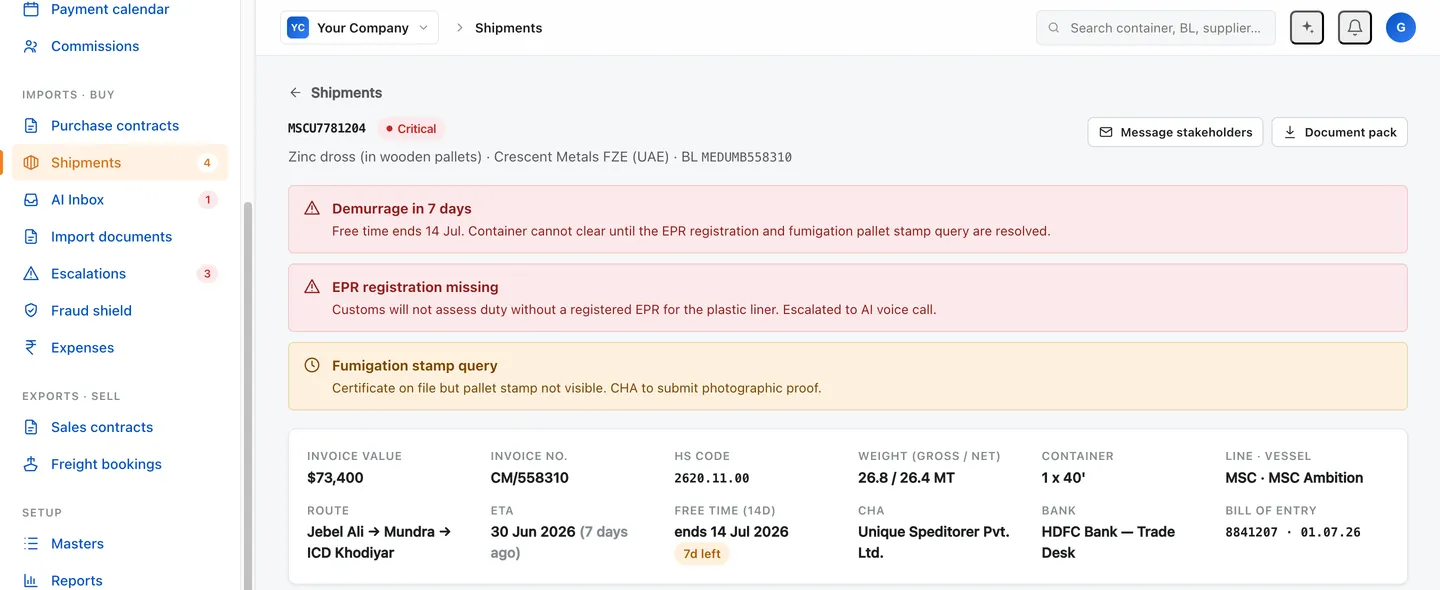
Four products sell as demurrage and detention software and the demo rarely says which one you are in. Six questions separate them: which clock it moves, whether it chases or alerts, where its last free day comes from, whether it can produce the lines a US demurrage invoice must carry by law, and what it costs against a week of demurrage on one container, which has cost US$12,000.
Four products sell under this name, and the demo rarely tells you which one you are looking at. They share a vocabulary, a set of screenshots and a promise about free time. They do different things to the number on your invoice, and what each kind of demurrage and detention software does is worth reading before any call.
What follows is the shorter version: six questions, each of which has a checkable answer, and each of which a sales deck will avoid if the answer is inconvenient.
Which clock does it move
Every import runs two clocks. The port clock starts at discharge and counts down your free days. The paperwork clock starts whenever the last party in the chain decides to act: the exporter, the bank, the insurer, the chamber of commerce, the forwarder, the customs broker.
Demurrage is what you pay when the second clock loses. So the question is not whether the product knows about demurrage. It is which clock it touches. A tool that reports the port clock more accurately, more often, in a nicer colour, has still not moved the clock that decides the outcome.
Ask: what did this product change about the date the pack was complete?
Does it chase, or does it alert
An alert is a message to you. A chase is a message to the person holding the document.
That distinction sounds pedantic until you count the work. Supplier follow-ups, document preparation and checking, status tracking and payment tracking run to about 2.2 hours of desk work per container. An alert adds to that number, because someone on your desk now has to act on the alert. A chase removes from it.
Ask: who receives the message this product sends, me or the supplier?
Where does its last free day come from
Free time is not a standard number. It varies by carrier, port, terminal, direction and equipment, and two lines calling the same port allow different periods. Any product that shows you a last free day got it from somewhere, and there are only two possibilities: your contract, or a generic table.
A generic table is wrong for somebody on every lane, and the person it is wrong for is the one who plans against it and pays. If the vendor cannot say which carrier tariff or service contract a date came from, the date is decoration.
Ask: show me the free-time term this date came from, for this carrier and this lane.
Can it produce the lines an invoice has to carry
This is the question nobody expects, and it is the most useful one, because the answer is written down in law rather than in a brochure.
In US trade, 46 CFR § 541.6 sets out what a demurrage or detention invoice must contain as a minimum. Among the required lines: the bill of lading and container numbers, the allowed free time in days, the start date and the end date of free time, the container availability date on an import, the rate and the tariff or service contract it comes from, a contact for questions and the timeframes for requesting mitigation, refund or waiver, and a certification by the billing party that its own performance did not cause or contribute to the charge.
Read that list as a specification for your own records rather than the carrier’s. For any container that moved last month, can the product you are buying show you its version of each line? The date the box became available, the free time that applied, the day the pack went complete, who was chased and when, and what came back?
If it can, you can check the carrier’s invoice against your own account of the same facts, which is the whole of what it means to be able to dispute a demurrage invoice. If it cannot, you have bought a dashboard.
Does it reach the people who actually hold the paper
The documents that decide the outcome sit with counterparties: a supplier’s export executive, a bank’s documentary credit desk, a broker’s filing clerk, an inspection agency. None of them works for you and none of them is going to log in to your portal.
Any product whose chasing model requires the other side to onboard has quietly moved the hard part onto you, because now you are chasing people to join a system so that the system can chase them. Ask what channels it reaches counterparties on without their having to sign up for anything.
What it costs, against what it is preventing
Price this against an event rather than against a software budget. A week of demurrage on one container has cost US$12,000. One missed document pack a month annualises to US$12,000 to US$24,000. Document packs routinely run about eight days late against free time.
Against those numbers, per-shipment pricing in single-digit dollars is not the decision. The decision is whether the product changes the eight days. If you want to see the shape of the exposure on your own lane, the demurrage calculator takes your own free days and your own per-diem tiers and publishes no tariff of its own.
What none of them can do
No demurrage and detention software prevents congestion, a customs hold, an inspection or an equipment shortage. Any vendor claiming otherwise has told you something useful about the rest of their claims.
What is addressable is the paperwork clock. That is the part caused by a document that arrived late and a person who did not reply, and it is the part demurrage and detention software should be judged on. Six questions, and the one about the invoice lines is the one that will change how the call goes.
Questions this raises
What should I ask a demurrage and detention software vendor?
Ask which of the four products it is, because the name covers all four: container visibility with free-time alerts, invoice audit and dispute, charter-party laytime claims, and document chasing. Then ask where its last free day comes from, whether it acts or only notifies, and whether it can show you, for a container that shipped last month, the same lines a carrier's invoice is required to carry. The last question is the one that separates a record from a dashboard.
What is the difference between demurrage management software and prevention?
Management, as the category describes itself, shows container status, counts down free time and alerts a person as the last free day approaches. Prevention starts earlier, on the document pack that decides whether the box clears inside free time, and does the chasing rather than the alerting. Both are honest products. Only one of them changes the number before the charge exists.
Does demurrage software stop demurrage charges?
No product stops them, and one that says so is selling. Congestion, customs holds, inspections and equipment shortages cause delays that no software touches. What is addressable is the paperwork clock, which routinely runs about eight days late against free time. That share is caused by a PDF and a person who did not reply, and it is the share worth buying software for.
How much should demurrage and detention software cost?
Compare it against one event rather than against a budget line. A week of demurrage on a single container has cost US$12,000, and one missed document pack a month annualises to US$12,000 to US$24,000. Docket is priced per shipment: $10 up to 50 a month, $8 from 51 to 300 and $6 above 300, with a shipment billing at most two containers. Price the tool against the event it is meant to prevent.
Sources
- 46 CFR § 541.6, Contents of invoice: (a) identifying information including bill of lading and container numbers, (b) timing information including the allowed free time in days, the start and end dates of free time and the container availability date on an import, (c) rate information and the tariff, service contract or negotiated arrangement it comes from, (d) dispute information including the contact and the timeframes for requesting mitigation, refund or waiver, and (e) certifications, including at (e)(2) that the billing party's performance did not cause or contribute to the invoiced charge [89 FR 14363, Feb. 26, 2024] · checked 2026-09-11
- 46 CFR § 545.5, Interpretation of Shipping Act of 1984 — Unjust and unreasonable practices with respect to demurrage and detention [85 FR 29665, May 18, 2020] · checked 2026-09-11
- Docket operational baseline, import–export desk · checked 2026-08-08
- Reported incident, import–export desk: one week of demurrage on one container, US$12,000 · checked 2026-08-08