Demurrage and detention software: four kinds, one prevents
Four products sell as demurrage and detention software: container visibility with free-time alerts, invoice audit and dispute tools, laytime claims software for chartered vessels, and document-chase software that finishes the pack inside free time. The first three act after the clock has started. Packs run about eight days late; a week of demurrage on one container has cost US$12,000.
Type demurrage and detention software into a search box and the first page of results is four different products wearing one name. They do not compete with each other. They are bought by different people, on different days, to fix different failures.
Here is what each one does, in its own words, and which day of the shipment it shows up.
Why does one search return four products?
Because the charge has one name and several causes.
Demurrage is the carrier’s charge for a container inside the terminal past its free days. Detention is the charge for the carrier’s equipment outside the terminal past its return date. Both are set by the carrier’s tariff or your service contract, and both start counting without asking you.
What starts them is not one thing. A bill of lading that arrived on day six. A customs hold. A transporter who could not get a slot. A vessel that discharged on Friday evening. Each failure has a vendor.
The US Federal Maritime Commission’s interpretive rule on the subject is a useful anchor here. It tests these charges against what it calls the incentive principle: whether the charge serves to move cargo. From the importer’s seat that reads simply. The charge exists to make you finish. The software question is what “finish” means on your desk.
One note on the vocabulary before the four kinds, because it decides which results you are reading. The category is sold as demurrage and detention software, as D&D software, as demurrage management software and, shortest of all, as demurrage software. That last phrasing pulls in charter-party laytime as well as containers, so a results page under it will mix two unrelated trades. Everything below is about containers on an import.
Kind one: visibility and free-time alerts
This is the largest group and the one most searches land on.
The products track the container through the carrier’s milestones, count down the free days, and alert a person when the last free day is close. The product pages promise alerts before free time expires, and status colours that move from normal to approaching to incurring as the free days run down. project44 sells the same idea inside a visibility platform, with the last free demurrage day as a data point beside holds and availability.
What they are for: knowing where every box stands, across carriers, without logging into each portal. That is a real problem on a desk with forty open shipments and it is worth solving.
What none of them usually tells you is whose free time is being counted. The number comes off a carrier’s milestone feed, so it is the carrier’s allowance; the terminal is running its own storage clock on the same container, on a published tariff, with a different start date and often a very different number of free days.
What they do on the day that matters: they tell you. An alert that free time expires on Thursday, sent on Tuesday, is only useful if the thing that will make you late can be fixed in two days. If the thing that makes you late is a document the exporter has not sent, the alert arrived a week after the useful moment.
Kind two: invoice audit and dispute
The second group works after the charge has been raised.
The carrier’s invoice is checked against the free time and rates in your contract. The gate and pick-up messages are kept as evidence, so that a deviation can be shown and a dispute with the carrier argued. project44’s release talks about auditing pick-up and gate messages “to refute inappropriate charges”. Cocoon sells a calculator that applies contract rates and carrier rules so the number on the invoice can be tested.
What they are for: paying the right amount, not the invoiced amount. Carriers make mistakes, free-time terms get lost in folders, and a desk that pays every demurrage invoice as billed is leaving money with the line.
What they do on the day that matters: nothing, because the day that mattered was three weeks earlier. Audit is the product you buy when prevention already failed. It is worth having. It is not a substitute.
Kind three: laytime and demurrage claims
The third group is a different trade and the word is the only thing it shares.
On a chartered bulk or tanker vessel, demurrage is the charterer’s payment for exceeding the laytime allowed under the charter party, calculated from the statement of facts. It is a claim, prepared and argued, sometimes for months. Marcura’s own article on demurrage software says out loud that this is “the other kind”, and that their platform is about “laytime and demurrage on a chartered vessel moving oil, chemicals or dry bulk”.
If you searched for demurrage software and your cargo is in containers, this group is not for you, and the pages will tell you so in the second paragraph. If your cargo is a bulk parcel on a chartered ship, none of the other three groups apply, and neither does this article.
Kind four: finishing the pack before free time ends
The fourth kind starts from a different premise. It treats the paperwork as the cause.
On an import desk, the container is rarely late. The paper is. Free time starts at discharge, and the document pack starts when the last party in the chain decides to act: the exporter, the bank, the insurer, the chamber, the forwarder, the CHA. Packs routinely run about eight days late against free time. A week of demurrage on one container has cost US$12,000.
None of those eight days is a tracking problem. A visibility tool would have shown the box sitting there, correctly, every one of them.
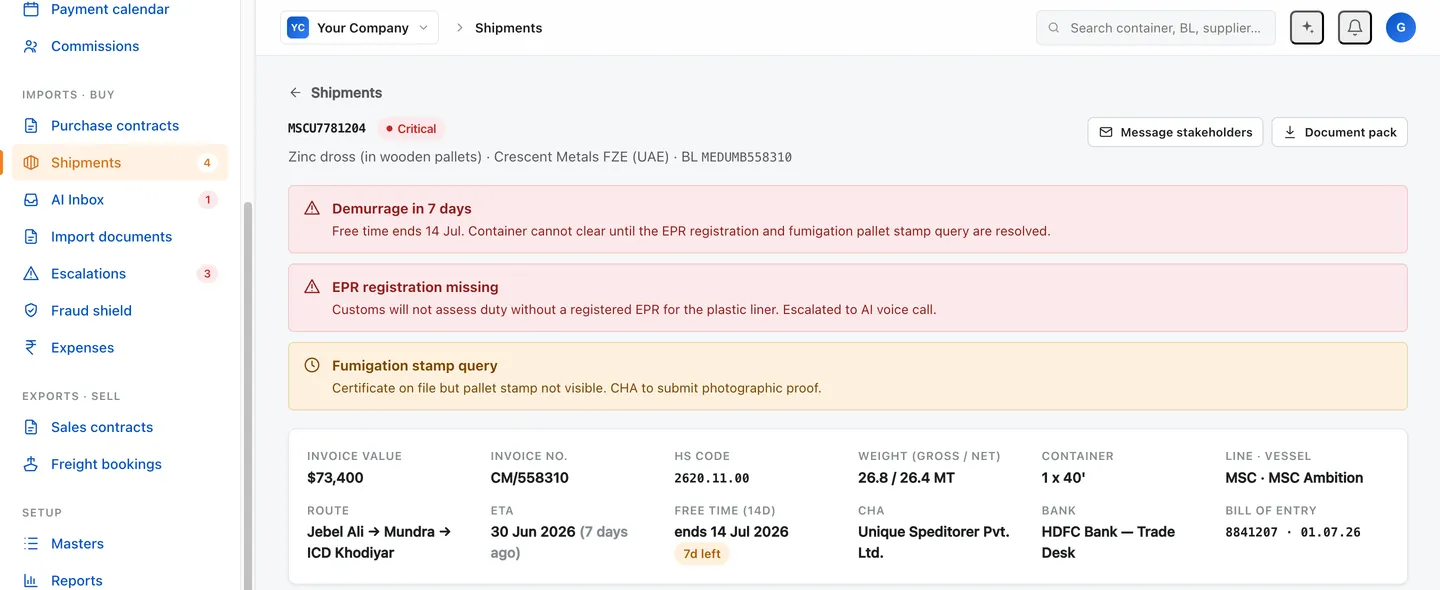
So this kind of demurrage and detention software works the other clock. It derives the last free day from discharge and the contract’s free time, takes the full document checklist for the lane and the letter of credit, assigns each item to the party who owes it with a deadline set backwards from the last free day, chases every party daily, and escalates when someone goes quiet: email first, WhatsApp at 24 hours, SMS at 48, an AI voice call at 72.
What it is for: having nothing to pay, because the pack was complete on day four.
What it does on the day that matters: the chasing, on the day the chase should start. Not the alert. The email, the follow-up, the call.
Which day do you want to find out?
Put the four on one timeline and the choice makes itself.
| Kind | Sold as | Acts on | Tells you or does it |
|---|---|---|---|
| Visibility and alerts | Demurrage tracking, D&D management, container visibility | The last few free days | Tells you |
| Audit and dispute | Freight audit, D&D optimisation, deviation evidence | After the invoice | Tells you what to argue |
| Laytime claims | Laytime and demurrage software | After the voyage, on a charter party | Prepares the claim |
| Document chase | Demurrage prevention, demurrage and detention software | Before free time starts | Does it |
Three of the four are honest, useful products. Two of them belong on a large import desk alongside the fourth: you want to see the box, and you want to check the invoice. But if you buy either of them to stop paying demurrage, you have bought a clock to fix a document problem.
The question to ask any vendor is short. On the day the exporter has not sent the bill of lading, what does your product do? If the answer is “shows you that the free days are running out”, you have found the first kind.
There are five more questions worth putting to a vendor, and the separate piece on how to choose demurrage and detention software works through them. The sharpest one asks whether the product can produce, for a container that moved last month, the same lines a carrier’s invoice is legally required to carry.
What the fourth kind does not do
It is worth being as plain about this as the other three are about their limits.
Document-chase software does not move containers, book trucks or talk to the terminal. It does not file the customs declaration; your customs broker does — the declaring agent in Singapore, the clearing agent in Dubai, the CHA in India — and that is their licence. It does not remove congestion, customs holds, inspection queues or equipment shortages, and any of those can produce demurrage no software touches. It does not dispute a charge after the fact, though the record it keeps is the timeline a dispute turns on.
What it removes is the eight days that came from paperwork. On most import desks, that is most of the gap.
Where to start
Take your last three demurrage invoices and, for each one, write down the day the document pack was actually complete and the day free time ended. If the pack was late on two of the three, the visibility tool would have shown you the problem and the audit tool would have priced it. Neither would have changed it.
If you have paid demurrage because a document was late, bring the invoice and the timeline. We will show you which day the chase would have started.
Questions this raises
What is demurrage and detention software?
Any product sold to reduce the charges a carrier raises when a container sits at the terminal past its free days (demurrage) or stays out with the consignee past its return date (detention). The name covers four different products: visibility tools that count down free time and alert a person, audit tools that check and dispute the carrier's invoice, laytime claims software for chartered bulk vessels, and document-chase software that gets the pack complete before free time ends.
Is demurrage management software the same as demurrage prevention?
No. Management software, as its vendors describe it, shows container status, monitors free-time consumption and alerts you as the last free day approaches. Prevention starts earlier, on the document pack that decides whether the box clears inside free time, and does the chasing rather than the alerting. Both are honest products. Only one changes the number before the charge exists.
Which kind of demurrage and detention software does an importer need first?
The one that works the cause on your desk. If your boxes clear late because the bill of lading, invoice or certificate of origin arrived late, you need the pack finished earlier, and an alert about the last free day only tells you what you already know. If your boxes clear late because of holds, congestion or a slow transporter, visibility and dispute tools earn their keep. Most import desks have the first problem and buy the second tool.
Does any of this apply to bulk cargo on a chartered vessel?
Laytime and demurrage under a charter party is a different calculation, settled from the statement of facts, and it has its own specialist software. Container demurrage and detention are carrier tariff charges on a box at a terminal or a depot. The word is the same. The clock, the contract and the tools are not.
Can software guarantee zero demurrage?
No, and a page that says so is selling. Customs holds, inspections, congestion and equipment shortages produce demurrage that no software touches. What software can remove is the share caused by paperwork, which on an import desk is most of it: packs routinely run about eight days late against free time.
Sources
- US Federal Maritime Commission, Interpretive Rule on Demurrage and Detention (46 CFR § 545.5) · checked 2026-09-07
- project44, Detention and Demurrage Optimization press release and Ports and Terminals product page · checked 2026-09-07
- Cocoon FMS, CocoonDEM Demurrage and Detention calculator page · checked 2026-09-07
- Marcura, Demurrage software vs spreadsheets (laytime and demurrage on chartered vessels) · checked 2026-09-07
- Shipsy, Demurrage management software explainer · checked 2026-09-07
- Docket operational baseline, import–export desk · checked 2026-08-08
- Reported incident, import–export desk: one week of demurrage on one container, US$12,000 · checked 2026-08-08