Customs house agent (CHA): what they do and do not do
A customs house agent, now called a customs broker in India, is a licensed intermediary who files the customs declaration and handles port formalities on the importer's behalf. The licence carries real legal duties. What it does not carry is responsibility for getting documents out of your supplier, and that is where most demurrage is born.
- Customs House Agent
- A licensed intermediary authorised to transact customs business on an importer's or exporter's behalf: filing the goods declaration, presenting supporting documents, arranging examination and clearing the consignment out of the port.
A customs house agent files your customs declaration and moves your container through the port. They are licensed by the customs administration, they sign the declaration on your behalf, and they carry legal duties for what they file. They do not chase your supplier, they do not own your free-time clock, and they cannot conjure a certificate of origin that nobody has issued.
Importers who assume otherwise are the ones paying demurrage.
What is the full form of CHA?
CHA stands for Customs House Agent. In India the licence has been reissued under the Customs Brokers Licensing Regulations 2018, so the current legal name is customs broker — the trade still says CHA, the statute says customs broker, and they are the same licence under section 146 of the Customs Act 1962. In shipping paperwork you will also see the same role called a clearing agent or declaring agent.
What is a customs house agent?
The Revised Kyoto Convention calls them third parties: persons authorised to act on someone else’s account in dealings with customs. Every trading nation has a version of the licence and a version of the name.
In India the Customs Act 1962, section 146, requires a licence to transact customs business, and the Customs Brokers Licensing Regulations 2018 set out how that licence is granted, what the holder has to do, and how it is suspended or revoked. India also changed the name. “Customs house agent” was the term under the 2004 regulations. Since the 2013 regulations the legal term is customs broker. Everyone on the docks still says CHA.
Elsewhere the label shifts. Singapore has declaring agents registered with Singapore Customs and TradeNet declarants. The UAE has customs clearing agents licensed at each emirate’s customs authority. The United States has customs brokers licensed by Customs and Border Protection. The European Union has customs representatives acting in direct or indirect representation. Same function, different statute.
What does a CHA actually do?
Six things, and it is worth being exact about the boundary of each.
They classify and value the goods for the declaration, working from your invoice, your packing list and your certificate of origin. They file the entry: the bill of entry on import, the shipping bill on export. They present the supporting documents to customs and answer queries raised against the entry. They arrange examination when the consignment is marked for it, and attend it. They pay duty on your behalf where you have funded them, and take delivery of the assessed entry. And they clear the box out of the port, surrendering the delivery order, settling terminal handling and arranging the move out of the gate.
Under the Indian regulations the broker also carries obligations that traders forget are theirs to comply with: verifying the identity and the address of the client, advising the client to comply with the law, and passing on to customs any non-compliance they become aware of. The licence is not a service contract. It is a regulated position with a suspension mechanism attached.
What is the CHA called in your market?
“CHA” is an Indian term. The role is universal, the word is not, and an importer outside India searching for “CHA” will not find their own broker under that name.
| Market | What the broker is called | What gets filed | Filed through |
|---|---|---|---|
| India | Customs House Agent, licensed as a Customs Broker under CBLR 2018 | Bill of Entry | ICEGATE |
| Singapore | Declaring Agent, registered with Singapore Customs | Permit declaration | TradeNet |
| UAE / Dubai | Clearing Agent in working use, licensed by Dubai Customs as a Customs Broker under Customs Policy No. 17 of 2008 | Customs declaration | Mirsal 2, on the Dubai Trade portal |
| United States | Licensed customs broker, licensed by CBP under 19 CFR part 111 | Entry, then the entry summary on CBP Form 7501 | ACE |
| Australia | Licensed customs broker | Import Declaration (N10), for consignments over A$1,000 and some goods regardless of value | Integrated Cargo System |
Two things hold across all five, and they are the two that decide whether you pay demurrage.
The broker files; the importer is liable. In the US the importer of record is the party liable for duties and for meeting the requirements of the entry, and appointing a broker does not move that. India’s CBLR duties sit on the broker for what they file, not on your commercial position. Singapore’s declaring agent regime works the same way. The signature is theirs. The exposure is yours.
The broker cannot file what they have not received. Whatever the filing is called, it needs the invoice, the packing list, the transport document and whichever certificates the cargo attracts. Every market on that table has a different form and the same failure mode: the pack arrives late and the clock has already been running since discharge.
CHA, freight forwarder, NVOCC: who does what?
Traders use these three words interchangeably and then argue with the wrong party when something breaks.
| Customs house agent | Freight forwarder | NVOCC | Shipping line agent | |
|---|---|---|---|---|
| Licensed by | The customs authority | Usually a trade registration, not a customs licence | Carrier registration where required | Appointed by the carrier |
| Core job | Files the customs declaration | Books and coordinates the movement | Issues its own bills of lading and buys slots | Represents the vessel operator locally |
| Issues a bill of lading | No | Sometimes, as a house bill | Yes, house bills against a master bill | Yes, the master bill |
| Talks to customs on your behalf | Yes, that is the licence | Only through a CHA | Only through a CHA | No |
| Releases your container | Presents the entry and the delivery order | No | No | Issues the delivery order |
| Chases your supplier for documents | No | No | No | No |
| Who they answer to | The customs authority and you | You | You | The carrier |
Note the row that is empty all the way across. Nobody in that table chases your supplier. Six parties touch a shipment, the supplier, the CHA, the bank, the forwarder, the insurer and you, and coordination is not any one of their jobs. It defaults to the importer, which means it defaults to whoever on your desk has time.
Why does the CHA get blamed for demurrage they did not cause?
Because they are the last party holding the file before the clock stops, so the delay is visible at their desk and invisible everywhere upstream.
Run the sequence. The vessel discharges and free time starts. The CHA cannot file the entry without the invoice, the packing list, the bill of lading and, where preference is claimed, the certificate of origin. The certificate is sitting with a chamber of commerce in the country of export. The original bill of lading is in a courier pouch or with your bank. The supplier has not answered the last three emails.
The CHA files nothing, because there is nothing to file. Demurrage accrues. The invoice for it lands on your desk with the CHA’s name on the covering note, and the conversation that follows is about the CHA.
Document packs routinely run about eight days late against port free time, and a week of demurrage on one container runs about US$12,000. Almost none of that lateness is created inside the port.
What should you actually hold your CHA to?
Four things, and they are all measurable.
A document checklist per shipment type, in writing, issued before the goods ship. Not after. A good broker will tell you on day one that this HS code needs a mill test certificate and that consignment needs a pre-shipment inspection certificate.
Filing turnaround, counted in hours from a complete pack. Once every document is in their hands, how long until the entry is filed? That number is theirs to own and yours to measure.
Query response time. When customs raises a query, how fast does the answer go back? This is where days disappear, quietly.
Escalation before the last free day, not after it. A broker who tells you on day 6 that the certificate of origin is missing has done their job. One who tells you on day 9 has not.
What you cannot hold them to is the arrival of documents from your seller. That is a term in your purchase contract and it belongs to you.
How do you stop the handover from leaking?
The handover from your desk to the CHA is where most import delay lives, and it leaks in three predictable places.
Documents arrive one at a time, over days, by email, with no list. The broker cannot tell whether the pack is complete because nobody agreed what complete means for this shipment. Agree the checklist per HS code and per country of origin, once, and reuse it.
Nobody counts backwards from the last free day. Discharge date plus free time gives you a hard date. Every document deadline hangs off it. Most desks track the vessel schedule instead, which is the wrong date.
The chase runs on whoever remembers. Supplier follow-ups take 30 to 45 minutes per container, sitting inside a total of about 2.2 hours of desk work per container. On a 500-container month that whole desk load runs to roughly 1,100 hours. Seven people at about 176 hours each gives 1,232 hours available. The desk is at about 90% capacity on grunt work before anyone buys or sells anything.
That is the honest shape of the problem. The CHA is not the bottleneck. The bottleneck is that chasing six parties is a full-time job that nobody was hired to do.
Where Docket sits
Docket does not replace your customs house agent and does not file entries. Filing needs a licence, the licence carries liability, and that liability sits with a named human. It stays that way.
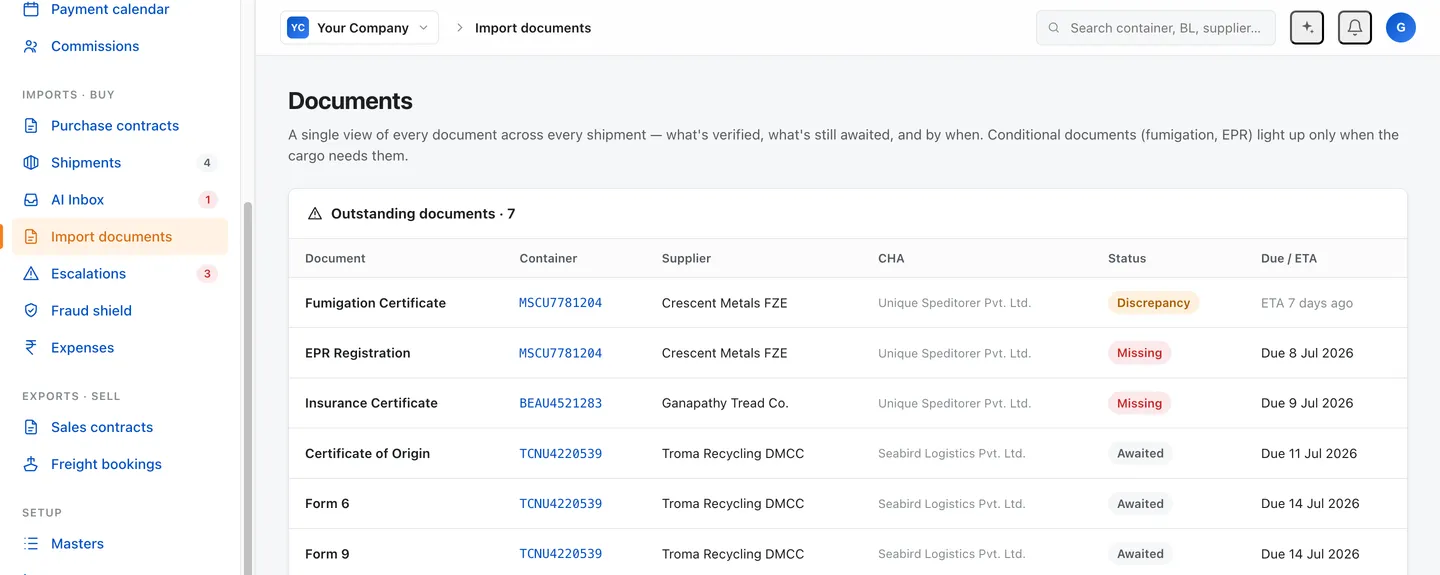
What Docket does is hand the CHA a complete pack, on time, without anyone on your desk spending the day on it. It reads the purchase contract, derives which documents the shipment needs and who owes each one, and chases them daily. Its import document checking software reads the invoice, the packing list, the bill of lading and the certificate of origin against each other and against the contract, and flags the fields that disagree before the entry is filed. It counts the last free day from discharge and works every deadline backwards from that date. And when someone stops replying it escalates on the channels they already use: email, then WhatsApp at 24 hours, SMS at 48, an AI voice call at 72. Nobody has to sign up for a portal.
Docket is built to automate about 85% of the chasing and about 65% of the doc-pack drafting, which comes to roughly 70% blended across the desk work as a whole. Per container the chase drops from about 2.2 hours to about 20 minutes.
Your CHA is better at their job when the pack is complete on the day the ship berths. That is the only thing Docket is trying to buy you.
Questions traders ask
What is the full form of CHA?
CHA stands for Customs House Agent. In India the licence is now issued under the Customs Brokers Licensing Regulations 2018, so the current legal name is customs broker — the trade still says CHA, and both names describe the same licence under section 146 of the Customs Act 1962.
What documents does a CHA need?
The commercial invoice, packing list and transport document at minimum, plus the certificate of origin where preference is claimed and whatever inspection, survey or analysis certificates the commodity requires. The CHA files from these — they cannot file an entry until the pack is complete.
What does a CHA do?
They classify and value the goods, file the customs entry, present supporting documents and answer customs queries, arrange and attend examination, pay duty where funded, and clear the container out of the port. What they never do is chase your supplier for the documents the filing needs.
Is the CHA responsible for demurrage?
Usually not. The CHA is the last party holding the file before the box clears, so the delay is visible at their desk — but most demurrage is born upstream, in a document pack the supplier has not completed. A CHA cannot file an entry that has nothing to file.
What is a CHA invoice?
The bill your customs house agent raises for a clearance. It has two parts: the agency fee for filing and attending the clearance, and the disbursements the agent paid on your behalf and is recovering: customs duty where they funded it, port and terminal charges, examination and survey fees, delivery-order and container charges. Ask for the disbursements line by line with the underlying receipts. A demurrage charge on a CHA invoice is one the terminal or carrier billed, passed through; it is not the CHA's own fee.
What is a CHA licence?
The licence a customs broker must hold to transact customs business for someone else, issued under section 146 of the Customs Act 1962 and the Customs Brokers Licensing Regulations 2018 after a written and oral examination. It carries a list of obligations under regulation 10, including verifying the client's identity and advising them to comply with the law, and it can be suspended or revoked for breaching them. Before you appoint an agent, ask for the licence number and check it is current.
Sources
- Customs Act 1962 (India), section 146, licensing of customs brokers
- Central Board of Indirect Taxes and Customs, Customs Brokers Licensing Regulations 2018 (Notification 41/2018-Customs (N.T.)), regulations 6, 7, 10, 14 and 17 · checked 2026-09-04
- World Customs Organization, Revised Kyoto Convention, General Annex Chapter 8 (Relationship between Customs and third parties)
- Singapore Customs, import procedures and the Declaring Agent regime (TradeNet permit declarations) · checked 2026-09-07
- Dubai Trade, Clearing Agent business registration and Mirsal 2 customs declarations · checked 2026-09-07
- Dubai Customs, Customer Guide, § 4 Customs Broker: a licence to prepare, sign and submit customs declarations for another party's account, with eligibility set out in Customs Policy No. 17 of 2008 — the licensed role behind the working term 'clearing agent' · checked 2026-09-12
- US Customs and Border Protection, customs broker regulations (19 CFR part 111) and the Entry Summary, CBP Form 7501 · checked 2026-09-07
- Australian Border Force, Import Declarations (N10) lodged in the Integrated Cargo System · checked 2026-09-07
- Docket operational baseline, import–export desk